49 works in this view — arrow keys or swipe to move between them.
Dance in Art
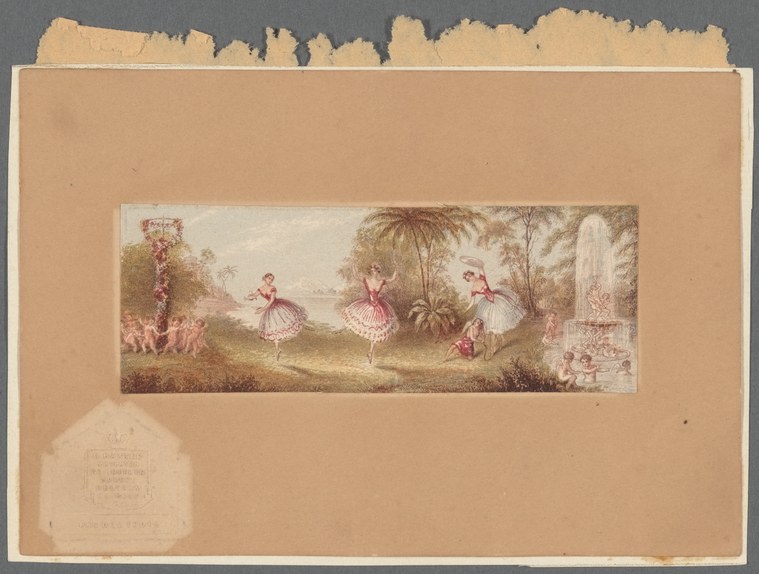
Three female dancers with putti in a landscape
Unknown artist
- Collection:
- Prints depicting dance
- Source:
- New York Public Library
- Rights:
- Public domain — free to use, share and adapt.
- Recorded as:
- Public Domain
This image is a primary source for understanding how Romantic ballet was visualized and marketed in the nineteenth century, showing what audiences expected to see and how the ballet body was idealized in print culture. For dancers and choreographers, it documents the aesthetic vocabulary of the Romantic period—the silhouette, the ethereal staging, the narrative of enchantment—that remains foundational to classical ballet pedagogy and the contemporary imagination of what ballet 'is.'
What you are looking at
A Romantic-era pastoral idyll in which three female dancers in pink tutus perform among putti (cherubic figures) in a sylvan landscape. The composition is horizontal and frieze-like, with the dancers arranged across a shallow middle ground against foliage and distant trees. The nearest dancer, at left, is captured mid-leap or développé; the central pair appear to be in conversation or mirroring pose; a third, at right, gestures toward attendant putti. The setting is arcadian—grassy ground, flowering vines at left, palm and broad-leafed trees creating a dreamlike enclosure. The light is soft and diffused, characteristic of lithographic or hand-colored print work. Cherubs or putti dot the composition, some at ground level, others integrated into the foliage, giving the scene the allegorical flavor of Romantic ballet subjects. The whole suggests a moment of leisure or enchantment rather than virtuosic display.
The dancing
The three dancers are young women in classical ballet dress: short, layered tutus, fitted bodices, and pale tights. Their poses suggest the vocabulary of Romantic ballet—extended legs, lifted carriage, arms positioned in épaulement. The leftmost figure is in mid-jump or développé, weight airborne; the central dancers appear less elevated, engaged in a stationary exchange of gesture; the rightmost dancer reaches outward in a gesture of greeting or benediction. None are in partnered hold; each occupies her own space in the landscape, which is typical of the corps de ballet or solist work of the period rather than couple dancing.
The dance depicted
This is almost certainly Romantic ballet, most likely a scene from a mid-nineteenth-century ballet narrative involving sylphs, spirits, or pastoral nymphs. The pink tutus, the ethereal setting, and the presence of putti—signifiers of the supernatural and Romantic idealization of femininity—point toward works like *La Sylphide* (1832) or *Giselle* (1841), or similar ballets of the 1830s–1850s in which mortal or divine female dancers inhabited enchanted landscapes. The formal vocabulary—the extension, the épaulement, the lightness of the figures—is consistent with the technique of the Romantic period, before the rise of the pointe shoe as dominant aesthetic and before the classical tutu gave way to longer, more elaborate skirts. The image likely documents not a performance but a theatrical ideal or promotional image of the kind circulated as prints.
How it was made
This is a hand-colored print, most likely a lithograph or colored engraving from the mid-nineteenth century. The soft modeling of the figures, the delicate handling of the foliage and atmospheric effects, and the pale, watercolor-like palette are consistent with lithographic hand-coloring of the period. The technique allowed for relatively economical reproduction and wide circulation among balleto-manes and the fashionable public; such prints were commonly bound into theatrical souvenirs, periodicals, or collected as loose sheets. The quality of the work and the care taken in the composition suggest it was a commercial product of some status, aimed at an audience of subscribers to Romantic ballet culture rather than mere ephemera.
About this work
This is a mid-nineteenth-century hand-colored print depicting a scene of Romantic ballet—three ballerinas and attendant putti in an enchanted pastoral landscape. It is not an image of an actual performance but rather an idealized vision of the ballet as a realm of poetry and supernatural beauty. The work sits squarely within the visual culture of Romantic ballet, where such prints served to disseminate and consolidate the aesthetics of the era among a fashionable public. It belongs in a gallery of dance in art because it shows how Romantic ballet was imagined, promoted, and consumed by its contemporaries—not as technical display but as a vehicle for fantasy, feminine grace, and the supernatural.
How to look at it
Look at the moment the artist has chosen: none of the dancers is in a position of maximal extension or difficulty. Instead, the scene captures a moment of ease and interaction, as though the viewer is witnessing a private reverie rather than a public spectacle. Notice how the putti are integrated into the landscape—not as external observers but as part of the enchanted world itself, which was a convention of Romantic imagery used to signal that the viewer is witnessing something dreamlike and not of the real world. The lightness of the bodies, the softness of the outlines, and the pale palette all work to convey the immateriality and ethereal quality that Romantic ballet aspired to—the illusion of weightlessness and supernatural grace.
The period
This print dates to the height of the Romantic ballet era, approximately 1830–1860, when European ballet underwent a profound shift toward the ethereal, the fantastic, and the supernatural. Works like *La Sylphide*, *Giselle*, *La Peri*, and *Le Papillon* populated the stage with sylphs, spirits, and magical beings, often in sylvan or supernatural settings. This coincided with Romanticism in the visual arts—the taste for Gothic, exotic, and dreamlike subjects—and with technical innovations in ballet, particularly the increasing use of pointe work to suggest weightlessness and the otherworldly. Prints, lithographs, and engravings of ballet scenes were commercially produced and widely collected, functioning as a kind of extended marketing for the ballet house and as mementos for patrons. They circulated in albums, periodicals, and as loose sheets, making them one of the most accessible and influential forms of dance documentation of the era.
Where it lives
The work is held in the New York Public Library's collection of prints depicting dance. It is catalogued as part of a broader collecting effort to document the visual and material culture of theatrical performance. Such prints were typically produced in multiple copies and distributed commercially or as part of theatrical souvenir albums.
Dance in this work
Questions about this work
How can I tell what ballet this scene depicts?
The pink tutus, the sylvan setting with palms and flowering vines, and the presence of putti all point toward Romantic-era ballets involving supernatural or pastoral themes, most likely *La Sylphide* or *Giselle*, but without a text inscription or clearer identifying detail it is not possible to say with certainty which ballet is shown. If you have other images from the same series or album, you may be able to deduce it from context.
Was this made from a real performance?
Unlikely. This is an idealized vision created for commercial circulation as a print. While the figures and poses are drawn from actual ballet technique and aesthetics, the composition, setting, and execution are too refined and harmonious to represent a moment captured from a live stage. It is a theatrical ideal—what the ballet *should* look like—rather than a documentary image.
Why are there cherubs in a ballet scene?
Putti (cherubic figures) were a longstanding convention in European art for signaling the presence of love, beauty, innocence, and the supernatural. In Romantic ballet, they appear to anchor the scene in a realm of fantasy and allegory, making clear to the viewer that the dancing is happening in an enchanted or divine space, not the real world. They were a visual shorthand for 'this is not ordinary.'
What is the dance style of these figures?
The style is classical ballet as it was practiced in the Romantic period (approximately 1830–1860). The extended legs, the lifted torso, the arm positions, and the lightweight tutu are all hallmarks of Romantic ballet technique. Pointe work was in use by this time but is not explicitly shown in the poses captured here.
More dance artwork





