49 works in this view — arrow keys or swipe to move between them.
Dance in Art
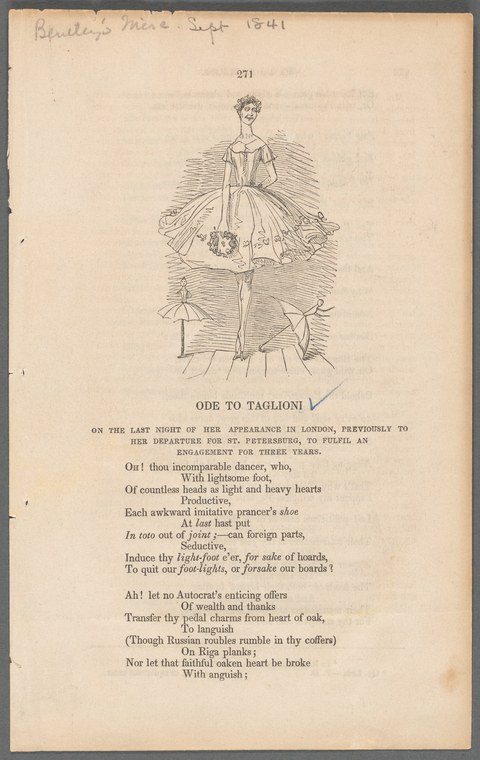
Ode to Taglioni: on the last night of her appearance in London, previously to her departure for St. Petersburg, to fulfil an engagement for three years
Unknown artist
- Collection:
- Prints depicting dance
- Source:
- New York Public Library
- Rights:
- Public domain — free to use, share and adapt.
- Recorded as:
- Public Domain
Maria Taglioni is one of the two or three most important dancers in ballet history; her technical innovations and artistic presence defined Romantic ballet and shaped the art form permanently. This image is a record of how she was seen and celebrated in her own time, and the poem—written in her honor—documents contemporary understanding of her achievement and her reputation for transcendent artistry.
What you are looking at
A single female dancer in a pale, full-skirted dress stands in a classical ballet pose, her frame elegant and upright. She wears pointe shoes and her arms are positioned in a graceful, classical line. The composition is a portrait-style study of the dancer against a plain background, with loose, sketchy pen hatching suggesting wings or a luminous aura around her figure. The drawing captures a moment of stillness and poise rather than dynamic movement. The image appears to be a memorial or tribute: the printed text below identifies it as an 'Ode to Taglioni,' marking the last night of her appearance in London before her departure to St. Petersburg. The poem beneath the figure celebrates her artistry and her imminent departure.
The dancing
The dancer stands in a classical upright posture with a clear, vertical line from head through torso. Her arms are positioned at middle height, framing the body in a restrained, elegant manner characteristic of academic ballet training. One leg bears her weight while the other appears lightly placed, suggesting the preparatory or finishing position of a movement. The torso is lifted and composed, with no visible tension or strain. The delicate execution and formal bearing convey technical mastery and the refined physicality prized in mid-nineteenth-century ballet.
The dance depicted
This is a portrait of the Romantic-era ballet dancer Maria Taglioni (1804–1884), the most celebrated female dancer of the early nineteenth century. The inscription and poem confirm that the drawing commemorates her final London performance before a three-year engagement in St. Petersburg beginning in 1841. Taglioni was the defining figure of Romantic ballet, famous for her technical brilliance, ethereal lightness, and the revolutionary use of full pointe work in a continuous, weightless manner. The drawing captures the classical, upright carriage and refined port de bras that made her famous, and the delicate rendering of the figure reflects contemporary admiration for her as a symbol of grace and artistry.
How it was made
This is an engraving (or possibly a lithograph) printed on aged paper, executed with fine pen lines and cross-hatching. The technique was a common method for distributing theatrical imagery and commemorative prints in the nineteenth century, allowing multiple copies to reach a wide audience of theatergoers, collectors, and admirers. The loose, expressive hatching around the figure—particularly the suggestive lines radiating outward—conveys an almost spiritual quality, elevating Taglioni's image beyond mere portraiture into the realm of idealization. The worn state and handwritten provenance mark suggest this was a valued keepsake, possibly owned by someone with personal connection to the London theater world.
About this work
This is a commemorative engraving honoring Maria Taglioni's farewell London performance in 1841, a pivotal moment in the history of Romantic ballet. The image preserves not a choreographed scene but a portrait of the dancer herself, emphasizing the physical authority and grace that made her a legend of her age. Taglioni's influence on ballet technique and aesthetic—her establishment of pointe work as a norm, her ethereal presence, and her embodiment of Romantic ideals of feminine beauty and transcendence—shaped theatrical dance for generations. This print is a historical document of that influence, capturing how contemporaries visualized and memorialized one of dance's most consequential figures.
How to look at it
Focus on the posture and arm placement: these are the signature of Taglioni's classical technique—an upright, elongated carriage and a restrained, elegant arm position that emphasizes line over ornamentation. The artist has chosen a moment of stillness rather than dynamic movement, treating the dancer as a portrait subject; this choice itself reflects nineteenth-century convention, in which the greatest dancers were honored through formal, idealized images rather than action shots. The hatching around the figure, particularly the wing-like lines, is not literal but suggestive of an aura or spirituality—a visual echo of the Romantic language in the poem below.
The artist
The artist is not recorded. The work was likely produced by a London printer or theater illustrator, as commemorative and theatrical prints were a standard commercial product in the nineteenth century. Such prints were often unsigned or attributed only to the publisher. The quality of the draftsmanship suggests professional training in figure drawing, but the work is typical of mid-market theatrical ephemera rather than fine art printmaking.
The period
Taglioni's career spans the height of Romantic ballet (1830s–1840s). In the 1830s, Romantic ballet emerged as a distinct aesthetic in works such as La Sylphide (1832), which Taglioni danced and which showcased her revolutionary technique: a continuous, weightless performance on pointe, with elongated port de bras and an ethereal, otherworldly quality. By 1841, when this print was made, Taglioni was not only the most celebrated dancer alive but also a symbol of the Romantic movement's idealization of feminine grace, spirituality, and transcendence. Her departure to St. Petersburg (to perform and teach at the Imperial Ballet for three years) was a major cultural event in London, and commemorative prints like this one were produced to mark the occasion. The poem itself is Romantic in sentiment and language, celebrating her artistry in elevated, poetic terms.
Where it lives
The work is held in the New York Public Library's collection of prints depicting dance. The handwritten annotation at the top suggests it may have been owned by a London theatergoer or theater professional and later acquired for the NYPL's collections.
Dance in this work
Questions about this work
Who was Maria Taglioni?
She was an Italian-Swedish dancer (1804–1884) and the most celebrated female dancer of the Romantic era. She revolutionized ballet technique by establishing pointe work as a continuous, weightless practice rather than an occasional ornament, and she embodied the Romantic ideal of ethereal, transcendent femininity. Her performances in La Sylphide and other works defined the aesthetic of Romantic ballet and influenced all subsequent development of the art form.
What does 'Ode to Taglioni' mean?
An ode is a formal poem of praise. This print includes a poem honoring Taglioni on the occasion of her final performance in London before leaving for a three-year engagement in St. Petersburg. The poem celebrates her artistry, her technical gifts, and her imminent departure, treating her farewell as a significant cultural moment.
Why is she standing still in this image?
The artist chose to represent Taglioni as a portrait rather than in a dramatic moment of choreography. This was a common way to honor great dancers: a formal, idealized image that emphasized their presence and physical mastery rather than narrative or action. The stillness also allows the viewer to appreciate her carriage, posture, and line—the fundamental vocabulary of classical ballet technique.
What do the lines around her figure mean?
The loose, radiating hatching is a technique used by the artist to suggest an aura or spiritual presence around the dancer. It is not literal but expressive, reflecting the Romantic-era convention of idealizing great artists as transcendent or otherworldly figures. The effect echoes the language of the poem, which praises Taglioni's artistry in elevated, almost supernatural terms.
More dance artwork





