49 works in this view — arrow keys or swipe to move between them.
Dance in Art
Danseuse de l'Opéra
Unknown artist
- Collection:
- Prints depicting dance
- Source:
- New York Public Library
- Rights:
- Public domain — free to use, share and adapt.
- Recorded as:
- Public Domain
This print preserves visual evidence of how Romantic ballet dancers dressed, moved, and were marketed to contemporary audiences, offering a crucial window into performance practice and the cult of celebrity that surrounded individual ballerinas. The inscription referencing Lillian Moore, the foundational historian of American ballet, suggests this image may document an important performer or have been used by scholars to reconstruct dance history. Such prints are rare primary sources for understanding the bodies, technique, and aesthetics valued in 19th-century theater.
What you are looking at
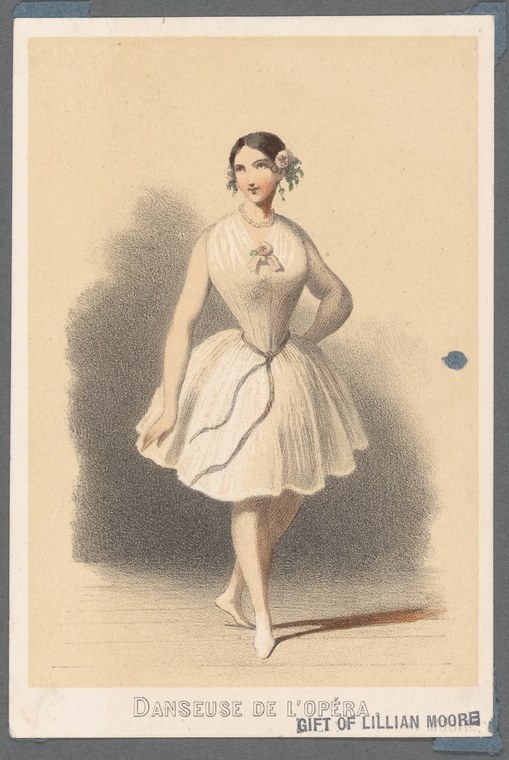
A single female dancer is posed against a neutral, softly shadowed background in a three-quarter stance. She wears a pale, high-waisted dress with a fitted bodice and full skirt that falls to mid-calf—the silhouette characteristic of early 19th-century fashion. The skirt is caught mid-movement, creating a curved line that suggests the momentum of turning or traveling across the stage. Her dark hair is styled up and adorned with flowers or ornamental pins. Her left arm is raised and bent, the hand delicate; her right arm hangs at her side. Her posture is upright and refined, with weight shifted onto her right leg, her left leg extended slightly behind. The setting is theatrical and intimate—the background dissolves into shadow, creating the effect of a stage lit by gas or candlelight. A small blue mark appears in the lower right, possibly a printer's mark or signature.
The dancing
The dancer stands in a restrained, graceful pose that emphasizes verticality and line rather than dramatic movement. Her frame is open and elongated, with no partner and no closed hold. The raised arm suggests either a preparatory position or the moment of a simple port de bras (arm movement). Weight appears centered but with a soft shift to the supporting leg, consistent with the épaulement (shoulder emphasis) of early Romantic ballet technique. Her legs are straight rather than deeply flexed, and her turned-out position is moderate and natural rather than extreme.
The dance depicted
This is almost certainly a Romantic ballet dancer, most likely from the 1830s–1840s era, printed as a commemorative or promotional portrait of a specific ballerina. The title *Danseuse de l'Opéra* (Opera House Dancer) and the inscription referencing Lillian Moore (a major dance historian) suggest this may document or honor an important performer of that period. The pose is too constrained and elegant to represent a specific step or choreographic moment; instead it presents the dancer as an idealized figure embodying the refined, ethereal aesthetic of Romantic ballet. The lack of pointe work visible and the moderate turnout suggest this may predate or sit early in the Romantic period, when full Romantic technique was still developing.
How it was made
This is a hand-colored or tinted lithograph or engraving, printed on cream-colored paper. The technique allows for soft tonal gradation in the background shadow and delicate rendering of the dress fabric and the dancer's features. The use of color—the pale dress, dark hair, and subtle pinking on the cheeks—is consistent with hand-tinting of a black-and-white printed stone or plate. Such prints were mass-produced and affordable, circulating widely among theater audiences and collectors of dance imagery in the 19th century. The presence of the artist's name or publisher's mark (if decipherable) would confirm production method and date more precisely.
About this work
This is a 19th-century theatrical portrait of an opera house dancer, almost certainly Romantic ballet in style, rendered as a hand-colored lithographic or engraved print. The work documents both the physical ideal of the Romantic ballerina—the upright carriage, the refined arm position, the modest but elegant costume—and the commercial practice of circulating dancers' likenesses to the theatergoing public. The restraint of the pose and the shadow background emphasize the performer's status and refinement rather than the spectacle of the movement itself. It belongs to a large and important body of 19th-century dance portraiture that shaped how ballet was understood, promoted, and remembered.
How to look at it
Look at the dancer's stillness: the pose is not a moment caught mid-step but a composed portrait, a presentation of the ideal Romantic dancer to the viewer. Notice the costume—the high waistline, the soft fullness of the skirt, the lack of pointe shoes—and compare it mentally to later photographs of late 19th-century ballet, where the aesthetic has shifted. The soft modeling of shadow and the hand coloring create an effect of intimacy and gentleness. The careful rendering of the dancer's face and posture emphasizes beauty and refinement over technical difficulty, which was the Romantic period's deepest value.
The period
This print dates to the height of the Romantic era in ballet, roughly 1830–1850, when lithography and hand-colored engraving had made theatrical portraiture accessible and collectible. Ballerinas became celebrities and objects of fascination; prints, daguerreotypes, and sketches of famous dancers circulated widely. The aesthetic of the image—the ethereal costume, the lifted posture, the theatrical lighting—reflects the Romantic period's idealization of the dancer as a supernatural or idealized being rather than an athletic performer. The reference to the New York Public Library's dance collection and to Lillian Moore (1911–1984), a pioneering dance historian, indicates this print has been preserved and studied as evidence of performance history.
Where it lives
This print is held in the Prints depicting dance collection of the New York Public Library. The inscription 'Gift of Lillian Moore' indicates it was donated by the historian and scholar, suggesting its provenance in a documented collection and its use in the study of American and European dance history.
Dance in this work
Questions about this work
Was this dancer famous?
The print's title does not identify her by name, but the careful rendering and the formal publication as a named work suggest she was a known performer of the opera house. The reference to Lillian Moore implies this may document someone important enough to merit collection and study by a major dance historian. Without the artist's name or a date, and without more detailed inscription, we cannot identify her with certainty from the image alone.
Why is she not on pointe?
Pointe work existed in the 1830s but was not yet the dominant technical language it became later in the century. Early Romantic ballerinas trained heavily on pointe but often posed in portraits in soft ballet slippers or even street dress for grace and femininity. This portrait reflects the period's aesthetic values: the dancer is idealized and ethereal, not presented as an acrobat.
What is the small blue mark in the corner?
This is likely a printer's mark, edition number, or accession mark from the NYPL collection. It is not part of the original artistic composition.
More dance artwork





