49 works in this view — arrow keys or swipe to move between them.
Dance in Art
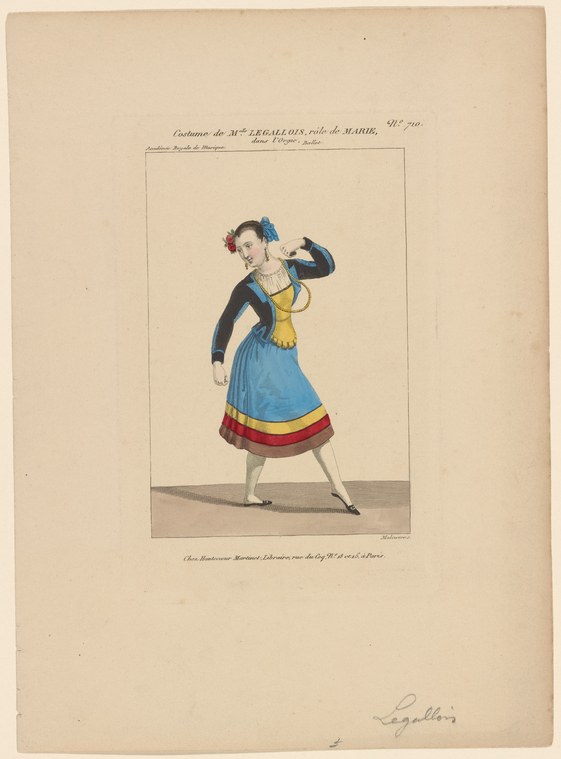
Costume de Melle. Legallois, rôle de Marie, dans L'Orgie, ballet
Unknown artist
- Collection:
- Prints depicting dance
- Source:
- New York Public Library
- Rights:
- Public domain — free to use, share and adapt.
- Recorded as:
- Public Domain
Costume prints like this are among the few visual records of how specific roles were performed and imagined in the early Romantic ballet era, before photography. The named performer (Mlle. Legallois) and specific production title (*L'Orgie*) make this a documented record of theatrical practice rather than a generic dance image, and the energy of the pose tells us something about how dancers were expected to convey emotion and narrative through the body.
What you are looking at
A single female dancer in theatrical costume stands against a plain background, captured in a moment of energetic movement. She wears a dark navy or black bolero jacket with long sleeves over a blue skirt with a deep yellow-gold band at the waist and a contrasting red-and-gold striped hem. Her posture is dynamic: she leans back slightly with one arm raised to her head in a gesture of abandon or exertion, while her body twists as if mid-step. Her legs are visible to the knee, clad in light-colored stockings and dark shoes. The figure is rendered as a hand-colored engraving or aquatint on cream paper, with careful hatching defining the shadows and volume of the form. The composition is spare and formal—the dancer isolated in an oval frame against white space, with only a simple ground line beneath her feet.
The dancing
The single dancer's weight appears to be shifting, with her torso in a slight backbend and her right arm raised toward her head in a gesture of dramatic expression rather than formal technique. Her left arm hangs lower, and her stance is open rather than held in a closed frame. The gesture is theatrical and full-bodied, suggesting a performer conscious of an audience. The raised arm and tilted head position suggest emotion or exertion—a moment of climax in a narrative rather than a formal pose.
The dance depicted
This appears to be a costume study for a theatrical ballet, most likely Romantic-era ballet given the period of the print and the title's reference to a specific role in a production called *L'Orgie* (The Orgy). The costume and dynamic posture suggest a female soloist in a dramatic scene rather than a corps dancer. The cut of the dress—fitted bodice with a full skirt that has distinct decorative bands—and the overall theatricality of the pose place this in the early-to-mid 19th century, when such costume prints were circulation to document major roles and performers. The energetic arm gesture and backward lean suggest a moment of passion or revelry consonant with the ballet's title.
How it was made
This is a hand-colored engraving or aquatint, printed on cream wove paper. The print shows the characteristic line work of engraving combined with soft tonal passages achieved through aquatint or fine stippling, particularly in the shadows of the jacket and legs. Hand coloring in watercolor or pigmented medium has been applied to define the blue, gold, and red of the costume and the flesh tones. The technique allowed for rapid reproduction and distribution of costume designs and performance documentation; such prints were sold to audiences, collectors, and other theatres as records of celebrated performances and roles. The oval framing and isolation of the figure against white space is typical of theatrical costume prints of the 1820s–1840s.
About this work
This is a costume study for a female dancer in the role of Marie in the ballet *L'Orgie*, performed by Mlle. Legallois. It documents a specific moment in a theatrical narrative through the dancer's dramatic pose and costume details. Such prints served multiple purposes: they commemorated celebrated performers, circulated information about successful productions, and provided visual reference for other theatres and performers. The work sits at the intersection of theatrical documentation and fashion illustration, a common genre in early 19th-century print culture. For dance historians, it is valuable evidence of how female roles in Romantic ballet were costumed, posed, and presented to the public, and of the expectation that dancers embody emotional narrative through body and gesture.
How to look at it
Notice the energy and torsion in the dancer's pose: her body is not at rest or in a formal presentational frame, but caught mid-movement, twisting and leaning back with one arm raised dramatically. This is a deliberately chosen moment—not a neutral standing position, but a peak of expression. The gesture is theatrical and full of narrative import, telling you something about the character or emotion of the scene (the ballet is titled *L'Orgie*, suggesting revelry and abandon). The costume is rendered with precise detail: observe how the engraver has defined the folds of the skirt, the striped hem, and the fitted jacket, and how the hand coloring emphasizes the distinction between the dark bodice and the bright blue skirt. The oval framing and the careful placement of the figure suggest this is a formal costume document meant for circulation and study.
The period
This print dates from the early-to-mid 19th century, likely 1820s–1840s based on the style of engraving and the costume silhouette. This was the era of Romantic ballet, when narrative and emotion came to dominate ballet aesthetics, and when the female dancer became the central focus of theatrical spectacle. The theatrical costume print was a flourishing commercial genre during this period; prints of celebrated dancers and roles were sold to theatre-goers and collectors, and such images circulated widely across Europe. The costume itself reflects the fashions of the period—the small waist, the full skirt with decorative borders, and the fitted jacket are all consistent with 1820s–1830s silhouettes adapted for the stage.
Where it lives
This print comes from the New York Public Library's collection of prints depicting dance. It is a hand-colored engraving or aquatint, a form of commercial theatrical documentation common in the early-to-mid 19th century.
Dance in this work
Questions about this work
Who was Mlle. Legallois?
The print identifies her only as the performer in the role of Marie in *L'Orgie*. She appears to have been a professional dancer in the early 19th century, but detailed biographical information about her has not been recovered in standard dance historical sources. The existence of this costume print suggests she was a performer of sufficient reputation that her roles were documented and circulated.
What ballet is *L'Orgie*?
The title is French for 'The Orgy,' suggesting a narrative ballet set in a scene of revelry or excess. The print does not provide information about its choreographer, date of premiere, or detailed plot. It may be a lost ballet, or known under another title.
Why was the dancer posed this way?
The raised arm and backward lean suggest a moment of emotional intensity or physical exertion—peak action in the narrative. Costume prints often captured not a neutral pose but a characteristic or climactic moment of the role, to give viewers a sense of the character and the performer's interpretation.
How was this hand coloring done?
The color appears to have been applied by hand after the engraving was printed, using watercolor or similar medium. This was standard practice for theatrical costume prints of the period, allowing mass production with individual color variation. The quality of coloring could vary depending on the workshop and the cost of the print.
More dance artwork





