49 works in this view — arrow keys or swipe to move between them.
Dance in Art
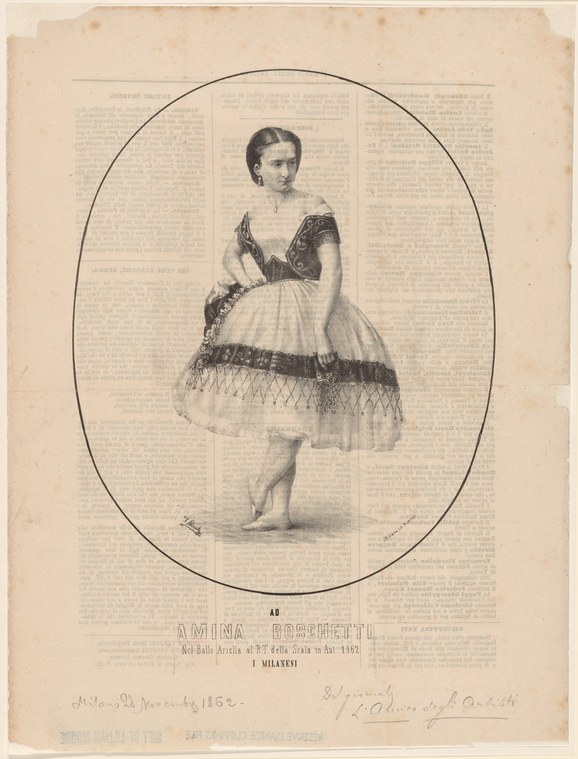
Amina Boschetti nel ballo Ariella al R. T. della Scala in Aut. 1862
Unknown artist
- Collection:
- Prints depicting dance
- Source:
- New York Public Library
- Rights:
- Public domain — free to use, share and adapt.
- Recorded as:
- Public Domain
This image preserves the likeness and costume of a historically significant Italian prima ballerina at a specific moment in her career, documenting both her professional identity and the Romantic ballet aesthetic of the 1860s. For historians of ballet and printmaking, it exemplifies how theatrical fame was mediated and disseminated through the popular press of the period, making the private spectacle of the stage publicly accessible through engraved reproduction.
What you are looking at
A young woman in theatrical dress stands alone against a background of dense printed text, framed by an oval border. She wears a dark off-shoulder bodice with short puffed sleeves and a voluminous pale skirt with a deep black trim or flounce at the hem, a silhouette typical of mid-19th-century ballet costume. Her pose is poised and balletic: she stands in a slight contrapposto with one leg bearing weight, the other subtly extended, her arms positioned with grace—one raised and bent, the other held softly at her side. Her gaze is directed slightly downward and to the side, creating an introspective, almost demure quality. The figure is rendered in fine engraved line work, suggesting this is a reproductive print made from a drawing or painting. The printed text visible behind her—legible in places as small typography—is characteristic of 19th-century illustrated periodicals or almanacs, indicating this was likely a page from a larger publication.
The dancing
A single female dancer is depicted in a standing pose with classical ballet bearing. Her weight appears anchored on one leg while the other is softly extended, a position suggesting she is not mid-leap but rather captured in a moment of posed elegance. Her upper body is held with the upright carriage of trained ballet dancers of the period, her arms graceful but not in any single codified hold—one arm curves upward while the other hangs softly, suggesting either a moment between positions or a deliberate pose for the portrait. Her neck and head posture conveys refinement and the inward focus expected of Romantic-era ballerinas.
The dance depicted
This is a theatrical ballet portrait, almost certainly a Romantic ballet of the 1860s based on the costume, pose, and visual language. The inscription identifies the subject as Amina Boschetti dancing in the ballet *Ariella* at La Scala, Milan in autumn 1862. Boschetti was a celebrated Italian prima ballerina of the mid-to-late 19th century, and this print documents a specific performance of what may have been a lesser-known work. The pose and costume are consistent with the vocabulary of Romantic ballet—the soft tulle skirt, the off-shoulder bodice, the graceful arm position—though the engraved medium and the formal framing as a portrait rather than an action scene means we see Boschetti as a posed figure rather than in dynamic movement. No footwork or spatial relationship to other dancers is visible.
How it was made
This is a wood or steel engraving, a reproductive printmaking technique that allowed for fine detail and mass circulation. The dense background of legible text indicates this was printed as an illustrated page in a periodical or collected volume, likely an Italian theatrical or cultural journal or almanac. Engraving as a medium was ideal for celebrity portraiture and for preserving images of celebrated performers for a wide audience; the technique's precision allowed for subtle rendering of facial features and the delicate textures of fabric. The integration of text and image on a single page was standard for theatrical documentation of the period and suggests this was part of a larger series or publication documenting notable performances or artists.
About this work
This is a mid-19th-century engraved portrait of the Italian ballerina Amina Boschetti in costume for the ballet *Ariella*, performed at La Scala, Milan in 1862. The work documents both a specific performer and the visual conventions of Romantic-era ballet costume and deportment. As a reproductive print integrated with surrounding text, it is characteristic of how theatrical celebrity was circulated and consumed in the 1860s—through illustrated periodicals and collected prints that brought images of famous dancers into homes and studies across Europe. The work sits at the intersection of theatrical documentation, celebrity culture, and the history of reproductive printmaking.
How to look at it
Attend to the dancer's posture and the way her weight is distributed: she is not captured mid-leap or in a moment of kinetic energy, but rather in a poised, almost portrait-like stance that emphasizes her training and refinement. The off-shoulder bodice, the delicate tulle skirt with its dark trim, and the soft arms are the visual markers of mid-19th-century ballet costuming. The artist has chosen to present Boschetti as a composed, introspective figure rather than as an explosive performer, suggesting either a moment of rest between dances or a deliberate choice to emphasize her status as a celebrated artist rather than merely a moving body. The formal oval frame and the engraved medium itself position this as a documentary portrait—a record of a specific performer in a specific role—rather than as an imaginative representation of the dance itself.
The artist
The artist is not recorded in the catalogue. The engraving style and integration with Italian text suggests this was produced by an Italian printmaker or publishing house, likely working for a theatrical or cultural periodical. The level of finish and the celebrity of the subject indicate this was a commissioned work, part of the infrastructure of theatrical publicity and documentation that flourished around major opera houses like La Scala.
The period
The 1860s were a period of extraordinary popularity for theatrical dance across Europe, particularly at grand opera houses like La Scala. Romantic ballet—characterized by pointe work, ethereal tutus, and narratives of supernatural or exotic fantasy—had reached its maturity after its peak in the 1840s-50s, though it remained the dominant form of theatrical dance. Printmaking played a crucial role in this ecosystem: engraved portraits of celebrated ballerinas circulated widely, creating a culture of celebrity and allowing audiences to possess images of performers they had seen or read about. The integration of image and text in illustrated periodicals and collected volumes made theatrical culture accessible to the literate middle class, even those who could not attend performances. Boschetti's career spanned the mid-to-late 19th century, and she was among the generation of Italian dancers who maintained the technical and aesthetic standards of Romantic ballet even as European taste began to shift toward new forms.
Where it lives
This engraving comes from the New York Public Library's collection of prints depicting dance. It is likely a page from an Italian theatrical or cultural periodical, possibly an almanac or annual review of performances at La Scala or other major Italian theaters. The integration of image and text on a single sheet is consistent with 19th-century illustrated journalism.
Dance in this work
Questions about this work
Who was Amina Boschetti?
Amina Boschetti (1836–1881) was an Italian prima ballerina who performed throughout Europe in the mid-to-late 19th century. She was celebrated for her technical skill and her performances in Romantic ballets, and she danced at major theaters including La Scala in Milan. She was part of the generation of Italian dancers who kept Romantic ballet alive even as European dance aesthetics began to change toward the end of the century.
What is an engraving and why was it used for theater publicity?
An engraving is a printmaking technique in which a design is cut or etched into a hard surface (wood or metal plate) and then inked and printed. Engravings allowed for multiple copies to be made from a single image, making them ideal for mass distribution. In the 19th century, engraved portraits of celebrated performers were published in theaters programs, periodicals, and collected volumes, allowing audiences to own images of their favorite artists.
What does the costume tell us about Romantic ballet?
The off-shoulder bodice, voluminous tulle skirt, and delicate proportions are hallmarks of Romantic-era ballet costuming (roughly 1830s–1870s). The pale, ethereal skirt and the dark trim are characteristic of the period's aesthetic, which emphasized grace, lightness, and a sense of the supernatural or otherworldly. Dancers of this era performed on pointe, though pointe shoes are not clearly visible in this portrait.
More dance artwork





