49 works in this view — arrow keys or swipe to move between them.
Dance in Art
Danseuse de l'Opéra
Unknown artist
- Collection:
- Prints depicting dance
- Source:
- New York Public Library
- Rights:
- Public domain — free to use, share and adapt.
- Recorded as:
- Public Domain
This image shows how Romantic ballet dancers were presented to and consumed by the public outside the theater—not as artworks in themselves, but as documents of celebrity and fashion. It also preserves detailed costume information (cut, proportions, ornament) that cannot be reliably inferred from written sources alone. For historians of dance and material culture, such prints are among the most plentiful visual records of 19th-century stage practice.
What you are looking at
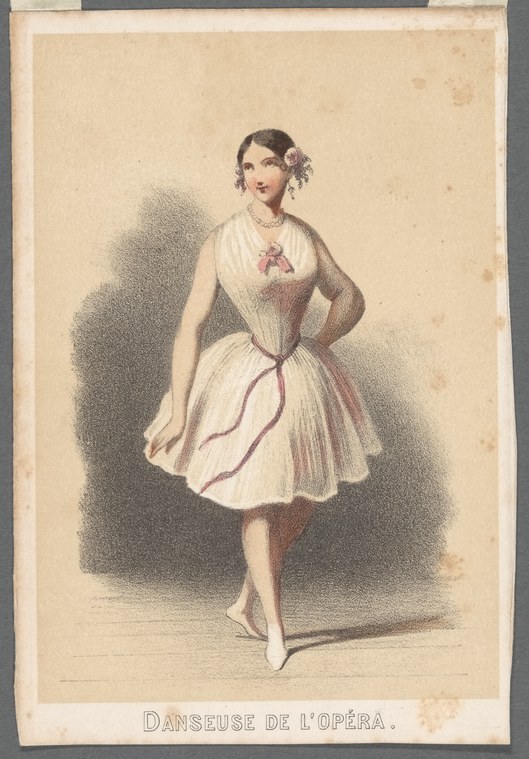
A single female dancer stands in three-quarter pose against a neutral background rendered in soft grey wash. She wears a pale silk dress with a fitted bodice, short puffed sleeves, and a full skirt that falls to mid-calf, with a contrasting purple ribbon or sash at the waist. Her dark hair is gathered back and adorned with what appears to be a flower or ornament. She wears pale tights and soft ballet shoes. Her posture is upright and graceful, with one leg extended slightly forward in a position suggesting readiness or mid-step. The composition is intimate and focused: the dancer fills most of the frame, centered against the muted background with careful attention to the fall of fabric and the geometry of her limbs. The printing technique—hand-colored lithograph or engraving—gives the work a documentary quality while the soft modeling of light and shadow lends elegance.
The dancing
The dancer stands in an open, frontal position with her weight on her back leg, her front leg gently extended. Her arms hang naturally at her sides with a slight turnout at the elbows, a posture suggesting poised readiness rather than active movement. Her frame is upright and symmetrical, her shoulders level and her neck extended. The proportions and anatomical accuracy suggest study from life or careful observation of trained dancers. There is no partnering; this is a solo study of a single figure.
The dance depicted
This is an opera dancer (danseuse de l'opéra) depicted in the style of Romantic-era ballet, most likely from the 1830s-1850s based on costume and lithographic convention. The dress, pose, and presentation all mark her as a professional theater dancer of the Paris Opéra. The work shows her in a moment of formal presentation rather than mid-choreography—a convention of portraiture that allowed spectators to study the dancer's bearing, physique, and costume detail. The soft shoes, the moderate skirt length, and the ease of her stance are consistent with Romantic ballet as danced in this period, before the rise of pointe work became dominant.
How it was made
This is a hand-colored lithograph or engraved print, as evidenced by the fine linear work, the tonal modeling through hatching and wash, and the characteristic soft yet distinct outline. The technique allowed for relatively inexpensive reproduction and wide circulation among the opera-going public of Paris. Hand coloring (visible in the dress, hair ornament, and sash) was applied after printing, a labor-intensive process that suggests this work was marketed to a clientele with disposable income—likely fans and subscribers of the Opéra who collected images of celebrated dancers. The print format made the dancer's likeness and costume accessible to a broad audience beyond the theater itself.
About this work
This is a portrait print of an anonymous Opéra dancer from the Romantic era, created in the 1830s–1850s when lithographic portraiture of stage performers was at its height. The work captures both the physical ideal and the social reality of Romantic ballet: a trained, graceful female body in fashionable stage dress, presented for the admiration and collection of metropolitan audiences. The print belongs within a large category of theatrical portraiture that emerged in the early 19th century, documenting both the dancers and the aesthetic values of the period. It is a primary source for understanding what Romantic dancers wore, how they carried themselves, and how they were celebrated in popular culture.
How to look at it
Notice the careful attention to the fall of the skirt and the transparency suggested by the shading—the artist understood the properties of silk and how it moves. Observe the dancer's posture: she is not mid-leap or in an extreme position, but rather presented in a neutral, self-possessed stance that allows the viewer to appreciate both her body and her costume. The hand-coloring adds a painterly gentleness to the underlying print, creating an effect of intimacy despite the formal composition. The title 'Danseuse de l'Opéra' (Opera Dancer) is printed at the bottom, marking this as a type-image—a generic portrait of a category rather than a named individual, typical of the period.
The period
This print dates to the heyday of Romantic ballet in France (1830s–1850s), when the Paris Opéra dominated European dance. Lithography, perfected by Aloys Senefelder in the 1790s, became the dominant medium for theatrical portraiture by the 1820s, allowing publishers to meet voracious demand from collectors and fans. Theaters actively promoted their dancers through such prints, which circulated as souvenirs and collectibles. The aesthetic of the Romantic period—the emphasis on lightness, gracefulness, and the ethereal (soon embodied in pointe work and the 'sylph' ideal)—is evident in the dancer's costume and presentation. This image predates or coincides with the emergence of the tutu and the widespread adoption of pointe technique in the 1840s–1850s.
Where it lives
This print is held in the New York Public Library's collection of prints depicting dance. It is part of a large body of 19th-century theatrical portraiture that was widely distributed, collected, and preserved.
Dance in this work
Questions about this work
Is this a portrait of a specific famous dancer?
The catalogue record provides no name, and the generic title 'Danseuse de l'Opéra' (Opera Dancer) suggests it was marketed as a type-image rather than a portrait of an identified individual. Many such prints were sold unsigned or with only a generic title, allowing them to represent 'the' opera dancer as an ideal rather than a specific person. Without further documentation, the dancer's identity cannot be established from the image alone.
What is the date of this print?
The catalogue record does not provide a date. Based on the costume (the style of the dress, the absence of pointe shoes, the hair ornament), the lithographic technique, and the conventions of theatrical portraiture, this work most likely dates to the 1830s–1850s, during the height of Romantic ballet in France. More precise dating would require examination of the paper, printing technique, and publication marks.
Is this dancer on pointe?
No. She wears soft ballet shoes, not pointe shoes. This indicates the work predates or falls in the early phase of the widespread adoption of pointe technique in professional ballet, which became standard in the 1840s–1850s. The dancer's stance—upright, balanced, without extreme turnout—is consistent with early-to-mid 19th-century ballet technique.
What does the ribbon or sash at her waist represent?
The purple ribbon is likely a costume detail—possibly part of a specific ballet costume, or a decorative element typical of Romantic-era stage dress. It may also indicate rank or role within the company. Without knowing the specific ballet or costume tradition, its exact significance cannot be determined from the image alone.
More dance artwork





