49 works in this view — arrow keys or swipe to move between them.
Dance in Art
Genus - Ballantes
Unknown artist
- Collection:
- Prints depicting dance
- Source:
- New York Public Library
- Rights:
- Public domain — free to use, share and adapt.
- Recorded as:
- Public Domain
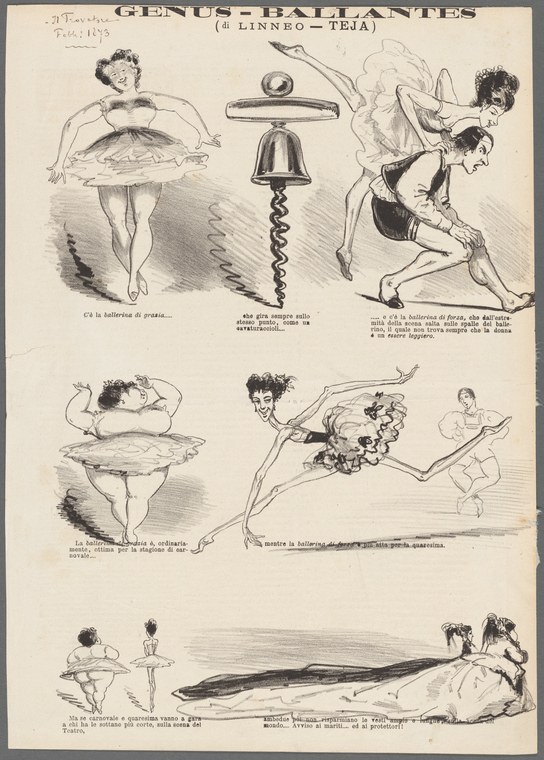
This print is a rare and direct expression of anti-ballet sentiment in the 19th century, preserving the voice of cultural skeptics who rejected Romantic ballet's pretensions. It reveals the extent to which ballet's extreme aesthetic—the impossible extensions and ethereal poses we now associate with Romantic-era performance—was controversial and subject to active mockery by educated audiences. For historians, it documents the gap between what ballet dancers actually did and what contemporary critics thought of it.
What you are looking at
This is a satirical print depicting female ballet dancers in exaggerated, absurdist poses arranged across the page. The composition presents six vignettes, each showing a solitary dancer or pair in impossible or grotesque positions. In the upper left, a woman in a tutu strikes a wide second position with an enormous ballooning skirt. Center-top shows a dancer rendered as a thin horizontal line beside a large bell. Upper right depicts two women in contorted positions, one extreme backbend and another folded forward. The lower register continues the grotesquerie: a woman spreads across a fish-like form, pairs perform impossible arabesques and extensions, and the final right figure shows dancers beside what appears to be a reclining male form. The print is rendered in pen and ink with cross-hatching for shadow; the style is that of 19th-century satirical journalism. Each vignette includes handwritten Italian captions describing the "genius" of these ballet movements.
The dancing
The dancers are shown in extreme positions that violate classical ballet technique: massive extensions that create grotesque angles, impossible spinal curves, and weight distributions that defy gravity. Bodies are rendered with exaggerated proportions—hugely swollen tutus, impossibly thin limbs, pinhead proportions for heads. The poses mimic ballet vocabulary (arabesques, extensions, poses on one leg) but distort them into parody. Several figures appear to be partnered, but the interactions are nonsensical rather than supportive. The artist demonstrates knowledge of ballet positions while systematically inverting their aesthetic and physical logic.
The dance depicted
This is a satirical critique of contemporary (19th-century) Romantic ballet and the cult of the ballerina. The Italian title and captions suggest this responds to a specific ballet performance or performance tradition, likely Italian or performed in Italy. The exaggerations target the visual extremism of mid-19th-century ballet technique—the impossible extensions and ethereal stylization that audiences celebrated in dancers like Marie Taglioni. The work mocks the pretense of "genius" in ballet dancing by showing what such claims would look like if taken literally: inhuman, grotesque, anatomically absurd positions presented as artistic achievement.
How it was made
This is a pen-and-ink engraving or etching, rendered in the popular satirical print style of 19th-century European journalism. The fine line work, cross-hatching for tone, and crowded composition are characteristic of wood or steel engraving for mass reproduction. The handwritten Italian captions suggest it was published in an Italian periodical or as a standalone broadsheet; the printing quality and distribution format indicate it was made for popular circulation rather than fine art. Such prints were inexpensive and widely disseminated, making them effective vehicles for social and artistic satire.
About this work
This is a mid-19th-century satirical print attacking the conventions of contemporary Romantic ballet, likely published in Italy. The artist uses exaggerated, anatomically impossible poses to mock the pretensions of ballet "genius" and the extremism of modern technique. The work belongs in a dance history because it documents a moment of cultural backlash against the very aesthetic that had just defined ballet as the preeminent European theatrical form. It shows us not ballet as practitioners wanted to be seen, but ballet as critics and the skeptical public experienced it: as absurd, inhuman, and deserving of ridicule.
How to look at it
Attend to the specific ballet positions the artist has chosen—each one is recognizable as a classical vocabulary word (arabesque, attitude, développé) but rendered grotesque through exaggeration or physical impossibility. Notice how the artist uses anatomical distortion as satire: swollen tutus, pinhead heads, and skeletal limbs all signal mockery while demonstrating intimate knowledge of what ballet dancers actually looked like on stage. Read the Italian captions, which label these impossible positions as achievements of "genius." The humor works through recognizable distortion rather than simple misrepresentation.
The artist
Unknown. The style, format, and Italian captions suggest an Italian or Italian-educated artist working in the mid-19th-century satirical print tradition. The competent draftsmanship and specific knowledge of ballet vocabulary indicate a trained artist familiar with both artistic practice and popular satirical conventions. The work sits within a European tradition of theatrical satire that included artists like Honoré Daumier in France; Italian print culture had a strong satirical component in the 1840s-1860s.
The period
This print dates to the height of Romantic ballet in Europe, when dancers like Marie Taglioni and Fanny Elssler were international celebrities and ballet had become the dominant theatrical dance form. The extreme aesthetic of Romantic ballet—pointe work, ethereal costuming, extreme extensions—was revolutionary and widely admired, but also controversial among cultural conservatives and skeptics. The print reflects a counter-current of satire and doubt running through 19th-century responses to ballet. Italian ballet culture in particular was experiencing a transition as French and Danish techniques replaced Italian traditions. The work also sits within a broader 19th-century tradition of satirical journalism that used visual exaggeration to critique artistic and social excess.
Where it lives
The work is held in the New York Public Library's print collection as part of a broader collection of dance-related imagery. The library acquired it as a historical document of theatrical practice and satirical culture. As a mass-produced satirical print from the 19th century, it was likely published as a single sheet or as part of a serialized periodical, making it part of popular print culture rather than a unique artistic object.
Dance in this work
Questions about this work
Is this actually depicting how ballet was danced in the 19th century?
No. This is satire. It exaggerates real ballet aesthetics—the extreme extensions and ethereal poses of Romantic ballet—to the point of grotesquerie. The artist clearly understood ballet technique and costume, but inverted them to mock the pretensions of contemporary ballet culture. It tells us more about how skeptics *perceived* ballet than how it was actually performed.
What does the Italian text say?
The captions label these absurd positions as achievements of "genius" and describe impossible technical feats. The Italian context suggests this was a response to Italian ballet culture specifically, or to Italian performances of French Romantic ballet tradition.
Why would someone make fun of ballet like this?
In the mid-19th century, Romantic ballet's extreme aesthetics—especially the impossible-looking extensions and ethereal costuming—struck many educated observers as ridiculous or affected. Satirical prints like this expressed skepticism about ballet's claims to artistic seriousness and mocked the worship of ballerinas as genius artists.
More dance artwork





