49 works in this view — arrow keys or swipe to move between them.
Dance in Art
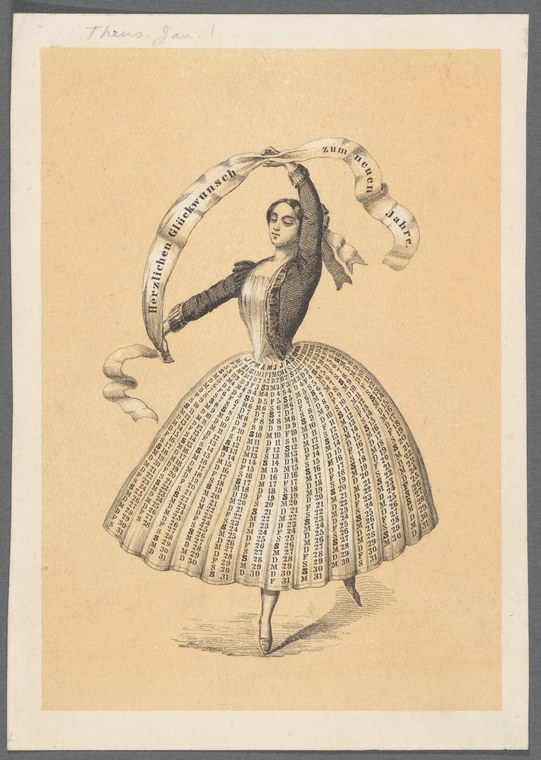
Herzlichen Glückwunsch zum neuen Jahre
Unknown artist
- Collection:
- Prints depicting dance
- Source:
- New York Public Library
- Rights:
- Public domain — free to use, share and adapt.
- Recorded as:
- Public Domain
This work documents the visual codes of Romantic ballet at the height of its cultural dominance—a moment when a particular silhouette, pose, and ideal of femininity were instantly legible to a broad audience as the essence of theatrical grace. The conversion of a ballet figure into a greeting card reveals how ballet moved beyond the opera house into everyday European domestic life, becoming a symbol of refinement, aspiration, and good wishes. For historians of dance imagery and of 19th-century visual culture, this print is evidence of how the dancing body was standardized, reproduced, and consumed as a commodity.
What you are looking at
A young woman in theatrical dress stands alone against a plain cream background, captured in a moment of balletic pose. She wears a fitted dark jacket or bodice with long sleeves and a dramatically full skirt composed of radial pleats or panels that flare outward from the waist, creating a perfect cone or bell shape—a silhouette characteristic of mid-19th-century Romantic ballet. She holds one arm aloft in an elegant curve, the hand extended upward, while the other arm curves gracefully across her body. Her head is turned in profile, and she appears to be en relevé or on the balls of her feet, suggesting upward lift. A flowing ribbon or sash streams from her raised hand, inscribed with German text that reads like a New Year's greeting ("Herzlichen Glückwunsch zum neuen Jahre")—Happy New Year. The ribbon trails across the upper portion of the composition. The dress, stance, and the delicate theatrical quality of the pose all signal a professional or amateur dancer of the Romantic era, posed as if to wish the viewer well.
The dancing
The dancer is a single figure, shown in a standing position with a clear vertical orientation. The weight appears centered with a slight lift through the upper body and onto the balls of the feet—a fundamental ballet position. The raised arm forms a classical port de bras (carriage of the arm), curved and open rather than rigid, with the hand elegantly extended. The other arm completes a gentle counterbalance, creating bilateral symmetry and grace. There is no evidence of jumping, turning, or complex footwork; the pose emphasizes stillness, poise, and the verticality that defines Romantic-era ballet posture.
The dance depicted
This is almost certainly a Romantic ballet figure, likely from the mid-19th century (1840s–1850s based on silhouette). The skirt is the quintessential tulle or gauze tutus of the Romantic era—full, weightless, and designed to enhance the illusion of weightlessness and ethereal movement. The pose itself is a classical ballet position, demonstrating the balletic vocabulary that dominated European and North American stages during this period. The inscription repurposes the dancer as a New Year's greeting card, personalizing the theatrical figure for a domestic or gift audience. Whether this depicts a named dancer or a generic Romantic ballerina is unclear from the image alone; the pose and costume are canonical rather than individually specific.
How it was made
This is a steel or wood engraving on paper, executed in black line with fine detail work. The technique allows for crisp, precise outlines and carefully rendered crosshatching on the jacket bodice and skirt pleats, creating volume and texture. The cream paper shows through as highlights, particularly on the face and the full expanse of the skirt. The engraving process was ideal for reproductive printing and mass distribution—this would have been printed from a metal plate, allowing hundreds of impressions. The inscription in ornamental script suggests it was designed as a commercial novelty print, likely sold as a greeting card or keepsake in the German-speaking regions.
About this work
This is a mid-19th-century engraved New Year's greeting that depicts a Romantic-era ballet dancer in a canonical pose. The figure exemplifies the visual language of Romantic ballet: the dramatically full tulle skirt, the elegant arm carriage, the suggestion of weightless verticality, and the refined pose that dominated European stages from the 1830s onward. The repurposing of a theatrical figure as a greeting card demonstrates how thoroughly ballet imagery had infiltrated popular visual culture and domestic gift-giving by the 1840s–1850s. The work sits at the intersection of theatrical documentation and commercial popular culture, capturing both the aesthetic ideals of Romantic ballet and the era's appetite for sentimental, personalized prints.
How to look at it
Look first at the silhouette: the skirt shape is the key period marker, and its pleated construction is rendered with meticulous precision to convey lightness and volume. Observe the dancer's posture—she is not in an extreme arabesque or attitude, but in a quiet, composed position that emphasizes verticality and grace rather than technical difficulty. The raised arm and the flowing ribbon transform the pose into a gesture of offering or blessing, befitting its use as a greeting. The stillness of the image contrasts with the dynamic reputation of Romantic ballet; this captures a moment of repose, the quiet dignity of the dancer rather than the drama of performance.
The period
This engraving dates to the height of the Romantic ballet era, when works like La Sylphide (1832) and Giselle (1841) had established a new aesthetic: otherworldly female dancers in weightless tutus, often portraying sylphs, spirits, or tragic heroines. The Romantic era privileged verticality, ethereal lightness, and emotional restraint in the female dancing body, in sharp contrast to the more grounded, virtuosic style of classical ballet that would emerge later in the century. Engraving and lithography were the dominant methods for disseminating theatrical images to the public, and by the 1840s–1850s, dancers and theatrical figures appeared on commercial prints, sheet music covers, and greeting cards across Europe and North America. The German inscription suggests a Central European market, where ballet culture was strong but more domestic and amateur-oriented than in Paris or London.
Where it lives
The work is held in the New York Public Library's Prints collection, listed under "Prints depicting dance." It is one of many 19th-century engravings in this collection that document both theatrical dance and the commercial and amateur dance practices of the period.
Dance in this work
Questions about this work
What era of ballet does this represent?
This depicts Romantic ballet, the dominant European ballet style of the 1830s–1850s. The full tulle skirt, the elegant port de bras, and the ethereal pose are all hallmarks of this period. Romantic ballet emphasized weightlessness, verticality, and the female dancer, often portraying supernatural or tragic characters.
Is this a portrait of a real dancer?
The image shows a generic Romantic ballet figure, not necessarily a portrait of a named dancer. The costume and pose are canonical—instantly recognizable as "ballet" to a 19th-century viewer. Without additional documentary evidence, it cannot be attributed to a specific performer.
Why is there a German inscription on a ballet image?
The inscription converts the theatrical figure into a New Year's greeting card, a common commercial use of ballet imagery in the 19th century. Romantic ballet was popular across Europe, and German-speaking audiences purchased and collected such prints as sentimental gifts and keepsakes.
How was this image made and distributed?
This is an engraving—an image incised into a metal or wood plate, inked, and printed onto paper. Engraving allowed for fine detail and multiple printings, making it ideal for commercial reproduction. Such prints were sold to the middle class as affordable theatrical souvenirs and greeting cards.
More dance artwork





