49 works in this view — arrow keys or swipe to move between them.
Dance in Art
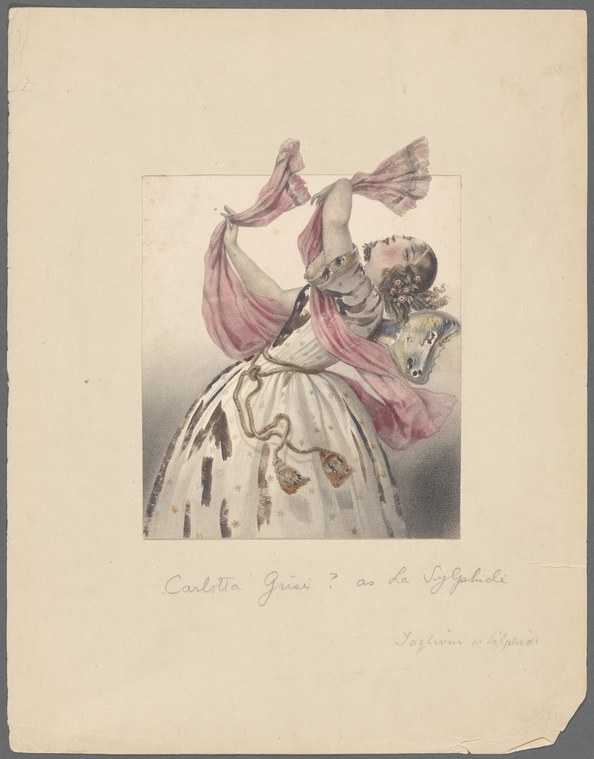
Romantic era ballerina in backbend wearing wings and swirling a pink scarf
Unknown artist
- Collection:
- Prints depicting dance
- Source:
- New York Public Library
- Rights:
- Public domain — free to use, share and adapt.
- Recorded as:
- Public Domain
This work documents the visual culture of Romantic ballet at its height, showing how the genre's supernatural themes were communicated to audiences through costume, pose, and composition. For dancers and historians, it is evidence of how the Romantic sylph was conceived and presented—as an idealized, weightless, otherworldly being rather than a human dancer executing steps. The print also reveals the 19th-century practice of celebrity portraiture in dance, documenting both the role and its cultural reach.
What you are looking at
A single ballerina in mid-arabesque or backbend, her body arched dramatically backward in a pose that emphasizes extension and flexibility. She wears a Romantic-era tutu—a white skirt with a fitted bodice—and has dark hair styled in the period fashion, adorned with what appears to be a jeweled circlet or tiara. Two large pink fabric panels billow around her, held aloft in her hands and trailing through the air, creating a sense of motion and weightlessness. Her posture is balletic and ethereal, with pointed feet and an elongated line through her body. She wears what appear to be small gossamer wings at her shoulders, identifying her as a sylph or fairy—a supernatural creature of the Romantic ballet. The figure is set against a neutral, pale background that emphasizes her form. The composition is a portrait-format study, likely a theatrical costume design or character study rather than a narrative scene.
The dancing
A single dancer in an extreme backbend with fully extended arms raised overhead, holding flowing pink scarves that frame the composition. Her body follows the exaggerated S-curve characteristic of Romantic ballet iconography—the chest lifted, the spine curved, weight articulated through a pointed foot. The pose suggests either a moment of flight or transcendence rather than functional movement. Her arms are active and expressive, the hand and wrist position refined and deliberate. The artist demonstrates understanding of the balletic vocabulary: the turned-out leg, the articulation of the foot, the elongation of the torso.
The dance depicted
This depicts a character from Romantic ballet of the mid-19th century, most likely a sylph or supernatural female character such as those in *La Sylphide* (1832) or *Giselle* (1841). The wings, the ethereal tutu, and the dramatically arched back in an attitude or backbend are all hallmarks of the Sylph archetype that dominated Romantic ballet imagery. The pink scarves function as both costume elements and compositional devices, emphasizing weightlessness and otherworldliness. This is not a dance step captured in motion but rather a character portrait—a moment designed to convey the essence of the role and its supernatural nature.
How it was made
This appears to be a hand-colored engraving or lithograph, based on the line work visible in the composition and the selective application of watercolor or gouache for the flesh tones, pink fabrics, and shadows. The technique allowed for precise delineation of the costume details—the tutu's structure, the jewelry, the wings—while the hand-coloring brought the figure to life. This was a common and economical method for circulating theatrical imagery in the 19th century, allowing theaters and publishers to distribute portraits of celebrated dancers and roles to a broad audience. The quality and finish suggest this was a professional theatrical print, likely commissioned or sold in connection with a specific production.
About this work
This is a theatrical character portrait of a Romantic-era ballerina as a supernatural female character, rendered as a hand-colored engraving. It captures the visual and emotional vocabulary of Romantic ballet: the ethereal sylph in her tutu, wings, and weightless pose, designed to convey transcendence rather than technical virtuosity. The work belongs to a large category of 19th-century theatrical prints that served both as souvenirs for audiences and as documentation of celebrated roles and performers. The image freezes not a moment of dance but an iconic stillness—the pose that defined the character and the era.
How to look at it
Observe the extreme arch of the spine and the lifted chest—this is not a functional dance pose but an idealized expression of weightlessness and transcendence. The pink scarves are essential: they are not part of the choreography but serve as visual metaphors for flight and ethereality, extending the line of the body upward. Note the precise rendering of the foot and leg, demonstrating balletic training, and the jewelry and tiara, which mark this as a character of supernatural rank. The artist has chosen a moment of stillness rather than motion, treating the pose as a character emblem.
The period
This work dates to the Romantic era in ballet, roughly the 1830s–1850s, when European dance shifted decisively toward supernatural and fantastical narratives. The sylph—a creature of air and magic—became the defining archetype of the period, embodied most famously by Marie Taglioni in *La Sylphide*. The tutu evolved during this period from a knee-length skirt to the longer, fuller romantic tutu visible here. The era privileged illusion, otherworldliness, and the appearance of effortlessness over technical display. Hand-colored theatrical prints were the primary medium for circulating images of celebrated dancers and roles, serving a function similar to theatrical photographs and lobby cards in later eras.
Where it lives
This work is held in the New York Public Library's prints collection focused on dance. The inscription in Italian below the figure suggests it may be a European print, possibly Italian or circulated through Italian publishers.
Dance in this work
Questions about this work
What is the character in this print?
This is a sylph or fairy character from Romantic ballet, identifiable by the wings, ethereal tutu, and supernatural pose. Such characters appeared in ballets like *La Sylphide* and *Giselle*, which dominated European stages in the mid-19th century.
Why is the dancer in such an unusual backbend?
This pose is not from choreography but is a character portrait—an idealized image designed to convey the essence of the role. The extreme arch suggests weightlessness, otherworldliness, and transcendence, all central to the Romantic ballet aesthetic.
What are the pink scarves for?
The scarves function as both costume elements and compositional devices. They extend the visual line of the body and reinforce the sense of flight and ethereality central to the sylph character.
How was this print made?
This is a hand-colored engraving or lithograph, a common method for circulating theatrical imagery in the 19th century. The base image was printed, then each print was individually colored by hand, making it both economical and labor-intensive.
More dance artwork





