49 works in this view — arrow keys or swipe to move between them.
Dance in Art
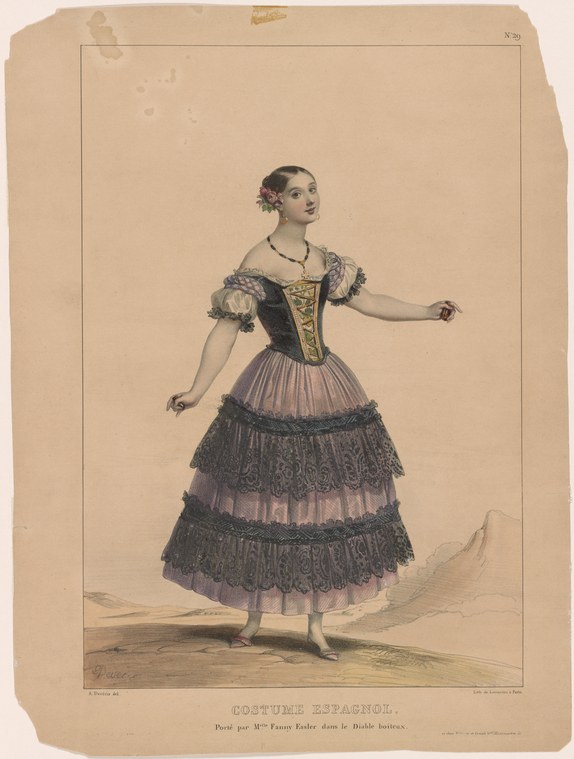
Costume espagnol. Porté par Melle, Fanny Essler [sic] dans Le diable boiteux
Unknown artist
- Collection:
- Prints depicting dance
- Source:
- New York Public Library
- Rights:
- Public domain — free to use, share and adapt.
- Recorded as:
- Public Domain
Fanny Elssler was a pivotal figure in the history of theatrical dance technique and performance, and her Spanish and character dances were considered revolutionary in their specificity and authenticity. This print is a primary document of how her most celebrated roles were understood and circulated in real time, and of the intimate relationship between costume design and movement vocabulary in Romantic ballet. For historians of dance, fashion, and 19th-century theatrical practice, it offers rare visual evidence of how a canonical role was dressed and presented to public audiences.
What you are looking at
A young woman in theatrical Spanish dress stands in a graceful contrapposto pose against a plain background, her body angled to the left while her gaze lifts upward. She wears a striking ensemble: a short-sleeved corset bodice in gold or cream with dark velvet panels, paired with a full skirt composed of three tiers of pleated fabric alternating between pale mauve or pink silk and deep charcoal lace. The skirt falls to mid-calf, revealing her legs and feet in the balletic fifth position. Her hair is styled in ringlets and adorned with flowers. Her arms are held in an open frame, one extended gently outward at approximately chest height. The composition is a portrait-format theatrical costume study, likely a print produced for circulation among dancers, choreographers, and theatrical patrons.
The dancing
The single figure is a young woman in a controlled, lifted stance typical of early-to-mid 19th-century theatrical dance training. Her weight appears centered and upright; her feet suggest a turned-out balletic position. Her arms are held away from the body in an open, expressive frame rather than in any closed dance hold, which makes sense since this is a costume study of a single dancer rather than a social dance image. The overall posture conveys the formality and artifice of theatrical training rather than the looseness of folk or social dance.
The dance depicted
This is identified in the inscription as a costume worn by Fanny Elssler in *Le Diable Boiteux* (The Lame Devil), a popular Romantic-era ballet. Elssler was one of the most celebrated dancers of the 1830s-40s, known for her crisp footwork, dramatic presence, and mastery of character dances. The *Spanish* costume depicted here reflects the Romantic ballet's fascination with exoticized European folk traditions. While Elssler was celebrated for her cachucha—a Spanish dance—the exact role this costume represents in this particular production cannot be confirmed from the image alone, though the theatrical nature of the dress and the controlled balletic posture suggest a leading character role rather than a corps de ballet figure.
How it was made
This is a hand-colored engraving or lithograph, likely French, produced in the 1830s-40s based on the printing technique and the saturation of the colors. The delicate linear work of the face and the layered tonal modeling of the fabrics—especially the lace—are characteristic of engraving. Hand coloring was applied after printing, evident in the subtle gradations of the skirt tiers and the pale flesh tones. This technique allowed for mass production and wide distribution among the theater-going public and the dance community, making such prints both artworks and promotional documents. The inscription in French confirms French production and a European circulation.
About this work
This is a costume documentation print of one of the 19th century's most celebrated dancers, Fanny Elssler, in a role that exemplified Romantic-era ballet's appetite for exotic national character dances. The Spanish costume combines theatrical artifice—the structured corset, the layered skirt construction—with balletic discipline, frozen in a moment of poised expectation. As a genre, theatrical costume prints served both as souvenirs of celebrated performances and as technical references for other dancers learning roles; this image occupies that intersection. It captures the precise moment when European ballet was redefining itself around the charisma and technical virtuosity of individual star dancers and their signature roles.
How to look at it
The artist has chosen a moment of stillness, not dynamic movement—a preparation or presentation rather than a step. Notice the careful attention to the construction of the skirt: the three distinct tiers of material, the interplay of the pleated silk with the denser lace, and how this layering would have created both visual drama and practical resistance to movement. The turned-out position of the feet, the lifted torso, and the open arm position all communicate balletic training and control. The upward gaze and the slight angle of the body suggest grace and expectation rather than exertion, which is consistent with Romantic aesthetic values. The hand coloring is uneven, which is typical of prints circulated quickly for contemporary consumption rather than carefully finished as fine-art objects.
The artist
The artist is not recorded on this impression. The inscription attributes the design of the costume to 'Melle. Fanny Essler' [sic], but this refers to the performer, not the designer. French theatrical printmaking of the 1830s-40s was a developed industry centered in Paris, with multiple workshops producing costume and role prints after designs or performances. Such prints were typically printed from engraved or lithographic plates and distributed through theaters and print sellers; they functioned as both theatrical merchandise and reference documents. The quality of the execution here—the delicate handling of the lace, the precision of the figure study—suggests a skilled commercial shop rather than a fine-art practice.
The period
This print dates to the height of the Romantic ballet era, when audiences across Europe became intensely invested in the virtuosity and star power of individual dancers, particularly women. Fanny Elssler (1810–1884) was at the apex of this moment in the 1830s and early 1840s, celebrated alongside Marie Taglioni as a leading exponent of the new Romantic movement. Romantic ballet was fascinated by the exotic and the folkloric—Spain, the East, the supernatural—and positioned these as sites of authentic emotion and natural grace that contrasted with the artifice of classical court dancing. Costume prints like this one democratized access to the spectacle of the theater; they circulated in tens of thousands and served as both commercial products and pedagogical tools. At the same time, they are also artistic records of how specific roles were conceived and danced by their originating performers.
Where it lives
This is a theatrical costume print held by the New York Public Library in its collection of prints depicting dance. Such prints were commercial products, typically produced in series and sold through print dealers, theaters, and as theatrical souvenirs. The NYPL holds extensive collections of these Romantic-era prints, which form a crucial archival record of 19th-century performance practice.
Dance in this work
Questions about this work
Who was Fanny Elssler and why was she famous?
Fanny Elssler (1810–1884) was an Austrian dancer and one of the two or three most celebrated performers of the Romantic ballet era, rivaling Marie Taglioni in fame and technical command. She was renowned for her brilliant footwork, dramatic intensity, and mastery of character dances—especially Spanish and Central European forms like the cachucha and the tarantella. She danced across Europe and famously toured North America in 1840–42, where she became a sensation. Her roles in ballets like *La Sylphide*, *Le Diable Boiteux*, and *La Tarentule* defined the character-dance vocabulary of the era.
What is Le Diable Boiteux and how did the Spanish costume fit into it?
*Le Diable Boiteux* (The Lame Devil), choreographed by Joseph Coralli to music by Gioachino Rossini and others, premiered in Paris in 1836 and became one of the defining roles of Romantic ballet. The ballet was based on a Spanish literary source and allowed for the insertion of national and character dances. Elssler's interpretation of roles in this ballet was celebrated for her Spanish character work, and this costume print likely documents one of her signature moments in the production. The ballet showcased the Romantic fascination with Spain as a site of passion and authentic national character.
How were these prints made and used?
These prints were produced from engraved or lithographic plates and colored by hand, usually in workshops after the printing was complete. They were sold as theatrical souvenirs and by print dealers, circulating among the dance-going public, other dancers, and choreographers. They served multiple functions: as remembrances of celebrated performances, as technical references for learning roles, as fan merchandise, and as documents of theatrical fashion. The inscription in French indicates this was produced for a French or French-reading audience, likely Paris.
What dance is she performing in this image?
The image is a static costume study rather than a documentary of a specific step or choreographed moment. However, the balletic posture—the turned-out positions, the lifted carriage, the open frame—indicates this was a theatrical dance role requiring classical training. Given the Spanish costume and the identification with *Le Diable Boiteux*, this likely depicts Elssler in a Spanish character number, possibly the cachucha or another Spanish dance adapted for the Romantic stage. The print documents the costume and the performer's cultivated theatrical presence rather than the specific choreography.
More dance artwork





