49 works in this view — arrow keys or swipe to move between them.
Dance in Art
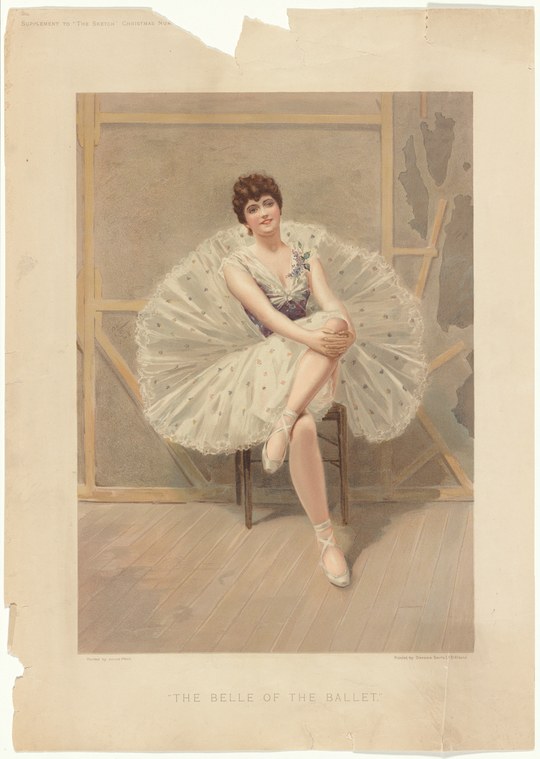
The belle of the ballet
Unknown artist
- Collection:
- Prints depicting dance
- Source:
- New York Public Library
- Rights:
- Public domain — free to use, share and adapt.
- Recorded as:
- Public Domain
This image documents how professional ballet dancers—particularly women—were celebrated and commodified through theatrical prints in the decades around 1900, when ballet was enjoying major cultural prominence. It shows the visual conventions used to present the ballet dancer as both an object of aesthetic appreciation and a skilled professional athlete, a tension that remains central to how ballet is understood and marketed today.
What you are looking at
A young female dancer sits poised on a wooden chair on a bare wooden stage, wearing a classical ballet tutu of white tulle with a fitted bodice decorated in what appears to be gold or jeweled embellishment. Her posture is demure and composed, with one knee raised and her foot arched in a ballet position, the other leg extended downward. She wears pale pink pointe shoes. Her dark hair is styled in an upswept Edwardian fashion, and her expression is serene, almost contemplative. The setting is a simple theatrical interior with a neutral beige wall behind her and a doorway or panel visible to the right. The lighting is soft and warm, characteristic of theatrical illustration of the period. This is clearly a portrait of a prima ballerina at rest, a moment of composed elegance rather than active performance.
The dancing
A single dancer, seated but maintaining balletic carriage and turnout even in stillness. Her supporting leg is bent at the knee with the foot on the floor; her other leg is extended with a pointed foot, demonstrating the muscular control required in ballet. Her arms are relaxed but graceful, one hand resting on her lap. The turned-out hip position and the precision of her pointed foot confirm trained classical ballet technique. Her port de corps—the way she holds her torso—shows the upright, elongated line demanded by Romantic and early twentieth-century ballet pedagogy.
The dance depicted
This is a portrait of a classical ballet dancer, most likely a professional of the theatrical stage. The white tutu, pointe shoes, and body position identify her as performing in the romantic or classical ballet tradition. The title 'The Belle of the Ballet' suggests this is a named professional or a role, and the composition—a private moment of a celebrated performer—was a popular subject in theatrical illustration and fine art of the late nineteenth and early twentieth centuries. The dress and styling suggest this dates to approximately the 1890s–1920s era. Without more information, the specific dancer, role, or ballet cannot be identified from the image alone.
How it was made
This is a color lithograph or chromolithograph, a process allowing detailed rendering of fabrics, skin tones, and theatrical lighting effects. The soft modeling of light on the white tulle, the warm tonality of the wooden stage floor, and the subtle gradation of background colors are characteristic of chromolithographic printing, which allowed for mass-market color theatrical prints and advertising materials. This technique would have made the image affordable and widely circulated as a theatrical souvenir or print, allowing audiences to own images of celebrated dancers.
About this work
This is a character study of a classical ballet dancer presented as a moment of private grace between performances or rehearsals. The work belongs to a rich tradition of theatrical portraiture that celebrated the new professional status of ballet dancers in the late nineteenth century, particularly female dancers who had become major celebrities. The image documents not only a style of dance—classical ballet with its pointe work and tutu—but also a moment in cultural history when the dancer's body became a subject worthy of fine art reproduction and public circulation. The work captures the professional identity of a ballet dancer at a moment when ballet had transitioned from court entertainment to a major urban theatrical art form.
How to look at it
Look at the stillness of this moment and what it tells you about ballet training. The dancer is seated, yet every muscle appears engaged—her turnout from the hip, her arched foot, her upright spine. This was a convention of theatrical portraiture of the period: to show the dancer in a moment of composed elegance rather than mid-performance, emphasizing grace and control rather than movement. The composition treats the dancer as a precious object, centrally placed on the stage. The artist has chosen to show her in private rather than in the energy of performance, suggesting that this is a portrait of celebrity and professional status as much as of dance technique.
The period
This work dates to the age of the prima ballerina as international celebrity. The late nineteenth and early twentieth centuries saw ballet transformed into a major theatrical and commercial enterprise, with dancers like Adèle Genée and Anna Pavlova becoming international stars whose images were mass-produced on postcards, in theatrical prints, and in illustrated journals. The clothing and styling visible here—the Gibson Girl–adjacent upswept hair, the Edwardian bodice detailing, the naturalistic flesh tones—place it in the 1890s–1920s period. This was also the era of the Ballets Russes (founded 1909), when ballet experienced a major artistic and commercial renaissance in Europe and America. Theatrical prints like this one were part of the broader commodification of theatrical entertainment for a growing urban middle-class audience.
Where it lives
This print is held in the New York Public Library's collection of prints depicting dance. It is a mass-produced theatrical print, likely sold as a souvenir or collectible during its period of circulation.
Dance in this work
Questions about this work
When was this print made?
The catalogue record does not specify a date. Based on the clothing, hairstyle, theatrical printing technique, and aesthetic conventions visible in the image, it was most likely produced between 1890 and 1925. The Edwardian styling and the chromolithographic printing process support this timeframe.
Who is the dancer in this image?
The catalogue record does not identify the specific dancer or performer. The title 'The Belle of the Ballet' is generic and does not refer to a known work or specific role. The image was likely produced as a commercial theatrical print celebrating an anonymous or generic 'prima ballerina,' making it typical of mass-market theatrical ephemera of the period.
What style of ballet is being shown?
This is classical ballet, performed en pointe with the turned-out positions and upright carriage characteristic of the late nineteenth-century romantic and classical ballet tradition. The white romantic tutu and jeweled bodice suggest a classical or fairy-tale role, typical of the standard repertory of the period.
Why is the dancer seated rather than in an active pose?
This reflects a convention of theatrical portraiture of the era: to present the dancer as a composed, elegant figure at rest rather than mid-movement. This poses her as an object of aesthetic appreciation and professional celebrity, emphasizing poise and status rather than physical virtuosity or dramatic action.
More dance artwork





