49 works in this view — arrow keys or swipe to move between them.
Dance in Art
Marie Taglioni (Sylphide)
Unknown artist
- Collection:
- Prints depicting dance
- Source:
- New York Public Library
- Rights:
- Public domain — free to use, share and adapt.
- Recorded as:
- Public Domain
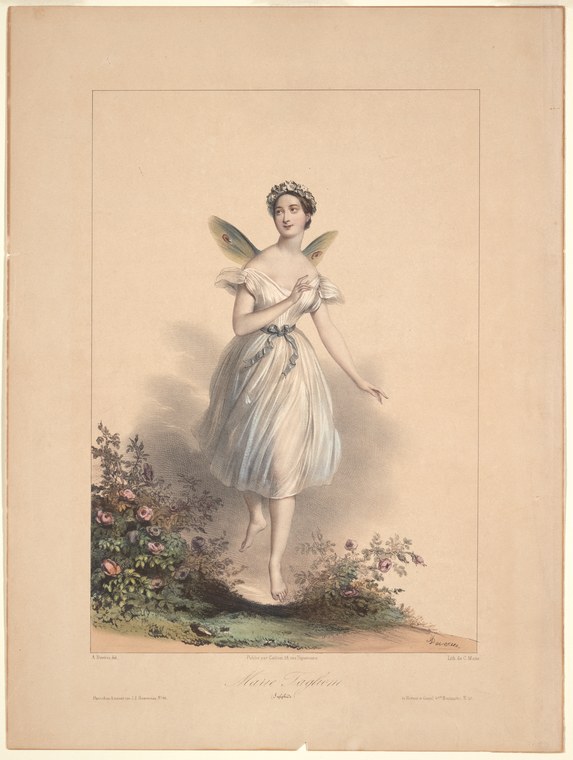
This image is evidence of how the Sylphide was actually performed in the nineteenth century—not as we reconstruct it today from notation and photographs, but as a contemporary artist saw it and chose to immortalize it. It shows the pose, the costume, the frame, and the ethereal quality that made the role revolutionary and that audiences were paying to see. For historians of ballet technique and Romantic aesthetics, it is primary source material.
What you are looking at
A young woman in a diaphanous white dress hovers weightlessly above a garden setting, her body angled upward in a graceful arabesque. She wears delicate fairy wings and a wreath or tiara in her dark hair, her arms extended in a gentle, open frame. Below her, dark foliage and flowering plants—roses or peonies—frame the lower portion of the composition, grounding the ethereal figure in a romantic garden. The figure appears to be caught mid-leap or in sustained flight, her toes just clear of the ground, creating an impression of otherworldly lightness. The soft, muted tones of the print—pale cream paper with delicate shading—enhance the dreamlike quality of the scene. This is a representation of the famous Sylphide role, the quintessential fairy character of Romantic ballet.
The dancing
The dancer is shown in a sustained arabesque or attitude, with her supporting leg straight and her free leg extended behind, the entire body elongated and weightless. Her arms are held in an open, gentle frame—one extended forward, one to the side—characteristic of classical ballet port de bras. Her upper body is lifted and turned, her gaze directed upward and to the side, away from the viewer. The positioning suggests both control and effortlessness, the paradox central to Romantic ballet technique. The fairy wings, small and translucent, are positioned on her back, and she appears to be en pointe or very nearly so, though the print's delicacy makes absolute certainty impossible.
The dance depicted
This is a portrait of the Sylphide, the title role of *La Sylphide*, the 1832 ballet that defined Romantic ballet and remains the oldest ballet in the active classical repertoire. The image documents how the role was performed in the early-to-mid nineteenth century, likely capturing the famous Danish dancer Marie Taglioni, who created the role and became synonymous with it for decades. The costume—the white tulle skirt, the translucence, the small wings—and the pose establish this as classical Romantic ballet, BAL-ROM. The suspension and weightlessness are the whole point: the Sylphide is a supernatural being, and Romantic ballet technique was deployed to make her appear to float above the mortal world.
How it was made
This is a hand-colored lithograph or engraving; the delicate line work, the soft gradations of tone, and the pale tinting are characteristic of mid-nineteenth-century theatrical portraiture. The technique allowed for mass production and wide circulation of images of celebrated dancers, making the work a form of fan culture and theatrical merchandise. The print preserves not only the costume and the arabesque, but also the artist's interpretation of the ethereal quality audiences sought in Romantic ballet—the soft shading and lack of harsh line work were deliberate choices to evoke the figure's supernatural character. This was a work made for consumption by a broad audience of opera-goers and ballet enthusiasts.
About this work
This is a portrait of the Sylphide, the central character of the 1832 ballet *La Sylphide*, one of the foundational works of Romantic ballet. The image shows a figure in a white tulle skirt and fairy wings, posed in an extended arabesque above a garden setting, capturing the aesthetic and technique that defined the role. The work is a hand-colored lithograph or engraving, a medium of mass circulation that made images of celebrated dancers accessible to the theatergoing public of the nineteenth century. It documents both a specific role and a historical moment in dance technique—the perfection of the illusion of weightlessness that was central to Romantic ballet's appeal.
How to look at it
The artist has chosen the moment of suspension—the dancer held aloft in an arabesque, weightless and still—which is the core visual fantasy of Romantic ballet. Note the careful positioning of the body: the supporting leg appears straight and secure, the free leg extended behind in perfect line, the upper body open and graceful. The small wings and the garden setting below anchor the figure as supernatural rather than human. The soft, almost dreamlike quality of the line and shading was deliberate: the artist was trying to capture not just the pose but the effect of magic that the technique was meant to create.
The period
This work dates to the height of Romantic ballet, a period when ballet was the dominant theatrical dance form in Europe and America, and when the fantasy and supernatural were standard subjects. *La Sylphide* premiered in Paris in 1832 and was performed and reperformed across Europe for decades; by the time this print was made, the Sylphide was one of the most famous roles in dance, and Marie Taglioni was its definitive interpreter. The print belongs to a vast industry of theatrical portraiture and merchandise that fed public appetite for images of celebrity dancers. This was the era before photography displaced lithography as the primary medium of theatrical documentation, making such prints the main visual record of nineteenth-century performance.
Where it lives
This print is held in the New York Public Library's collection of dance-related prints. It belongs to a widespread tradition of theatrical portraiture made for public sale and collection during the nineteenth century, when images of celebrated dancers were a standard form of theatrical merchandise and fan culture.
Dance in this work
Questions about this work
Was this actually Marie Taglioni?
The catalogue record attributes the work to 'Marie Taglioni (Sylphide)', which indicates it represents the Sylphide role, likely as performed by Taglioni, who created it and made it her signature. Without documentation of the artist or the print's original publication, we cannot confirm definitively that this is a portrait of Taglioni herself rather than another dancer in the role, but the association is strong.
How do we know this is the Sylphide and not some other fairy?
The title and the costume—the white tulle skirt, the small wings, the arabesque pose—are iconic to the Sylphide role in the 1832 ballet *La Sylphide*. This image became the canonical visual representation of the role and was reproduced and imitated many times. No other nineteenth-century ballet role had quite this iconic image.
Is the dancer actually on pointe?
The print's soft line work makes absolute certainty difficult, but the positioning of the foot and ankle suggests she is en pointe or very nearly so. This was still a relatively new technique in 1832—Taglioni was famous for her mastery of pointe work—and the artist may have wanted to emphasize the lightness this created.
What makes this Romantic ballet and not something else?
The costume (white tulle, wings), the supernatural subject (a fairy), the arabesque pose, the ethereal aesthetic, and the historical context all mark this as Romantic ballet. The role itself is one of the founding works of the Romantic ballet era, and its visual language—delicate, weightless, otherworldly—became the template for the period.
More dance artwork





