49 works in this view — arrow keys or swipe to move between them.
Dance in Art
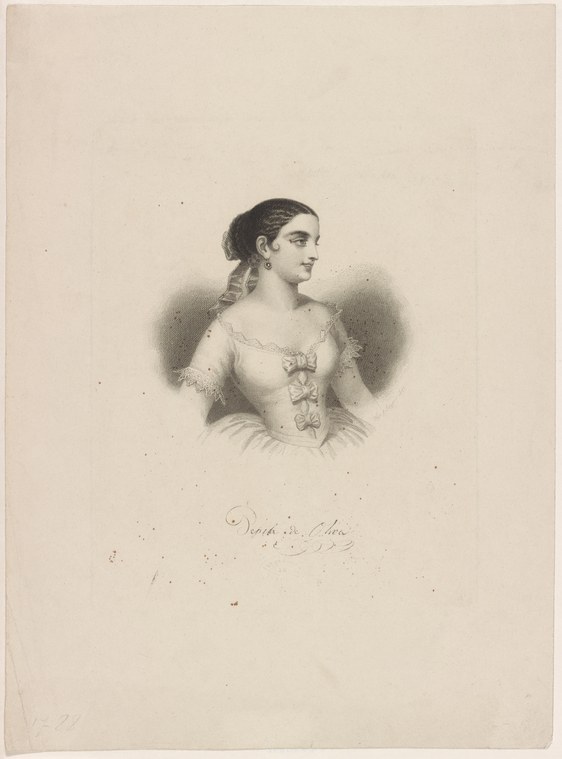
Pepita de Oliva [facsimile signature]
Unknown artist
- Collection:
- Prints depicting dance
- Source:
- New York Public Library
- Rights:
- Public domain — free to use, share and adapt.
- Recorded as:
- Public Domain
Pepita de Oliva is relatively unknown in modern dance history, but this portrait is evidence of her contemporary fame and of the international circulation of dancers in the romantic-ballet period. Such prints reveal how dancers were marketed and remembered by their audiences—as attractive public figures whose likenesses were worth printing and collecting.
What you are looking at
A half-length portrait of a young woman shown in profile facing left, rendered in a soft stippled or mezzotint technique that creates luminous modeling of the face and shoulders. She wears her dark hair pulled back in a simple arrangement, and is dressed in a low-cut bodice with decorative lacing or ribbon detail down the center front—a costume element suggesting theatrical or balletic dress rather than street wear. The figure emerges from a diffuse background rendered in warm tones, with a subtle halo or vignette effect around the shoulders. Below the portrait, in a delicate script hand, appears a signature or inscription reading 'Pepita de Oliva.' The entire composition has the character of a theatrical portrait or celebrity print, the kind of popular graphic that would have circulated as a souvenir of a celebrated performer.
The dancing
The woman is presented in a static three-quarter turn, her body relaxed and her gaze directed away from the viewer. There is no active gesture or indication of movement; this is a portrait pose rather than a dance pose. The exposed shoulders and neckline, together with the gathered or corseted bodice, suggest a costume, but the figure does not demonstrate any particular technique or hold. The low-cut dress and theatrical styling are consistent with romantic-era ballet costume, though the portrait format does not allow assessment of footwork or lower-body alignment.
The dance depicted
The inscription 'Pepita de Oliva' identifies this as a portrait of a named performer, likely a dancer of some renown in the early to mid-nineteenth century. The costume—a low-cut bodice with decorative front lacing—is consistent with romantic ballet dress of the 1830s–1850s, the period when Spanish or Latin American dancers performing in Europe often took prominent roles. Without additional documentation, the specific dance or role cannot be determined from the portrait alone. The work appears to be a commemorative print of a celebrated dancer, in the tradition of theater publicity and fan imagery.
How it was made
This is a stipple engraving or mezzotint, a printmaking technique that uses fine dots or burrs to create tonal gradation and the illusion of luminosity—especially suited to the rendering of skin and fabric with subtle shading. The softness of the technique and the warm background wash suggest a hand-colored or tinted print. Such prints were affordable and widely circulated, allowing popular performers to distribute their likenesses to admirers and the general public. The delicate, intimate quality of the rendering would have made this an appealing souvenir for theater-goers.
About this work
This is a commemorative portrait print of Pepita de Oliva, a performer of the romantic era, created in the stipple or mezzotint technique favored for celebrity portraiture in the nineteenth century. The costume—a low-cut theatrical bodice—and the formal inscription suggest she was a dancer of sufficient prominence to warrant a commercial portrait series. The work belongs in a gallery of dance imagery because it documents not just the visual appearance of a historical performer, but also the apparatus by which dancers became public figures: through printed likenesses that circulated among audiences and created a market for celebrity.
How to look at it
Observe the costume detail—the low neckline and decorative front lacing typical of romantic-ballet dress—which anchors this image in a specific period and genre. Notice the artist's attention to the texture of skin and fabric through the stipple technique, which creates an illusion of soft luminosity particularly suited to flattering theatrical portraiture. The profile pose and the averted gaze present the subject as an object of admiration rather than as an actor in a moment of movement, which is characteristic of romantic-era performer portraiture.
The period
This print dates to the romantic era of ballet (approximately 1830–1860), when ballet became a major form of popular entertainment in Europe and the Americas. During this period, celebrated ballerinas—including Spanish and Latin American dancers—achieved star status comparable to modern celebrities, and their portraits were produced and distributed in large numbers. The soft, flattering style of the mezzotint and the theatrical costume reflect the aesthetics and marketing practices of romantic theater. The inscription 'Pepita de Oliva' in Spanish suggests a performer of Iberian or Latin American origin performing in a European or transatlantic context.
Where it lives
The work is held in the New York Public Library's collection of prints depicting dance. It is a commercial portrait print, one of many such likenesses produced and distributed during the romantic-ballet era to satisfy public demand for images of celebrated performers.
Dance in this work
Questions about this work
Who was Pepita de Oliva?
The inscription identifies her as a performer in the romantic-ballet period, likely a dancer of Spanish or Latin American origin who performed in Europe. The commemorative portrait print suggests she achieved sufficient celebrity to warrant commercial reproduction and distribution. Beyond the inscription and costume, further details about her career and roles would require additional historical documentation.
What technique was used to make this print?
This is a stipple engraving or mezzotint, a tonal printmaking method using fine dots or burrs to create gradations of light and shade. The technique was especially favored for portrait work because it could render skin and delicate fabrics with soft, flattering modeling. Such prints were typically hand-colored or tinted, as appears to be the case here.
What does the costume tell us?
The low-cut bodice with decorative ribbon or lacing down the front is consistent with romantic-ballet dress of the 1830s–1850s. This type of costume appeared in major roles in works like La Sylphide and Giselle. The theatrical styling confirms that Oliva was a dancer, and the quality of the portrait print suggests she was a celebrated performer of her day.
More dance artwork





