49 works in this view — arrow keys or swipe to move between them.
Dance in Art
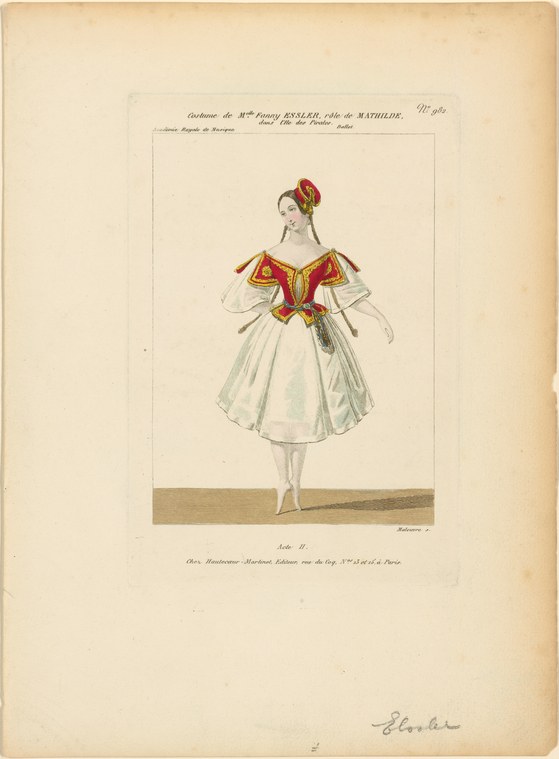
Costume de Melle. Fanny Essler [sic] rôle de Mathilde, dans L'ile des pirates. Ballet. Académie Royale de Musique
Unknown artist
- Collection:
- Prints depicting dance
- Source:
- New York Public Library
- Rights:
- Public domain — free to use, share and adapt.
- Recorded as:
- Public Domain
Fanny Elssler was a legend in her lifetime and remains central to the history of Romantic ballet. This print documents one of her roles and preserves the visual record of a major European ballet that was central to the repertory of the 1830s but has not survived. Costume plates like this are often the only visual evidence of how ballets were actually staged during the Romantic era.
What you are looking at
A single female figure stands in profile against a plain tan ground, wearing the costume of a Romantic-era ballet dancer. She is dressed in a white or pale tulle skirt of mid-calf length with a full, gathered silhouette, worn over the typical ballet pointe shoe of the period. Her bodice is a striking red velvet or silk material with gold braid trim and off-the-shoulder sleeves that fall away from the arms in the characteristic Romantic style. Her hair is styled up and adorned with a red ornament or tiara. She holds one arm extended gracefully to the side, the other resting naturally, in the pose typical of ballet costume plates. The figure is rendered in colored lithograph or engraving, with fine detail to the embroidery and textile work; the simplified background allows the costume to dominate the composition. This is clearly a costume design or performance record rather than a scene of action—a single dancer presented in a formal, frontal manner for documentation or reference.
The dancing
The dancer stands in a relaxed, frontal pose with minimal indication of balletic technique—no turned-out positions or lifted épaulement are marked. One arm extends gracefully outward at about shoulder height; the other hangs at her side. The posture is upright but not dramatically engaged, suggesting the pose is chosen to display the costume rather than demonstrate the dancer's virtuosity. The figure's stance is light and the proportions are elegant, but there is little articulation of the feet or indication of weight distribution that would suggest active dancing.
The dance depicted
This is a costume design for Fanny Elssler in the role of Mathilde from the ballet L'île des pirates (The Pirate Island). Fanny Elssler was one of the greatest Romantic-era ballet dancers, famous for her dramatic presence and technical brilliance; she was particularly celebrated for roles combining classical technique with character and narrative. L'île des pirates was a three-act ballet choreographed by Jean-Auguste Vestris and performed at the Académie Royale de Musique (Paris Opéra) in the 1830s. The ballet belonged to the tradition of Romantic narrative ballet, with exotic or dramatic settings and opportunities for both classical and demi-caractère dance. The costume—with its red velvet bodice and white tulle skirt—suggests a role of some importance or exotic character, departing from the pure classical white gown of a prima ballerina in a classical role. The image documents how this character was staged, not how it was performed.
How it was made
This is a hand-colored lithograph or engraving from the early-to-mid 19th century, a standard format for theatrical costume documentation of the period. Such prints were produced for a wide audience—dancers, choreographers, costume makers, theater-goers, and collectors—and could be issued individually or in series. The coloring is applied by hand, which accounts for minor variations in tone. The technique allowed for rapid dissemination of costume designs and performance records; these prints served as both artistic products and practical reference documents for how roles should be staged, and they remain valuable evidence of 19th-century performance practice.
About this work
This is a costume documentation print from the Romantic ballet era, recording the stage dress of one of the 19th century's most celebrated dancers in a narrative ballet that is now lost to the repertory. Fanny Elssler's career defined Romantic ballet in its most dramatic and virtuosic phase, and her roles were copied, debated, and imitated across Europe. L'île des pirates, while no longer performed, belonged to the golden age of the Paris Opéra and the emergence of the exotic and supernatural themes that characterized Romantic choreography.
The print itself is both a work of art and a historical document. It captures the specificity of 19th-century stage costume—the precise arrangement of trim, the weight and shape of the skirt, the height of the bodice—with a clarity that photographs could not yet provide. For costume historians and dance scholars, such prints are primary evidence of how roles were materialized on stage; for theater makers, they are inspiration and instruction.
How to look at it
Look at the costume in detail: the exact cut and proportion of the skirt, the placement of the trim, the style of the sleeves, the footwear. These details are recorded with precision because they mattered—they shaped how the dancer moved and how the role was recognized. The pose is formal and static, designed to display the costume clearly, not to capture a moment of dancing; this is a reference image, not a scene. The warm tones of the red bodice against the pale skirt create visual drama even in stillness, a balance Romantic costume design often achieved.
The artist
The print is attributed to the Académie Royale de Musique and would have been produced within or under the auspices of that institution. The artist is not recorded in the catalogue. Such prints were typically commissioned by theaters or published by print dealers in Paris and distributed to audiences, subscribers, and theater professionals. The level of finish and the formal presentation suggest this was an official or semi-official publication.
The period
This print dates to the 1830s, the height of the Romantic ballet era. The Paris Opéra was the center of ballet innovation and prestige in Europe; major new ballets premiered there and were copied or adapted across the continent. The Romantic period saw the emergence of the ethereal, supernatural heroine (as in La Sylphide, 1832) alongside roles of dramatic character and passion. Exotic settings—pirates, brigands, Eastern harems—were popular sources for narrative ballets. Fanny Elssler, who danced from the 1820s through the 1850s, represented the pinnacle of Romantic technique and star power; she was celebrated for her dramatic intensity, her elevation, and her ability to master both classical and character dances. Costume prints were a major form of theatrical publicity and documentation, and the preservation of such images is essential to our understanding of 19th-century stage practice.
Where it lives
The print is held in the Library of Congress (via NYPL collections). It belongs to a series of dance costume documentation prints produced in France during the 19th century, many of which survive in institutional collections. Such prints were issued individually and collected; they served as souvenirs of famous performances and as reference materials for theatrical professionals.
Dance in this work
Questions about this work
Who was Fanny Elssler?
Fanny Elssler (1810–1884) was an Austrian dancer who became one of Europe's greatest stars of the Romantic era. She danced at the Paris Opéra, London, and the United States, and was celebrated for her dramatic presence, technical brilliance, and charisma. She specialized in both classical roles and character dances and was known for her rivalry (in public perception) with Marie Taglioni, the other major ballet star of the era. She retired in 1851 at the height of her fame.
What was L'île des pirates?
L'île des pirates was a three-act ballet choreographed by Jean-Auguste Vestris and first performed at the Paris Opéra in 1835. It was a narrative ballet with an exotic setting—a pirate island—and combined classical and character dancing. Like many ballets of the Romantic era, it has not survived in the active repertory, and we rely on prints, playbills, and written descriptions to understand how it was staged and performed.
What was a Romantic ballet?
Romantic ballet emerged in the 1830s and dominated European ballet through the 1850s. It was characterized by ethereal heroines (often supernatural beings—sylphs, spirits, ghosts), exotic or fantastical settings, and a focus on the dancer's ability to seem weightless and otherworldly. Major works include La Sylphide (1832) and Giselle (1841). The aesthetic and technique of Romantic ballet continue to shape classical ballet training today.
Why are costume prints historically important?
Costume prints documented how roles were actually staged and dressed, providing visual evidence of 19th-century performance practice. Before photography became common, these prints were the clearest record of costume design, the arrangement of trims and silhouettes, and the appearance of roles. For scholars and costume makers, they are primary sources; for modern dancers and choreographers, they are evidence of how their predecessors worked.
More dance artwork





