49 works in this view — arrow keys or swipe to move between them.
Dance in Art
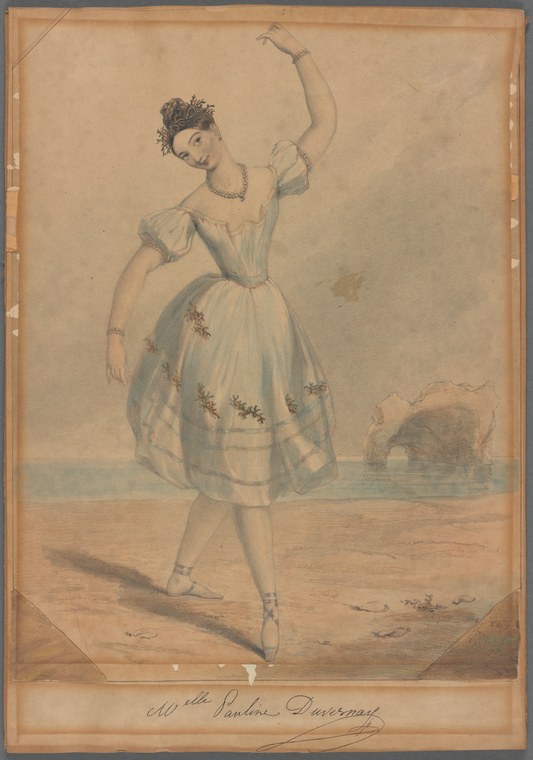
Melle. Pauline Duvernay
Unknown artist
- Collection:
- Prints depicting dance
- Source:
- New York Public Library
- Rights:
- Public domain — free to use, share and adapt.
- Recorded as:
- Public Domain
This print documents a major star of Romantic ballet at the moment of her fame and provides rare visual evidence of how classical ballet technique and the dancer's body were understood and represented in the 1830s–1840s. For dance historians, it is a window into the technical and aesthetic priorities of the Romantic era, capturing both the physical vocabulary of ballet and the commercial apparatus through which dance was promoted and preserved in the period before photography.
What you are looking at
A young female dancer stands alone on a bare stage or practice floor, posed in a moment of balletic extension. She wears a pale muslin dress with puffed sleeves and a fitted bodice, decorated with scattered floral sprigs or embroidery across the skirt, and her dark hair is gathered up and adorned. Her left arm is raised gracefully overhead, her body angled in a classical contrapposto, while her right leg is bent and her left is extended in a supported position. She stands en pointe or near-pointe on her right foot, her body creating an elegant diagonal line from her extended arm to her positioned legs. The setting is minimal and undefined—a warm, peachy-tan background suggesting stage lighting or the tone of aged paper—with no scenery, props, or other dancers visible. A simple line sketches what may be architectural elements or stage furnishings in the middle distance. The work has the quality of a theatrical study or souvenir print, and the inscription at the bottom identifies the subject.
The dancing
A single dancer is shown in three-quarter profile, weight balanced on the supporting leg with the free leg bent and held close to the body. Her raised arm extends upward with fingers extended, creating an open frame typical of classical ballet. The dancer's torso is held upright but with a slight forward tilt to the raised arm, suggesting the moment of a sustained pose rather than active motion through space. Her footwork is not definitively clear in the image, though the positioning of the supporting leg suggests a turned-out, classical stance. The dancer's proportions, posture, and the deliberateness of the pose indicate a trained performer executing a recognized movement vocabulary.
The dance depicted
This is a Romantic-era ballet study, almost certainly depicting a moment from one of the showpiece variations or solos typical of 1830s–1840s ballet. The costume—pale muslin with floral decoration—is characteristic of the pointe-work era and of the sylph or ethereal female dancer roles that dominated Romantic ballet. The inscription names Pauline Duvernay, a celebrated dancer of that period, suggesting this is a portrait study of her in a famous role or characteristic pose. The image captures the grammar of classical ballet as it was performed in the early nineteenth century: turned-out positions, vertical carriage, raised arms, and the cultivation of seeming weightlessness. Without identifying the specific ballet, the image speaks to the aesthetic ideals of Romantic-era dance—the emphasis on technical control, ethereal beauty, and the female dancer as the primary vehicle of theatrical spectacle.
How it was made
This is a hand-colored print, most likely a lithograph or engraving produced in the 1830s or 1840s, executed in a technique that permitted rapid, affordable circulation. The artist has used soft shading in sepia or brown tones over a delicate linear framework, with subtle hand-coloring of the dress and background tones. The inscription at the bottom in cursive script suggests this was a commercial theatrical print—a souvenir of a famous performance or dancer, intended for sale to the ballet-going public. The pale, translucent quality of the rendering and the warmth of the paper tone are consistent with lithography as practiced for theatrical portraiture in this period. The economy of the image—clear, legible, not ostentatiously detailed—indicates a work designed for reproducibility and wide distribution, a staple of theatrical publicity and dance documentation in the early nineteenth century.
About this work
This is a study of the celebrated Romantic-era dancer Pauline Duvernay, captured in a characteristic pose of early nineteenth-century classical ballet. The print documents both the technical vocabulary of ballet as it was danced in the 1830s–1840s and the theatrical persona of the female dancer at the height of the Romantic era. The image is at once a portrait of an individual performer and a statement about the visual and physical ideals of the period—ethereal grace, technical mastery, and the transformation of the female body into an instrument of theatrical illusion. As a printed artifact, it belongs to the culture of theatrical publicity and fan documentation that surrounded the Romantic ballet, and it serves as a record of how these dances were publicized and remembered by audiences of the time.
How to look at it
Look first at the posture of the dancer's torso and the precision of her arm and leg placement. The raised arm and extended limb, the turned-out stance, and the lifted carriage are all hallmarks of classical ballet vocabulary, and the artist has captured them with clarity and care. Observe how the pale, delicate dress and the dancer's upright bearing emphasize the aesthetics of Romantic-era ballet—the cultivation of seeming effortlessness and grace. Notice the minimal, undefined setting: the artist has chosen to isolate the dancer against a nearly empty stage, focusing attention entirely on her body and technique rather than on dramatic context or narrative. This was a convention of theatrical portraiture in the period—to show the dancer as a type or ideal rather than in the full context of a ballet.
The artist
The artist is not recorded in the catalogue. The style and technique are consistent with commercial theatrical printmaking of the 1830s–1840s, a field in which many skilled but uncredited artisans worked to produce souvenir prints and portraits for the theater-going public. Such prints were often produced by workshops or studios that specialized in ballet imagery, and the quality of the draftsmanship and the precision of the pose suggest a practitioner familiar with ballet and its conventions.
The period
This print was made during the height of the Romantic ballet era, a period when ballet underwent a profound transformation in its aesthetic ideals and technical practice. The 1820s–1840s saw the rise of the Romantic ballet, with works like La Sylphide (1832) and Giselle (1841) establishing a new vocabulary of weightlessness, ethereality, and supernatural subject matter centered on the female dancer. This was also the era of the 'ballerina' as a distinct public figure and object of desire—celebrated dancers like Marie Taglioni, Fanny Elssler, and Pauline Duvernay became international stars, and their likenesses were widely circulated in prints, playbills, and other ephemera. The rise of lithography and commercial printmaking made these images affordable and widely accessible, turning ballet dancers into commodities and cultural icons in a newly modern way.
Where it lives
This is a hand-colored theatrical print from the collection of prints depicting dance at the New York Public Library. Such prints were produced in large numbers during the nineteenth century as cheap, reproducible souvenirs for theater audiences, and many have survived in institutional collections.
Dance in this work
Questions about this work
Who was Pauline Duvernay?
Pauline Duvernay (1813–1894) was a celebrated French ballet dancer of the Romantic era, known for her technical skill and theatrical presence. She was a major star of the 1830s and 1840s, dancing in the principal European theaters and achieving the international fame typical of Romantic-era ballerinas. She eventually left the stage to marry a nobleman and became politically active in later life.
What does 'Romantic ballet' mean?
Romantic ballet was a distinct aesthetic and technical movement in dance that emerged in the 1820s–1830s and dominated the nineteenth century. It emphasized ethereality, otherworldly beauty, and supernatural subject matter, and it placed the female dancer at the center of theatrical spectacle. Key works include La Sylphide and Giselle. The Romantic era also saw major developments in pointe-work technique and in the cultivation of a new ideal of feminine grace and weightlessness.
Why was she printed and distributed so widely?
By the early nineteenth century, lithography and commercial printmaking had made theatrical portraiture affordable and reproducible. Major dancers became public figures and objects of intense fan interest, and prints of their likenesses were sold as souvenirs at theaters and through the print trade. These prints served as both publicity for the dancers and theater companies, and as mementos for audiences who wished to preserve images of their favorite performers.
Can you tell from the image what specific ballet this is from?
Not with certainty. The pale muslin dress and the dancer's pose are consistent with several roles typical of Romantic-era ballet—sylph roles, or variations from ballets centered on ethereal female characters. The image is a generalized portrait study rather than a scene from a specific ballet, designed to show Duvernay in a characteristic pose that would be recognizable to audiences of her time.
More dance artwork





