49 works in this view — arrow keys or swipe to move between them.
Dance in Art
Selected plates from Les maîtres de l'affiche
Unknown artist
- Collection:
- Prints depicting dance
- Source:
- New York Public Library
- Rights:
- Public domain — free to use, share and adapt.
- Recorded as:
- Public Domain
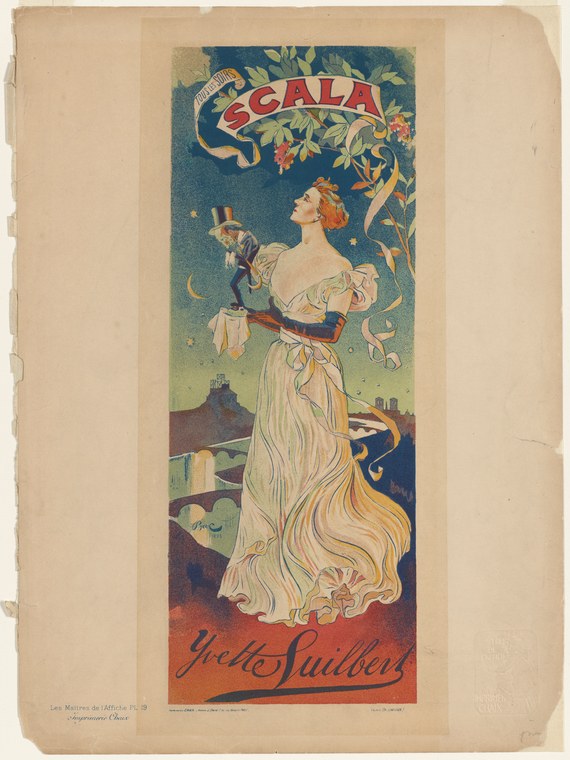
The work captures a pivotal moment in dance history when theatrical performance became inseparable from graphic design and commercial visual culture. For historians of early twentieth-century dance, it documents the costume, posture, and social context of café and cabaret performance—the spaces where modern dance was being shaped, outside the academy. It shows how dance was imagined and marketed to the public through the medium of the poster.
What you are looking at
A tall, graceful female figure dominates the composition, dressed in a flowing white gown with draped fabric that pools around her feet and trails behind her. She stands in a classical contrapposto pose, her upper body turned slightly to one side, her gaze upward and to the left. Her right arm is raised and extended, holding what appears to be a champagne glass or goblet; her left arm rests across her body. The figure is set against a night sky rendered in deep blue, with a crescent moon visible in the background. To her right, decorative climbing vines or ivy with pink flowers frame the composition, while a distant landscape with buildings silhouettes appears at the horizon. The overall mood is ethereal and celebratory, with an art nouveau sensibility. The signature "Scala" appears in red letters at the top, and "Udo Stillman" is signed at the bottom.
The dancing
The dancer's body displays the elongated, swaying elegance characteristic of early twentieth-century theatrical presentation. Her weight appears concentrated on one leg, allowing the other to extend subtly, creating a sense of fluid movement despite the static pose. The raised arm and uplifted gaze suggest a moment of reverie or celebration rather than active choreography. Her bearing is that of a solo performer, possibly addressing an audience or a moment of personal triumph, rather than a dancer engaged with a partner or ensemble.
The dance depicted
This appears to represent theatrical dance as performed in early twentieth-century European café and cabaret culture rather than concert ballet or folk tradition. The champagne glass and nocturnal setting suggest the world of entertainment venues, music halls, or fashionable social dancing of the Belle Époque and Edwardian era. The figure's pose—formal yet sensual, celebratory yet contemplative—suggests a moment between dances or a posed studio photograph rather than an active choreographic sequence. The work documents social performance practice of this period rather than codified technique.
How it was made
This is a colour lithograph from *Les Maîtres de l'affiche* (The Masters of the Poster), a series that reproduced the finest poster art of the 1890s and 1900s. Lithography allowed subtle gradations of colour and tone, visible here in the sky's blue-to-green transition and the delicate rendering of the drapery. The technique was ideal for poster reproduction and ensured wide circulation among collectors and the design-conscious public. The inclusion in this prestigious series indicates the work's recognition as exemplary design of its period.
About this work
This colour lithograph celebrates the aesthetics of Belle Époque theatrical entertainment, capturing the figure of a performer in a moment of elegant repose. The work belongs to the final flowering of art nouveau design, when commercial poster art achieved recognition as high art. It documents not a specific choreography but rather the cultural mythology of early twentieth-century performance—the ideal of the glamorous, solitary dancer as symbol of leisure, luxury, and refined entertainment. The image survived as a plate in *Les Maîtres de l'affiche*, meaning it was considered worthy of preservation alongside work by Toulouse-Lautrec, Mucha, and Chéret.
How to look at it
Attend to the figure's raised arm and uplifted gaze, which frame a moment of pause and reverie rather than movement. The champagne glass signals the social context—this is entertainment for pleasure and spectacle. The treatment of drapery is crucial: the fabric's flow and weight suggest both the elegance of classical dress and the sensuality of performance costume. The nocturnal setting and distant cityscape elevate this from a simple portrait to a scene of urban glamour and desire. The artist has chosen a moment of stillness that evokes motion through posture and line.
The artist
The artist is not recorded in the catalogue. The work appears in *Les Maîtres de l'affiche*, which reproduced posters from c. 1890–1900 by leading designers of the art nouveau movement. The signature "Udo Stillman" at the bottom may indicate the artist, though this has not been confirmed. Styles and iconography are consistent with the commercial poster workshops of Paris during this period.
The period
This work dates to the final decades of the nineteenth century or the first decade of the twentieth, a period of extraordinary innovation in both poster design and performance culture. The Belle Époque saw the rise of the cabaret (the Moulin Rouge opened in 1889), the music hall, and café-concert as dominant forms of popular entertainment. Theatre, dance, and visual art were deeply entangled: Toulouse-Lautrec's posters documented the same performance world. Meanwhile, classical ballet was undergoing radical revision through Diaghilev and the Ballets Russes (founded 1909), though this work represents a different, more commercial and social sphere of dance practice.
Where it lives
This work is housed in the New York Public Library's collection of prints depicting dance. It is a reproduction plate from *Les Maîtres de l'affiche*, an album series that collected and celebrated poster design from the 1890s and 1900s.
Dance in this work
Questions about this work
Is this a real performance or posed for the poster?
It is designed as a poster—a commercial artwork meant to advertise an entertainment or celebrate the aesthetics of performance. Whether it depicts an actual performer or an idealized figure is unclear, but the pose is carefully constructed for visual impact rather than documentary realism. The work belongs to a tradition of theatrical posters that blended promotion with art.
What dance is being shown?
No specific dance or choreography is identifiable. The work documents the social world and visual culture of early twentieth-century theatrical entertainment rather than a particular style or technique. The figure's pose and costume suggest café-concert or cabaret performance, but the artist's intention was to capture an ideal image of the performer rather than to illustrate a specific movement.
Why is this in a dance collection?
It documents how dance and performance were imagined, marketed, and consumed in the Belle Époque. For historians, it is evidence of costume, posture, and the cultural context of non-academic performance. It belongs to a broader conversation about dance in visual culture and the relationship between performers and the commercial image-making industries that surrounded them.
More dance artwork





