49 works in this view — arrow keys or swipe to move between them.
Dance in Art
Selected plates from Les maîtres de l'affiche
Unknown artist
- Collection:
- Prints depicting dance
- Source:
- New York Public Library
- Rights:
- Public domain — free to use, share and adapt.
- Recorded as:
- Public Domain
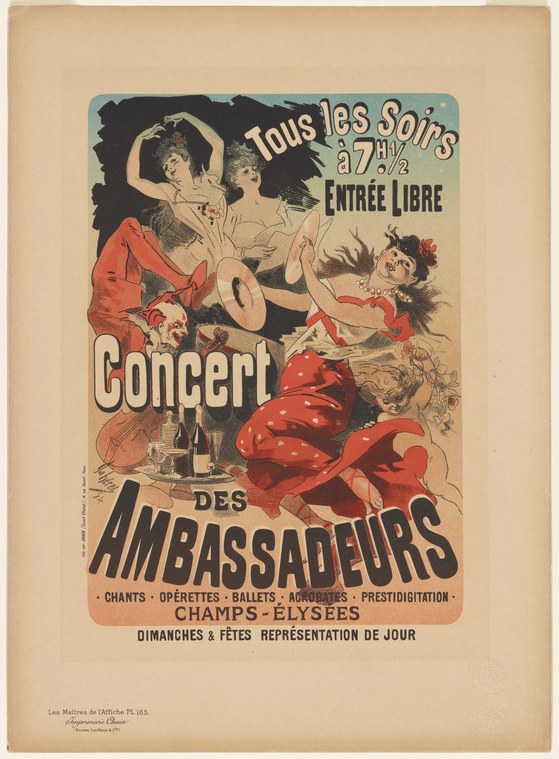
This poster documents the visual culture of Belle Époque cabaret—a crucial moment when stage dancing became mass entertainment and visual spectacle. It shows how artists and entrepreneurs represented dance to the public: not as refined classical art but as thrilling, sensual, accessible entertainment. For historians of performance, urban culture, and the rise of modernism, this image records both the dances performed and the visual language used to sell them.
What you are looking at
This is a vibrant Belle Époque poster advertising nightly concerts at the Ambassadeurs, a Paris venue. The composition is crowded with overlapping figures: three women dominate the upper register—two shown from behind with arms raised or posed elegantly, their bodies rendered in pale flesh tones against dramatic black silhouettes. A third woman in the center looks outward. Below them, a woman in brilliant red dominates the lower half of the frame, her pose theatrical and commanding, one leg extended in a high, open position. A cherub or putto figure appears at lower right. The color palette is restricted but bold: flesh tones, black, vivid red, and blue-grey backgrounds create strong contrast. The lettering announces "Tous les Soirs à 7 1/2" (every evening at 7:30) and "Entrée Libre" (free admission), with smaller text listing the program: songs, operettas, ballets, interludes, and "prestidigation" (magic acts). The style is unmistakably Art Nouveau, with sinuous lines, decorative typography, and a composition that treats text and image as unified ornamental whole.
The dancing
The central figure in red exhibits an extended leg position suggesting either a high kick or attitude, with her torso arched and arms in an open, dramatic frame—a posture associated with theatrical dancing of the 1890s-1900s. The women in the upper portion show less defined movement but graceful arm positions and upright carriage consistent with stage performance. Their poses are elegantly disjointed, suggesting different moments of a performance frozen together rather than a unified step. The composition prioritizes visual spectacle and allure over anatomical precision in movement.
The dance depicted
The poster advertises a cabaret or music-hall venue offering mixed entertainment rather than a single dance form. The red-dressed figure's extended leg and dramatic port de bras suggest cancan or other high-energy stage dances popular at Parisian venues of this era, though the pose is presented as theatrical display rather than documentary. The listing of "ballets" alongside operettas and songs indicates this was a variety program rather than classical ballet. The style and setting point to Belle Époque cabaret culture—entertainment designed for popular consumption and social mixing, characteristic of venues like the Moulin Rouge, the Folies-Bergère, and similar establishments where the can-can and related dances had found mass audience.
How it was made
This is a color lithograph, a technique ideal for poster production in the 1890s—mass-reproducible, capable of bold color effects, and economical enough for street advertising. Lithography allowed the artist to work directly with brushes and crayon on stone, enabling the painterly quality visible here alongside crisp graphic lettering. The bold color areas, limited palette, and strong line work are characteristic of Art Nouveau graphic design, which exploited lithography's strengths. This technology ensured wide circulation among Paris's urban population.
About this work
This is a Belle Époque entertainment poster advertising the Ambassadeurs, a Paris cabaret or music hall, likely from the 1890s or early 1900s. It is a color lithograph in the Art Nouveau style, treating dance and other theatrical acts as visual attractions for a popular urban audience. The poster conflates several performance types—ballet, operetta, magic—under a single aesthetic of spectacle. The dancing figure, rendered in brilliant red against dark grounds, exemplifies how fin-de-siècle Paris visualized stage entertainment: theatrical, sensual, accessible, and ornamental. It belongs in a dance gallery as evidence of how dance appeared in popular visual culture, what venues offered, and how artists marketed movement to urban audiences.
How to look at it
Attend to the pose of the red-dressed figure—the extended leg and arched torso represent a specific theatrical moment, one designed to thrill and arrest attention rather than convey sustained technique. Notice how the composition fragments the dancing body across multiple registers: the pose is not naturalistic but assembled from striking attitudes. The bold color, the dark silhouettes, and the legible typography are all calculated to work from a distance on a street wall. This is not a picture of dance for connoisseurs; it is dance designed as visual spectacle for a paying public.
The artist
The work is part of 'Les maîtres de l'affiche' (Masters of the Poster), an important series of poster reproductions published in France in the 1890s-1900s documenting the golden age of artistic poster design. The individual artist is not recorded in the catalogue, but the poster itself was created for the Ambassadeurs by designers working in the fashionable Art Nouveau idiom. The series 'Les maîtres de l'affiche' was itself a significant cultural artifact, demonstrating that posters had become recognized as art worthy of collection and study.
The period
This poster dates to the Belle Époque (roughly 1870–1914), a period of rapid urban growth, technological innovation, and popular entertainment in Paris. Music halls, cabarets, and dance venues proliferated, becoming central to Parisian social life. The can-can and related dances had emerged as symbols of Parisian modernity and transgression. Simultaneously, Art Nouveau became the dominant aesthetic for commercial design, print, and ornament. Dance in this era was not primarily a concert or classical art; it was embedded in cabaret and variety entertainment, reaching broad urban audiences. The poster represents the moment when dance and visual art converged in commercial popular culture.
Where it lives
This is a reproduction from 'Les maîtres de l'affiche', a portfolio series published in Paris in the 1890s–1900s that collected and archived significant poster designs of the period. The collection is held by the New York Public Library. It represents the work as a document of commercial culture rather than fine art.
Dance in this work
Questions about this work
What was the Ambassadeurs?
The Ambassadeurs was a music hall or cabaret in Paris offering mixed entertainment: songs, operettas, ballets, interludes, and magic acts. It was one of several venues competing for urban audiences in the Belle Époque. The poster's advertisement of free admission suggests a venue seeking to draw crowds—typical of music halls that profited from drink and gambling rather than ticket sales alone.
Is this cancan?
The extended leg position and theatrical pose are consistent with cancan and related high-energy stage dances, but the poster does not name a specific dance. It advertises 'ballets' generically. The figure's pose is presented as a moment of display rather than documentary of actual steps. For Belle Époque cabarets, 'ballet' often meant any staged dance act.
Why is there a cherub in the design?
The putto at lower right is a decorative element typical of Art Nouveau ornament, borrowed from fine art and classical tradition. Its inclusion lends the entertainment a veneer of artistic legitimacy and cultural aspiration—the venue is not mere vulgarity but art.
What is 'Les maîtres de l'affiche'?
A portfolio series published in the 1890s–1900s that collected and reproduced significant French poster designs. Its publication demonstrated that posters had become recognized as worthy of cultural study and collection—a recognition that commercial graphic design was an art form.
More dance artwork





