49 works in this view — arrow keys or swipe to move between them.
Dance in Art
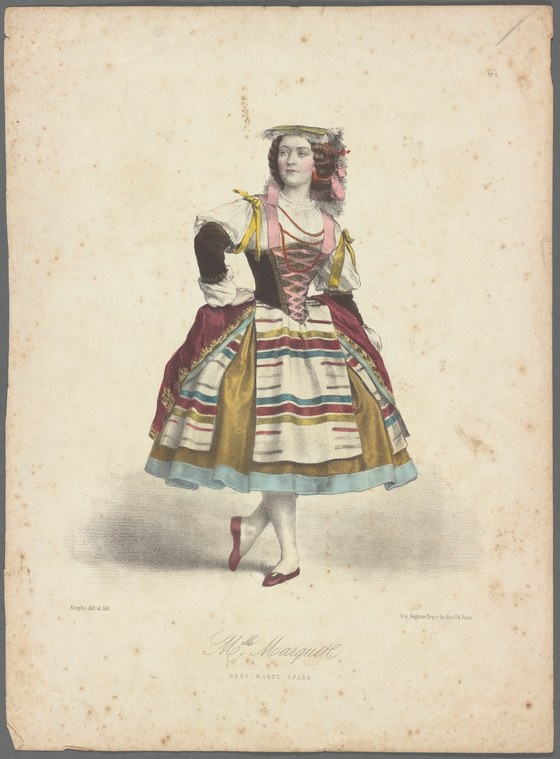
Melle. Marquet dans Marco Spada
Unknown artist
- Collection:
- Prints depicting dance
- Source:
- New York Public Library
- Rights:
- Public domain — free to use, share and adapt.
- Recorded as:
- Public Domain
This work documents the actual costume and presentation style of a real Romantic-era ballerina in a specific role, making it invaluable evidence for how ballet looked, how dancers presented themselves, and what the public desired to see in images of dance. Beyond the history of dance itself, it reveals the 19th-century commercial apparatus that made the ballet dancer a visual icon of feminine elegance and exotic otherness.
What you are looking at
A young woman in mid-19th-century performance costume stands against a plain background in a three-quarter pose, looking toward the viewer with a composed expression. She wears a richly decorated dress typical of Romantic ballet: a dark velvet bodice with gold shoulder epaulettes and trim, laced at the front, paired with a voluminous skirt of white tulle or gauze that falls to mid-calf. The skirt is decorated with horizontal stripes in red, gold, and dark blue—possibly representing national or theatrical insignia. A sheer dark overdress or panneau drapes from her shoulders. Her dark hair is dressed up and back, adorned with what appears to be a small tiara or decorative comb. She wears pale stockings and flat ballet slippers, standing with her weight on one leg in a relaxed but elegant stance. The print is hand-colored, with the pale background allowing the vibrant detail of the costume to dominate.
The dancing
A single figure stands in a supported but informal pose—weight shifted slightly to one side, arms at rest, the body upright and composed rather than in an active movement phrase. The stance suggests the moment between movements or the formal presentation of a character rather than the capture of active dancing. Her posture is dignified and her gaze direct, conveying a sense of theatrical self-presentation typical of the prima ballerina tradition.
The dance depicted
This is a portrait of a named performer—Melle. Marquet—in character costume from the ballet *Marco Spada*, a work by the choreographer Louis Henry in the Romantic ballet repertory. The title indicates this is Marquet's presentation as a character in that production, most likely captured during or shortly after a performance run. The costume combines the essential Romantic ballet vocabulary—pointe-readiness implied by the slippers, the tutu silhouette—with theatrical elaboration suggesting a specific dramatic role rather than a generic sylph or spirit.
How it was made
This is a hand-colored lithographic print, recognizable by the delicate tonal gradations in the background, the crisp line-work of the costume detail, and the careful hand application of color. The technique allowed for rapid production of multiple impressions and wide circulation among ballet enthusiasts, theater-goers, and collectors—this was a standard commercial format for distributing images of celebrated performers to the public. The coloring, while skillfully applied, shows the slight irregularities typical of hand work rather than chromolithographic precision.
About this work
This is a souvenir portrait of a Romantic-era ballet performer in the costume of a specific dramatic role. *Marco Spada*, first choreographed by Louis Henry and performed extensively in Paris and across Europe from the 1850s onward, was a story ballet set in the world of bandits and intrigue—far from the ethereal supernatural world of *Giselle* or *La Sylphide*. Marquet's costume reflects this: the military-style epaulettes and striped tunic suggest a character of rank or national identity within the narrative. The portrait documents both the performer's celebrity and the specific costume vocabulary of mid-19th-century ballet dramaturgy.
As a printed object, this lithograph belongs to a vast commercial apparatus built around the worship of the ballet dancer. Theater-goers purchased these images as mementos; collectors built albums; the prints advertised future performances and immortalized past ones. They circulated across borders and social classes far more widely than attendance at the opera house itself.
How to look at it
Notice the hybrid dress: the ballet slippers and the silhouette of the tutu clearly mark this as a dance role, yet the military styling—the epaulettes, the decorated tunic—signals a specific character, not a type (nymph, spirit, peasant). The artist has chosen a moment of stillness and presentation rather than movement, which is standard for souvenir portraits: the goal was to show the performer's beauty and the costume's detail clearly, not to capture the dynamic of performance. The hand-coloring is deliberately precise on the costume and sketchier on the face and background—a hierarchy that reflects what the buyer valued.
The artist
The artist is not recorded in the catalogue. The lithograph was likely produced by a commercial print house in Paris, where such souvenir portraits were a major enterprise throughout the Romantic era. Unsigned theatrical prints and prints after designs by others were common; the focus was on the performer and the role rather than the printmaker's identity.
The period
This print dates to the era of Romantic ballet, roughly 1830–1870, when the female dancer dominated European theatrical culture and narrative ballet was the dominant form. *Marco Spada* belongs to the second wave of Romantic ballet—not the ghostly, supernatural subjects of the 1830s–40s, but adventure and intrigue narratives. The 1850s saw the rise of commercial mass production of dancer images; these prints were sold at the theater, in music shops, and by subscription. The fashion for collecting and displaying dancer portraits was at its height, particularly in Paris, London, and St. Petersburg.
Where it lives
This print is held in the New York Public Library's collection of prints depicting dance. It is part of the wider commercial archive of 19th-century theatrical ephemera—the mass of printed images, playbills, and souvenirs produced around the ballet industry.
Dance in this work
Questions about this work
Who was Melle. Marquet?
She was a professional ballet dancer active in the mid-19th century, celebrated enough to merit commercial souvenir portraits. Beyond the evidence of this print—that she danced the role of [character name] in *Marco Spada*—her biographical details are not currently recorded. Many dancers of the period are now known only through such images.
What is *Marco Spada*?
*Marco Spada* is a story ballet, or ballet d'action, choreographed by Louis Henry (also known as Henri). It was first performed in Paris and became part of the international Romantic ballet repertory, performed across Europe. The plot concerns bandits, adventure, and romance—typical of the more dramatic narrative ballets that followed the initial ethereal phase of Romanticism.
What are the costumes telling us?
The epaulettes and striped tunic suggest Marquet was dancing a character of military rank or national significance—not a generic ballerina role but a specific dramatic persona. The tutu and slippers mark it unmistakably as ballet. The richness of the decoration (gold trim, bead-work if present) indicates this was a principal role for a celebrated dancer.
Why were these prints made and sold?
Souvenir portraits of dancers were a major commercial product in the 19th century, sold at theaters, by subscription, and through music and print shops. They allowed fans to own an image of their favorite performers and served as advertising for future performances. Collecting and displaying such prints was a widespread hobby among the theater-going public.
More dance artwork





