49 works in this view — arrow keys or swipe to move between them.
Dance in Art
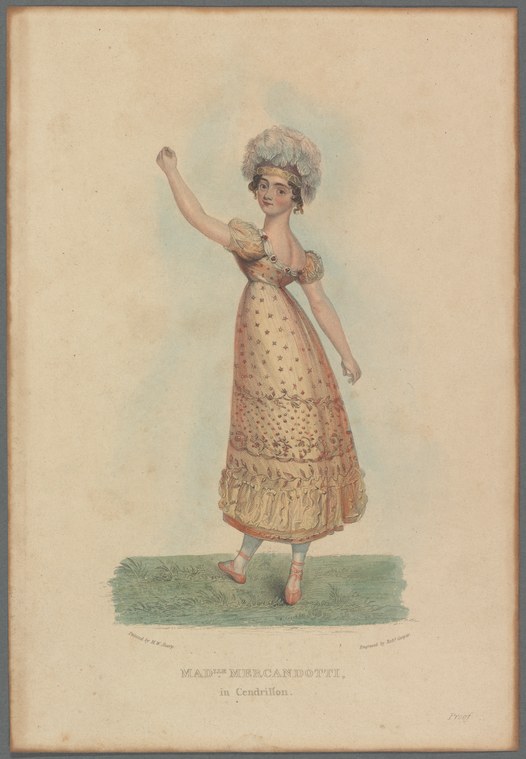
Madlle. Mercandotti in Cendrillon
Unknown artist
- Collection:
- Prints depicting dance
- Source:
- New York Public Library
- Rights:
- Public domain — free to use, share and adapt.
- Recorded as:
- Public Domain
This print documents a professional female dancer and a specific theatrical role at a moment when ballet was becoming a dominant art form in European popular culture and women dancers were beginning to achieve star status. It shows how Romantic ballet—characterized by weightlessness, grace, and pantomimic expression—was represented and marketed to the public, and it preserves the name and image of a performer who might otherwise be lost to history. For anyone studying the visual record of dance in the 19th century, this is primary source material: evidence of what was performed, how it looked, and how it was valued.
What you are looking at
A young female dancer stands alone against a pale background, captured in a moment of exuberant gesture. She wears a high-waisted pale yellow or cream muslin dress with a fitted bodice and short puffed sleeves, decorated with small red or rust-colored dots across the skirt. The dress falls to mid-calf and ends in a deep ruched or pleated flounce. Her hair is styled high and voluminous, characteristic of early 19th-century fashion, and she wears what appear to be pale stockings and shoes. Her right arm is raised with an open, welcoming gesture; her left arm hangs naturally at her side. Her posture is upright and animated, with her weight apparently on the balls of her feet. She stands on a narrow strip of green ground suggesting a stage or dance floor. The entire image is rendered in soft watercolor or hand-colored print, with delicate shading that emphasizes the translucency of her dress and the luminosity of her skin.
The dancing
The dancer stands in profile-frontal orientation, weight lifted and forward. Her raised right arm extends with palm open and fingers relaxed—a gesture of greeting, acknowledgment, or invitation common to pantomimic and theatrical dance of the period. Her torso is upright without rigidity, and her posture suggests ease and buoyancy rather than tension. The positioning of her feet, though not fully detailed, indicates she may be en relevé or on the balls of her feet, giving her an elevated, weightless quality appropriate to Romantic-era stage movement. She is a soloist, and the artist has chosen to show her at a moment of direct address—facing the viewer with an open, unguarded expression.
The dance depicted
This is almost certainly a theatrical soloistic dance from the Romantic ballet era, circa 1830s–1840s. The dress, the setting, and the printed inscription identifying the performer place this within the professional stage ballet tradition. The specific movement—raised arm, animated posture, the sense of a performed moment—is consistent with the vocabulary of Romantic ballet, which emphasized ethereal grace, lightness of weight, and emotional openness. The role of Cendrillon (Cinderella) was danced in the famous Perrot–Taglioni production of 1844, but stage versions existed earlier. Without being able to confirm the date of this print or the precise identity of Mlle. Mercandotti beyond the inscription, the image records a particular performer in a specific theatrical role, frozen in a gesture that was meant to convey joy, innocence, or triumph—qualities central to Romantic ballet characterization.
How it was made
This is a hand-colored engraving or lithograph, likely a theatrical souvenir or print from a playbill or popular dance print series. The technique allowed for rapid, affordable reproduction and wide distribution to audiences and enthusiasts. The soft, luminous hand-coloring—particularly the subtle gradations in the muslin dress and the delicate rendering of the face—suggests skilled hand-finishing, indicating this was a mid-to-upper-range souvenir rather than a cheap mass-produced print. The inscription beneath in a fine serif typeface is typical of commemorative portrait prints of performers. This object type—the colored theatrical portrait engraving—was a primary means of circulating images of celebrated dancers to the public before photography became dominant.
About this work
This is a hand-colored engraving of a Romantic-era ballet dancer, identified by inscription as Mlle. Mercandotti performing in Cendrillon. The print captures a single suspended moment of theatrical performance: a young soloist in a pale muslin dress, arms raised in a gesture of joy or triumph, her body lifted and weightless in the characteristic style of 1830s–1840s ballet. The work is both a portrait of a performer and a record of how Romantic ballet movement was understood and represented in popular visual culture. It belongs to a rich tradition of theatrical souvenir prints that documented the stars and roles of the operatic and ballet stage, making dance history visible to audiences beyond the theater itself.
How to look at it
Observe the moment the artist chose: not the height of a jump or the completion of a turn, but a moment of stillness and gesture—a moment of communication with the audience. The raised arm and open posture suggest direct address; this is not a moment of dancing alone on stage, but of connection. Notice the care taken to render the dress: the translucency of the muslin, the delicate pattern of dots, the deep ruching at the hem. This attention to fabric was part of the Romantic ballet aesthetic—the costume was meant to seem weightless, insubstantial, almost supernatural. The posture—upright, buoyant, effortless—is the key visual element: this is not a sturdy, grounded body, but one that seems to float.
The period
This work belongs to the Romantic ballet era of the 1830s–1840s, when the genre was at the height of its cultural prestige and commercial success in Europe. Female dancers, especially soloists and étoiles, became celebrities whose images were collected and circulated as prints, playbill illustrations, and lithographs. The aesthetic ideals of Romanticism—otherworldliness, ethereal grace, emotional authenticity—were embodied in the dancer's body and costume. The pale muslin dress, the lifted posture, the emphasis on weightlessness and buoyancy are all visual signatures of this period's dance aesthetic. The role of Cendrillon would have been a vehicle for showing the performer's range: combining pantomime (in the story scenes) with pure dance vocabulary. The print itself is a product of the period's hunger for theatrical images and celebrity portraiture.
Where it lives
This print is held in the New York Public Library's collection of prints depicting dance. It is a theatrical souvenir from the professional stage, likely produced and sold in the mid-19th century to commemorate a specific performance or performer.
Dance in this work
Questions about this work
Who was Mlle. Mercandotti?
The inscription identifies her as the performer, but without additional archival research it is not possible to confirm details of her career or life from the image alone. She was a professional stage dancer active during the Romantic ballet era, and this print is evidence of her performance in the role of Cinderella. Many such dancers achieved local or regional fame without extensive documentation.
What is Cendrillon?
Cendrillon is the French title for Cinderella. The Cinderella story was adapted multiple times for ballet during the 19th century, most famously by Jules Perrot and Marie Taglioni in 1844. This print may document an earlier or different production, but the role remained a staple of the Romantic ballet repertoire, offering dancers the chance to show both dramatic range and technical skill.
What does the raised arm mean?
In Romantic ballet, gesture was used to convey emotion and advance narrative. A raised arm with an open palm was a conventional gesture of joy, greeting, innocence, or appeal. Here it suggests a triumphant or joyful moment—perhaps Cendrillon's recognition as the prince's beloved, or a moment of gratitude or happiness in the narrative.
Why was she drawn this way?
The artist chose to show the dancer in a moment of stillness and direct address rather than in the midst of an active step. This was typical of theatrical portraiture: it emphasized the performer's presence and beauty, made the print legible and memorable, and allowed the costume and face to be rendered in detail. It is a portrait of a dancer, not a documentation of choreography.
More dance artwork





