49 works in this view — arrow keys or swipe to move between them.
Dance in Art
Le feu follet
Unknown artist
- Collection:
- Prints depicting dance
- Source:
- New York Public Library
- Rights:
- Public domain — free to use, share and adapt.
- Recorded as:
- Public Domain
This print preserves the visual language of Romantic ballet—the techniques and tropes through which nineteenth-century audiences understood supernatural choreography. For historians and dancers, it reveals how the pointe-work silhouette, the flowing skirt, and the isolation of the female dancer in space became the visual code for 'otherworldly' in theatrical dance. The work also documents the practice of illustrating ballets for commercial circulation, a major channel through which choreography was known and discussed before film.
What you are looking at
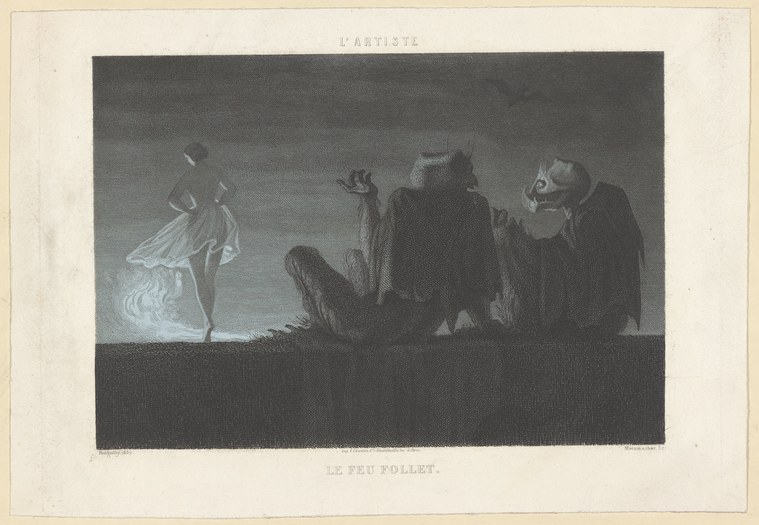
A supernatural nocturnal scene lit by a pale, spectral glow. On the left, a diaphanous female figure in a billowing white dress stands in an attitude of elegant repose or distress, her form luminous against the dark background. To the right, three male figures in dark clothing crouch or lean forward in attitudes of fear, amazement, or menace—their faces pale and mask-like, their postures tense and angular. The composition is divided between the ethereal brightness of the dancing or hovering figure and the shadowed realm of the earthbound men. The setting appears to be outdoors at night, with a low horizon line creating a sense of isolation. The print technique—likely an engraving or lithograph—renders the scene in dramatic chiaroscuro, with the white figure floating almost impossibly above or across from the darker figures.
The dancing
The female dancer stands in a pose that suggests weightlessness: her body is vertical or slightly tilted, with arms raised and her skirts spread in a full, theatrical sweep. Her weight appears to be on her toes or suspended entirely. The three male figures have contracted, earthbound poses: bent knees, forward-leaning torsos, and arms gesturing upward or outward toward the dancing figure. Their body language reads as urgent—watchful, frightened, or enchanted. The extreme contrast between the vertical, soaring female and the horizontal, grounded male bodies creates a narrative tension: one figure belongs to a different realm.
The dance depicted
This appears to be a theatrical Romantic ballet scene, likely depicting a supernatural or ghostly encounter—possibly from a work like *La Sylphide*, *Giselle*, or another mid-nineteenth-century narrative ballet involving spirits or sylphs. The female figure's pose, the ethereal costume, and the isolated nighttime setting are all hallmarks of Romantic ballet vocabulary. The men's reaction—fear, longing, or wonder—suggests they are witnessing something preternatural. The work is titled *Le feu follet* (the will-o'-the-wisp), which points to a creature of folklore: a ghostly or magical flame that leads travelers astray. This fits squarely within the Romantic ballet tradition of representing elusive, otherworldly beings through the language of the classical ballet body and pointe work.
How it was made
This is a black-and-white engraving or lithograph, techniques well suited to dramatic narrative illustration and theatrical publicity in the nineteenth century. The use of strong contrasts between illuminated and shadowed areas—chiaroscuro—creates the supernatural atmosphere and allows the artist to suggest both the solidity of the male figures and the luminosity of the dancer. The print medium meant this image could circulate widely: as a broadside, in newspapers, in illustrated theatrical journals, or as an affordable souvenir for patrons who attended the ballet. The technical skill required to render both the delicate folds of the dancer's skirt and the expressive, distorted faces of the men suggests this was made by a professional theatrical illustrator.
About this work
This engraving or lithograph documents a moment from a Romantic-era ballet, most likely from the mid-nineteenth century, depicting the supernatural encounter between a mortal man (or men) and a spirit creature—a *feu follet*, or will-o'-the-wisp. The work exemplifies how theatrical prints functioned as both artistic records and advertisements, capturing the essence of a dance scene in terms legible to the print-buying public: the contrast between ethereal grace and earthly fear, between the weightless dancer and the grounded, astonished witnesses. The composition and subject matter place it firmly within the theatrical Romantic ballet tradition, when narrative ballets about supernatural beings and impossible love were at the height of their popularity.
How to look at it
Observe the exact moment the artist has chosen: not a moment of motion, but one of encounter and revelation. The dancer is suspended in an attitude that defies gravity, while the men freeze in a moment of recognition or terror. The pale glow that surrounds her—achieved through the engraver's manipulation of light and shadow—makes her appear to exist in a different space from the men. Notice too the detail work on the men's faces: they are not generalized types, but individuals with distinct expressions of amazement. This specificity suggests the print was made to document a particular performance or production, not merely to illustrate a legend.
The period
This work belongs to the height of Romantic ballet in France, roughly 1830–1860. The 1830s and 1840s saw the premiere of foundational works like *La Sylphide* (1832) and *Giselle* (1841), which established the vocabulary of supernatural ballet: the female dancer in pointe work, ethereal costume, nocturnal and forest settings, and the theme of impossible desire between mortal and spirit. Theatrical prints were a major medium for publicizing and preserving these works; they appeared in newspapers, on playbills, and as collectible engravings for subscribers to illustrated journals. The *feu follet* had long been a figure in European folklore and Romantic literature; its appearance in ballet reflects the period's fascination with the unseen, the magical, and the irrational.
Where it lives
This print is held in the New York Public Library's collection of prints depicting dance. It appears to be a nineteenth-century theatrical engraving or lithograph, likely made for popular circulation—as a souvenir, advertisement, or illustration in a theatrical journal.
Dance in this work
Questions about this work
What is a 'feu follet' and why would it be the subject of a ballet?
A feu follet (will-o'-the-wisp) is a ghostly or magical light from European folklore, said to lead travelers astray. The Romantic era saw intense interest in folklore, the supernatural, and the irrational, making such creatures ideal subjects for ballet. The creature's ethereal, elusive nature translated perfectly into the movement vocabulary of Romantic ballet—weightlessness, grace, and otherworldliness.
How do we know this is a ballet and not another kind of dance?
The costume, pose, and theatrical setting all point to ballet. Specifically, the female dancer's vertical stance, the pointe-work silhouette suggested by her foot position, the billowing skirt, and the nocturnal, supernatural narrative are all signature elements of Romantic ballet. The print format and the men's stylized reactions suggest this is a scene from a theatrical production.
Who danced in this ballet, and when was it performed?
The catalogue record does not identify the artist or date of this print, and the title alone does not specify a particular named ballet or performer. However, the style, costume, and subject matter place it firmly in the Romantic ballet tradition of the 1830s–1860s. Further research would be needed to establish whether this illustrates a specific production.
Why were theatrical prints made, and who bought them?
Theatrical prints served multiple purposes: they advertised performances, documented memorable moments, and were sold to audiences as souvenirs. They appeared in illustrated journals, newspapers, and on playbills. They allowed people who had seen a ballet to own an image of it, and allowed those who had not to imagine it. They were accessible and affordable, reaching a much wider audience than the theater itself.
More dance artwork





