49 works in this view — arrow keys or swipe to move between them.
Dance in Art
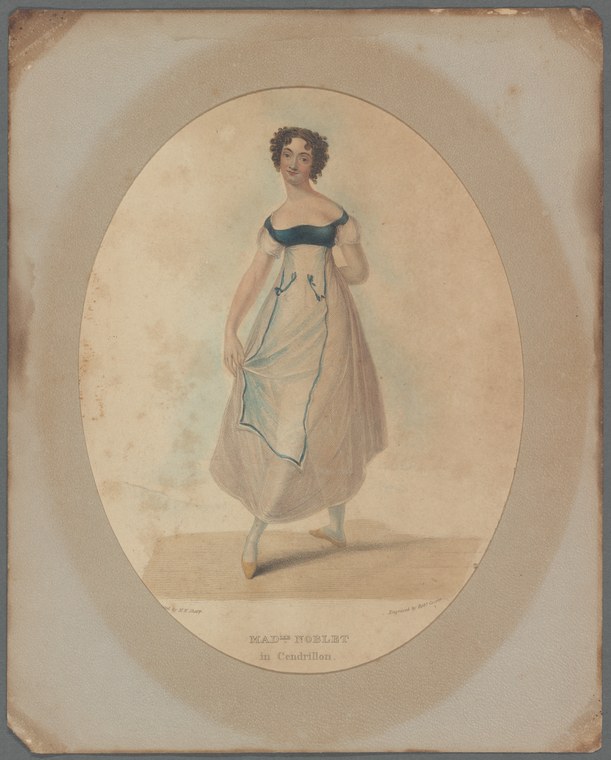
Madlle. Noblet in Cendrillon
Unknown artist
- Collection:
- Prints depicting dance
- Source:
- New York Public Library
- Rights:
- Public domain — free to use, share and adapt.
- Recorded as:
- Public Domain
Mademoiselle Noblet was a historically significant dancer whose career bridged the classical and Romantic eras, and this portrait preserves a record of her in a celebrated role at a pivotal moment in ballet history. The work also demonstrates how 19th-century dance was documented, circulated, and consumed—print culture was the primary way the public engaged with and remembered theatrical dance before the age of photography. Finally, the image is evidence of the aesthetic shift toward Romanticism: the costume, the pose, the very conception of beauty and grace embodied here represent a deliberate break from the courtly formality of the previous century.
What you are looking at
A young woman in Regency-era dress stands alone against a pale, neutral background in a three-quarter pose. She wears a high-waisted, diaphanous muslin gown in pale buff or cream, with a dark (navy or black) band across the bodice just below the bust—the characteristic silhouette of the 1810s–1820s. The gown drapes loosely from that band, falling nearly to her ankles in soft, columnar folds. Her bare arms are raised and slightly forward, one bent as if in gentle motion, the other extended. Her dark, curly hair is cropped short in the Regency fashion. Her expression is serene and turned slightly away. The composition is an oval vignette—the figure framed within a delicate oval mat—a standard format for theatrical portraiture of the period. The print is hand-coloured, with soft washes establishing the fabric and flesh tones against the warm cream of the paper. The title inscription at the base identifies her as "Madlle. Noblet in Cendrillon."
The dancing
The dancer is poised in a relaxed stance with weight evenly distributed, neither in a deep plié nor fully extended. Her arms are positioned in a soft, open carriage—not the rigid, turned-out Classical positions of formal ballet technique, but a gentler, more natural framing of the body. Her posture is upright but not stiffly formal; the slight tilt of her head and the quality of ease in her shoulders suggest a moment of stillness or repose rather than a leap or turn. There is no indication of hard, pointed feet or extreme turnout; the overall impression is of a light, graceful figure rather than an athlete.
The dance depicted
This is a portrait of a professional dancer in a theatrical role—that of Cendrillon (Cinderella). The print documents the Romantic ballet tradition, which emerged in the 1830s and dominated European theatre for decades. The role of Cendrillon was most famously danced by Marie Taglioni, but several other principal dancers of the era performed it. The absence of pointe work, the soft draping of the costume, and the air of gentle melancholy in the pose are consistent with the aesthetic of Romantic ballet: an emphasis on ethereal beauty, naturalism, and the illusion of effortless flight rather than technical display. The gown itself—high-waisted and columnar—reflects the theatrical fashion of the Restoration and early Romantic periods, when classical drapery was admired. The arms and carriage suggest the épaulement (port de bras) taught in the Romantic tradition, where arms move in fluid curves rather than sharp positions.
How it was made
This is a hand-coloured engraving or aquatint, a print technique that allowed rapid reproduction and wide distribution. The base image was engraved on copper or steel, then hand-coloured in the workshop, which explains the variations in tone and the somewhat translucent quality of the colour washes. This was the standard method for theatrical portraiture in the 19th century: affordable enough to sell to theatregoers, precise enough to capture a likeness, and tactile enough to display in a parlour. The oval vignette framing was a convention of the period, associated with refined, intimate subjects. The soft, diffused background is typical of theatrical prints, which aimed to isolate and dignify the performer against a neutral void.
About this work
This is a theatrical portrait print of a professional dancer—Mademoiselle Noblet—in the role of Cendrillon, likely from a production of the 1820s–1840s. It belongs to a vast corpus of Romantic-era dance imagery, most of which was produced in Paris and circulated throughout Europe and North America. Such prints served multiple purposes: they memorialized celebrated performances, allowed dancers to market themselves, and gave theatregoers a tangible memory of the dancers they had seen. The work captures the aesthetic values of Romantic ballet—a fusion of classical form with emotional interiority, of technical skill presented as natural grace. It is both a historical document of a specific performer and a window into how dance was understood and celebrated in the theatre of its time.
How to look at it
Notice the softness and fluidity of the pose: there is no locked turnout, no sharp angle of the foot, no sense of strain. The artist has chosen a moment of repose, not display—a moment that emphasizes beauty and grace over technical achievement. Observe how the gown falls in unbroken lines, almost like a classical Greek statue, yet the shortness of the skirt and the cut of the bodice place it firmly in the 19th century. The position of the arms and the tilt of the head create a sense of gentle melancholy or reverie, which aligns with the Romantic interest in emotion and interiority. Look also at the oval mat: this framing device, borrowed from neoclassical portraiture, elevates the dancer to the status of a celebrated performer worthy of such formal presentation.
The period
The 1820s and 1830s saw the emergence of Romantic ballet as the dominant aesthetic in European theatre. Marie Taglioni's debut in 1822 and her iconic performances in La Sylphide (1832) defined the new style: gossamer tutus (later shortened to mid-calf), pointe work used to suggest weightlessness, plots drawn from fairy tales and folklore, and an emphasis on the supernatural and the unattainable. Cendrillon was a popular subject—Charles Didelot had choreographed a version earlier in the century, and multiple versions appeared during the Romantic period. The fashion for theatrical portraiture in hand-coloured engraving was at its peak; London and Paris produced thousands of such prints, collected by theatregoers and preserved in theatrical scrapbooks. This was also the era of the "ballerina" as star—the shift of focus from the male dancer and the corps to the female soloist as the primary vehicle of the art.
Where it lives
The print is held in the New York Public Library's collection of theatrical dance imagery, which contains thousands of similar portraits from the 19th century. This is a typical object in that collection: a commercially produced theatrical souvenir or promotional image, meant to be sold at the theatre or to theatre-goers and collectors of theatrical memorabilia.
Dance in this work
Questions about this work
Who was Mademoiselle Noblet?
Mademoiselle Noblet was a French dancer active in the early 19th century. She was a principal dancer at the Paris Opéra and performed in a range of roles during the transition from neoclassical to Romantic ballet. She is remembered primarily through images like this one. Specific dates of her performances and career are not well-documented in surviving records.
When would this portrait have been made?
Based on the costume style, the aesthetic of Romantic ballet, and the printing technique, this print was likely made in the 1820s–1840s, probably around the time of a notable performance of Cendrillon. Hand-coloured engravings like this were produced in runs as theatrical performances occurred, so it likely commemorates a specific production or revival.
What is a hand-coloured engraving?
An engraving is an image created by incising a design into a metal plate, inking it, and pressing paper against it. For theatrical portraiture, the base image was engraved, then each print was hand-coloured by workers in a workshop, using watercolour or gouache. This allowed for rapid production and sold cheaply, making theatrical images accessible to ordinary theatregoers.
What can we learn about Romantic ballet from this image?
The soft, columnar draping of the gown, the gentle pose, the absence of technical display, and the ethereal quality of the presentation all reflect Romantic ballet's aesthetic values: grace, beauty, and the illusion of effortless movement over athletic prowess. The short gown (compared to earlier theatrical costumes) and the bare arms also show the evolution toward the modern tutu and the dancer's body as a legible instrument of expression.
More dance artwork





