49 works in this view — arrow keys or swipe to move between them.
Dance in Art
Mademoiselle Taglioni
Unknown artist
- Collection:
- Prints depicting dance
- Source:
- New York Public Library
- Rights:
- Public domain — free to use, share and adapt.
- Recorded as:
- Public Domain
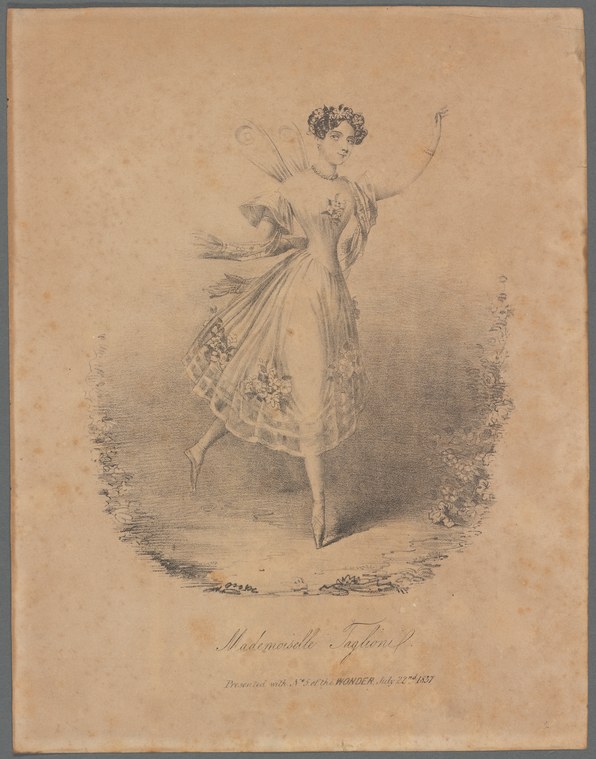
Taglioni was the defining figure of Romantic ballet and changed how dance was understood and valued in European culture. This print is evidence of her fame and the machinery of celebrity that built around her—it is an artifact of how dance was marketed, memorialized, and consumed in the early 19th century. For historians of ballet and print culture alike, it documents the visual language in which dancers' bodies were presented to the public.
What you are looking at
A young woman in classical dress stands in a graceful, elongated pose against a plain background, her body angled in three-quarter view. She wears a high-waisted Regency or early Romantic-era gown with a fitted bodice and full skirt; the skirt is caught mid-movement, its hem decorated with a checked or tartan band. Her arms are raised with elegant line—one arm extended upward in a gentle arc, the other held at her side or across her body. Her posture is balletic: the weight appears lifted and centered, the torso long and composed. Her hair is arranged in an ornamental style typical of the 1820s–1840s, with curls pinned atop her head. The background is plain and atmospheric, with subtle shading that suggests depth but no architectural or landscape detail. The overall effect is of a formal theatrical portrait—a moment of stillness that nonetheless conveys grace and lightness of being.
The dancing
A single standing figure, female, in a pose that emphasizes vertical extension and poised balance. The raised arm creates a line of elegance from shoulder through fingertips; the supporting leg is straight and engaged, the free leg lightly pointed or extended. The torso is held with the upright carriage typical of early Romantic ballet training. There is no obvious contact or narrative between bodies—this is a solo portrait of a dancer's bearing and technique.
The dance depicted
This is almost certainly a portrait of Marie Taglioni, the legendary Italian-Swedish Romantic ballet dancer who dominated European stages from the late 1820s onward and became the embodiment of the ethereal, weightless ideal of Romantic ballet. The inscription 'Mademoiselle Taglioni' on the print confirms this. The pose—the lifted carriage, the elongated line, the raised arm in a gentle port de bras—captures the essence of her famous technique and the vocabulary of early Romantic ballet. She is known to have danced in works like *La Sylphide* (1832), a role that came to define the genre. The pose may not represent a specific moment from a particular ballet but rather a standardized theatrical portrait meant to disseminate her image and codify her elegant style for audiences across Europe.
How it was made
This is a lithograph or steel engraving, printed on laid paper with visible hand-finishing or wash toning to suggest depth and atmosphere. The technique allowed rapid reproduction and wide circulation; such prints were the mass media of the 1830s–1840s, sold to theatregoers and collectors who wished to own an image of their favourite performers. The delicate linework of the figure contrasts with the soft, atmospheric background, a convention of the period that emphasized the dancer's form while abstracting her setting. The print's survival and its holding in the New York Public Library suggest it was a popular and durable format.
About this work
This is a formal theatrical portrait of Marie Taglioni, the defining dancer of the Romantic ballet era, captured in a pose that exemplifies the weightless, elongated ideal of early 19th-century classical dance. The work is a lithograph or engraving—a mass-produced print designed for circulation among theatregoers and dance enthusiasts across Europe. It belongs in a gallery of dance in art because it documents both the physical vocabulary of Romantic ballet and the cult of personality that surrounded its greatest star; such prints were instrumental in creating and sustaining Taglioni's iconic status. The image preserves not a moment from a specific performance, but the ideal image of the dancer that she and her audiences wished to remember and celebrate.
How to look at it
Attend to the posture and line of the body. The raised arm, the long neck, the lifted torso, and the pointed foot are all deliberate statements about what ballet was becoming—an art of weightlessness and aspiration rather than technical display. The plainness of the setting is also significant: it is not a stage set or a narrative scene, but a neutral space that focuses all attention on the dancer's body and bearing. The artist has chosen a moment of rest and composure, not movement or drama; this emphasizes the ideal of stillness and grace that defined the Romantic aesthetic. The fashion details of her gown—the high waist, the full skirt, the checked hem—ground the portrait in a specific historical moment, even as the pose aims at a timeless ideal.
The artist
The artist is not recorded in the catalogue. The work is a commercial theatrical print, likely produced by a print publisher in Paris, London, or another major European theatrical centre. Such portraits were often made from drawings by theatre portraitists or choreographers' sketches, then engraved or lithographed by workshop hands; attribution to a single artist is typically lost or irrelevant to the print's original purpose and audience.
The period
This print dates to the height of the Romantic ballet movement in Europe, roughly the 1830s–1840s. Taglioni's debut in *La Sylphide* in 1832 sparked a revolution in ballet aesthetics: the turn toward ethereal, otherworldly female characters; the development of pointe-work technique; and the cult of the ballerina as the central figure of theatrical dance. This was also a period of explosive growth in mass printing and visual media. Lithography and steel engraving made theatrical portraits affordable and widely available, creating a new culture of celebrity around stage performers. Women dancers, in particular, became objects of intense public fascination and desire, celebrated in prints, playbills, and critical writing. Taglioni's image circulated more widely than that of any dancer before her.
Where it lives
The print is held in the New York Public Library's collection of prints depicting dance, identified as a source in the NYPL database. Such popular theatrical prints were widely distributed and reprinted across multiple printmaking centres and decades; this example's specific date and place of production are not recorded but can be inferred from stylistic and costume evidence to be European, most likely 1830s–1850s.
Dance in this work
Questions about this work
Who was Marie Taglioni?
Marie Taglioni (1804–1884) was an Italian-Swedish dancer who became the supreme figure of Romantic ballet. She created the role of the Sylph in *La Sylphide* (1832), a watershed moment in dance history, and dominated European stages for three decades. She was celebrated for her lightness, technical brilliance, and ability to embody the ethereal, otherworldly characters that defined the Romantic era. She retired from the stage in 1847.
What is 'Mademoiselle Taglioni' a portrait of?
This is a formal theatrical portrait intended to disseminate Taglioni's image to the public. It is not a portrait of her face or personality in the modern sense, but rather a standardized pose showing her body at rest in the balletic line she was famous for. Such prints were sold in theatres and by print publishers; they were the merchandise of celebrity in the 19th century.
What dance technique does this image show?
The pose embodies the vocabulary of Romantic ballet: vertical extension, lifted carriage, pointed feet, and elongated arm lines. The straight supporting leg and the raised free leg (likely pointed) suggest the balletic positions that were becoming codified in this period. There is no indication of rapid movement or virtuosity; instead, the emphasis is on grace, lightness, and an ideal of weightlessness.
How do we know this is Taglioni?
The inscription at the bottom of the print reads 'Mademoiselle Taglioni.' The catalogue record also identifies her by name. Her fame and the circulation of her image make her the most recognizable dancer of the era, and the style and date of the print are consistent with commercial theatre portraiture of the 1830s–1840s.
More dance artwork





