49 works in this view — arrow keys or swipe to move between them.
Dance in Art
Child dancers
Unknown artist
- Collection:
- Prints depicting dance
- Source:
- New York Public Library
- Rights:
- Public domain — free to use, share and adapt.
- Recorded as:
- Public Domain
The Taglioni sisters represent the height of Romantic ballet prominence, and Marie Taglioni's innovations and celebrity shaped European dance for decades. This image is one of relatively few surviving visual records of how these celebrated performers presented themselves, and what kind of dress and carriage signified elite classical training in the 1830s–1840s. For historians of the Romantic period, it documents both aesthetic values and marketing practice.
What you are looking at
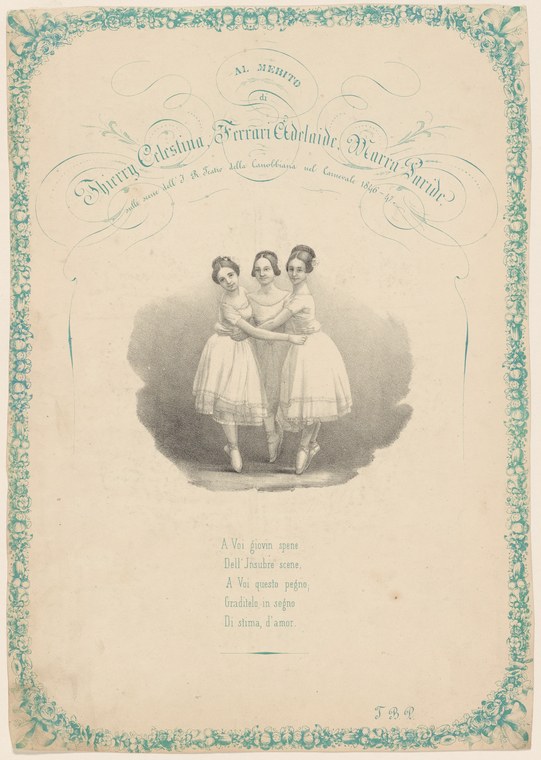
Three young female dancers in white gauze skirts stand close together in an intimate grouping, their bodies arranged in a gentle triangular composition. The central figure stands between two companions who lean toward her with a tender, protective quality. All three wear classical ballet dress—white tulle skirts of mid-calf length and fitted bodices. Their hair is styled up in the fashion of the mid-nineteenth century. The dancers are posed against a soft, shadowed background that gives them sculptural presence without a defined setting. A decorative turquoise and cream border frames the entire composition, suggesting this is a printed illustration from a theatrical program or souvenir. The title at the top identifies these as the three "Taglioni" sisters—a celebrated dynasty of Romantic-era dancers. The inscription below in Italian speaks to sisterly bonds and youthful charm.
The dancing
The three figures stand en face or nearly so, their bodies close enough to touch. The two outer dancers incline gently toward the center figure, creating a pyramidal arrangement that suggests both unity and a hierarchy of prominence. None of the figures displays active movement or dramatic pose; instead, they present themselves as if for a formal portrait. Their arms are held softly and demurely, consistent with Romantic-era ballet deportment. The full skirts and fitted bodices follow the silhouette of classical ballet dress as it evolved in the 1830s and 1840s.
The dance depicted
This is a souvenir or program illustration celebrating the Taglioni sisters—Marie, Paul, and Salvatore Taglioni—who were among the most celebrated dancers of the Romantic ballet era, roughly 1820–1860. The intimate, non-narrative grouping suggests this was created to market or memorialize a performance or season in which all three appeared together, rather than to document an actual choreographed moment. The dress and deportment are consistent with the classical ballet vocabulary of the period, but the image is as much portrait as dance document. Marie Taglioni was the pre-eminent ballerina of her age; her siblings benefited from her fame and their family's dominance of European dance.
How it was made
This is a lithographic print hand-colored in turquoise, cream, and black ink. The figural imagery is created through stone lithography—allowing for soft tonal modeling and the atmospheric shading visible in the dancers' forms—while the ornamental border is rendered crisply. The technique and format indicate this was a commercial product of moderate cost, likely sold as a souvenir at theaters or by print sellers. The presence of hand-coloring and the fine decorative border suggest it was aimed at a genteel middle-class audience with some disposable income, rather than mass-market circulation.
About this work
This is a mid-nineteenth-century lithographic souvenir celebrating three members of the Taglioni dancing dynasty at the height of Romantic ballet. The image records not a choreographed moment but a formal presentation of three celebrated performers in the dress and deportment that defined the period's aesthetic. It belongs in a dance gallery both as a document of what Romantic-era ballet looked like—the silhouette, the carriage, the restraint—and as evidence of how performers and impresarios marketed themselves to an adoring public. The Taglioni name was a brand; this print is part of that brand.
How to look at it
This image asks you to read restraint and nobility as dance presence. There is no action, no dramatic lift or extension, no moment of the step itself—only three figures in stillness, presented as objects of admiration. The composition emphasizes vertical alignment and gentle curves; the skirts and hair define the silhouette more than the bodies within. The soft modeling of light and shadow creates a sense of otherworldliness appropriate to Romantic aesthetics. Notice how the frame and border transform what might be a simple theatrical photograph into a precious object—this is marketing disguised as art.
The period
This lithograph dates to the height of Romantic ballet in Europe, a period (approximately 1820–1860) when ballet was dominated by the cult of the ballerina—ethereal, ethereal, and often cast in supernatural or exotic roles. Marie Taglioni's 1832 performance in *La Sylphide* established her as the supreme dancer of the age; her siblings capitalized on this fame. Lithography, perfected in the 1790s and industrialized by the 1820s, became the dominant medium for theatrical portraiture and souvenir imagery, allowing theaters to sell relatively affordable prints of favorite performers. The decorative border and soft coloring are typical of French and Italian theatrical lithography of the 1840s–1850s.
Where it lives
This work is held in the New York Public Library's collection of prints depicting dance. It is catalogued only as "Child dancers" with no attribution and unknown date, though stylistic analysis and the Taglioni identification suggest a date in the 1840s–1850s.
Dance in this work
Questions about this work
Were these actually the Taglioni sisters?
The title at the top of the print reads "Taglioni" (visible in the ornamental cartouche), so the maker intended this as a representation of Marie, Paul, and Salvatore Taglioni. Whether it is a faithful likeness or a generic "type" image marketed under the Taglioni name is unknown. In the nineteenth century, theatrical prints often served as much as advertisement as document.
What is the dance they are doing?
They are not shown dancing; they are posed in a formal portrait arrangement in theatrical dress. This is a souvenir image meant to celebrate their fame and beauty rather than to document a specific choreography or performance. The pose and dress communicate "classical ballet" but not a particular step or combination.
Why are they called 'child dancers'?
The catalogue record labels this 'Child dancers,' likely because the figures appear young and the image emphasizes their delicate, youthful beauty—a key selling point in Romantic-era ballet marketing. Marie Taglioni was born in 1804 and was an adult and established star by the 1830s, but theatrical prints often exaggerated youthfulness and innocence regardless of the performers' actual ages.
Is this a real moment or an imaginary grouping?
It is almost certainly imaginary or at least highly arranged. The intimate, almost familial pose was designed to appeal to audiences' curiosity about the celebrated performers' private lives and relationships. The frame and presentation suggest this is a souvenir made for sale, not a record of an actual stage moment.
More dance artwork





