49 works in this view — arrow keys or swipe to move between them.
Dance in Art
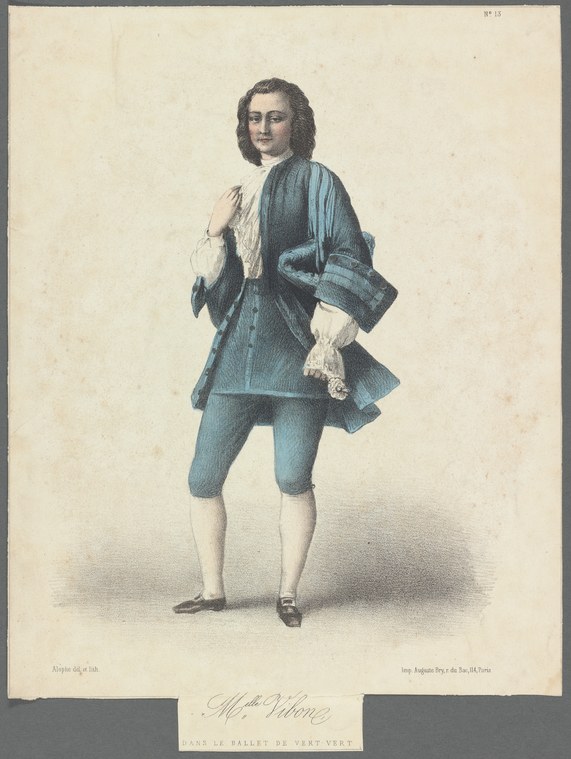
Melle. Vibon dans le ballet de Vert-Vert
Unknown artist
- Collection:
- Prints depicting dance
- Source:
- New York Public Library
- Rights:
- Public domain — free to use, share and adapt.
- Recorded as:
- Public Domain
This print is a primary document of mid-19th-century theatrical dance costume, personnel, and marketing practice. For dancers and historians, it is evidence of who performed, what they wore, and how theatrical dance was promoted and memorialized in an age before photography became universal. The name, the role, the date, and the costume are all legible here—information that would otherwise be lost.
What you are looking at
A single male dancer in theatrical dress stands against a plain background, viewed from the front in a relaxed pose. He wears a blue-grey coat or tunic with white lace cuffs and collar, matching white stockings, and black shoes with buckles. His long hair falls past his shoulders in the style of 18th-century portraiture. His right arm hangs naturally at his side while his left arm is bent with the hand near his hip, creating an informal, almost conversational stance. The figure is rendered in hand-colored engraving or lithograph with subtle shading to model the form and suggest depth beneath his feet. The composition is a type of theatrical portrait common to dance documentation: the named performer isolated against emptiness, their costume and carriage alone carrying the meaning.
The dancing
A single standing figure without a dance partner. The weight is evenly distributed on both legs, the stance open and frontal rather than turned or crossed. The arm positions are relaxed and natural—not held in the formal frame of court dance or the lifted port de bras of theatrical ballet. The body shows neither the tension of a performed step nor the balletic extension; instead, this is a portrait pose designed to display the costume and the dancer's bearing rather than to capture movement.
The dance depicted
The title names this as Melle. Vibon in the ballet *Vert-Vert*, a work not otherwise identified in the catalogue. *Vert-Vert* was a comic ballet by the Venetian choreographer Jean-Philippe Taglioni, first performed in Paris in 1851 and revived and revised multiple times. However, this print's style and the dancer's dress suggest an earlier period—likely the 1830s or 1840s. If this is Taglioni's *Vert-Vert*, the work is a comic ballet d'action with a libretto derived from a 17th-century French poem about a convent parrot. Melle Vibon's role and the exact nature of her costume cannot be determined from the image alone, but the informal stance and theatrical street dress suggest a character role rather than a classical ballerina.
How it was made
Hand-colored engraving or lithograph printed from a stone or plate. The technique is evident from the careful linear work describing the coat, the subtle hatching in the background, and the way the color (blue, flesh tone, black) is applied flatly within drawn boundaries. This mode of production—labor-intensive and expensive to hand-color individually—was the dominant form of theatrical portraiture in the mid-19th century and circulated widely among theatre subscribers and dance aficionados. The print is a commercial product, one of a series documenting performers in specific roles, and would have been sold as a souvenir or collected as a record of the production.
About this work
This is a theatrical portrait engraving of a named dancer, Melle Vibon, in a specific character role from a comic ballet of the mid-19th century. The print documents both the dancer and the costume design of the period, presenting the performer in a relaxed pose that emphasizes presentation over movement. It belongs to a vast parallel archive of theatrical documentation—not action paintings but portraiture—that circulated as prints and functioned as a form of theatre review and celebrity promotion. The work sits at the intersection of performance, fashion, and print culture, evidence of how 19th-century dance was circulated and consumed by a public that never saw the live performance.
How to look at it
Look at the pose and what it tells you: this is not a moment of action but a presentation. The dancer is shown frontally, almost as if on display, rather than captured mid-step or in a narrative moment. The costume is clearly legible and central to the image's purpose—the coat, cuffs, stockings, and shoes are all rendered with precision. Notice the contrast between the formal architectural elements (the coat) and the relaxed, almost domestic stance. This is a portrait mode, not an action mode, and it tells you how 19th-century dancers were marketed: as named personalities whose costume and presence mattered as much as their movement.
The artist
The artist is not recorded in the catalogue. The print carries a publisher's mark at the bottom (partially legible as "Imp. Bénouville" or similar), indicating a commercial Paris print shop. Theatrical portrait engravings and lithographs of this type were produced by workshops rather than individual artists; the engraver, colorist, and designer were often different hands, and attribution was typically given to the publisher or theatre rather than the maker.
The period
The mid-19th century saw the rapid professionalization and commercialization of ballet in Paris, Vienna, and London. The Romantic era had established the ballerina as a celebrity; prints of named performers in named roles became a primary means of publicity and fan culture. Comic ballets and character roles were as popular as classical ones, and the costume and staging of such works were subjects of intense interest. The hand-colored engraving was still the standard mode for theatrical portraiture in the 1840s and early 1850s; it would be superseded by photography only gradually after the 1860s.
Where it lives
The print is housed in the New York Public Library's dance print collection and is catalogued as a work depicting dance performance. It is one of thousands of such theatrical portrait prints produced in Paris in the mid-19th century and circulated internationally. The publisher's mark and the style indicate a commercial Paris print shop; the exact publication date and print run are unknown.
Dance in this work
Questions about this work
Who was Melle Vibon?
Melle Vibon is named in this print as a performer in the ballet *Vert-Vert*, but no other biographical information is recorded. She was likely a coryphée or character dancer in the Paris Opera ballet of the mid-19th century. The title "Melle" indicates she was unmarried and of sufficient rank to be named in theatrical publicity.
What is Vert-Vert?
*Vert-Vert* is a comic ballet with a libretto derived from a 17th-century French poem about a green parrot living in a convent. The first recorded choreography is by Jean-Philippe Taglioni (premiered 1851), but the subject may have inspired earlier works. The ballet is a typical example of mid-19th-century comic ballet d'action, blending storytelling, mime, and dance.
How do we know this is mid-19th century?
The style of dress, the engraving technique, and the format of the theatrical portrait all point to the 1830s–1850s. The hair style, coat cut, and stockings are consistent with this period. The hand-colored engraving was the standard mode for theatrical portraiture before photography; after 1860, these prints were largely replaced by photographic reproductions.
What does her pose tell us about 19th-century dance?
The relaxed, frontal stance is typical of theatrical portraiture and is not meant to show movement or virtuosity. It suggests that 19th-century dance documentation prioritized the display of costume and personality over the capture of technical or choreographic information. For that, one would need action paintings, lithographs showing multiple dancers, or written reviews.
More dance artwork





