49 works in this view — arrow keys or swipe to move between them.
Dance in Art
Perrot
Unknown artist
- Collection:
- Prints depicting dance
- Source:
- New York Public Library
- Rights:
- Public domain — free to use, share and adapt.
- Recorded as:
- Public Domain
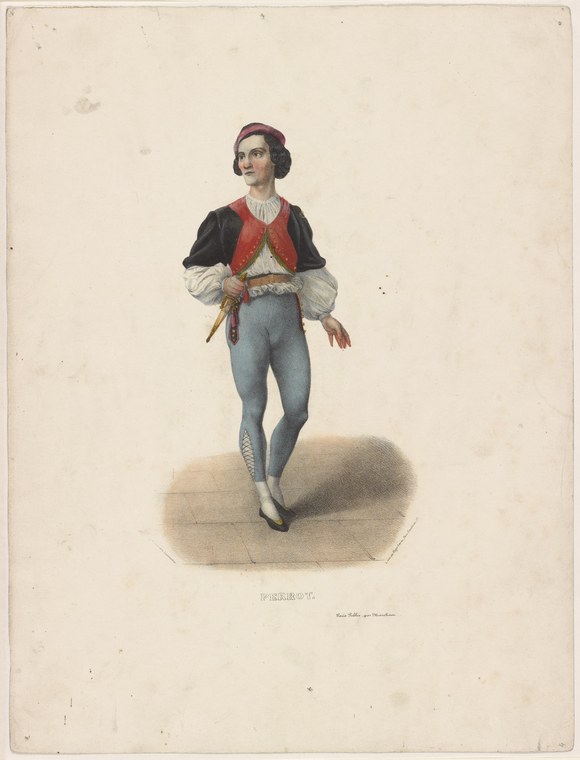
Jules Perrot was one of the most influential figures in 19th-century ballet, and surviving images of him in costume are important documents for understanding Romantic ballet's visual culture and the male dancer's role in it. This print preserves the appearance of a star whose own ballets and partnerships shaped the repertory danced today, and it shows how his celebrity was marketed and consumed through mass-produced theatrical prints.
What you are looking at
A young male dancer stands alone against a neutral background, caught in a moment of elegant repose. He wears the costume of early 19th-century theatrical dance: white tights that extend to pointed feet, a short red velvet jacket or spencer worn open to reveal a white shirt with a high collar and white waistcoat, and a dark jacket draped at the shoulders. His hair is styled in the fashion of the 1830s–40s, parted and close to the head. His weight rests easily on one leg, the other slightly forward, and his arms hang naturally at his sides with hands visible and relaxed. The figure is rendered with careful attention to the anatomy of the leg and foot, suggesting technical precision. He stands on a subtle ground plane indicated by soft shading, and the entire composition is spare and focused, centering all attention on the dancer's form and costume.
The dancing
A single male dancer, posed in a moment of rest rather than active movement. His weight appears anchored to the supporting leg, with the free leg held straight but unforced. His frame is upright but not rigid; the shoulders are level and relaxed, the arms at rest. The posture suggests training—the turnout of the legs and the carriage of the torso indicate classical ballet vocabulary—but the moment chosen is one of stillness and display rather than dynamism. The pose is characteristic of theatrical portraiture of the early 19th century, designed to show the dancer's physique and the costume he performed in.
The dance depicted
This appears to be a theatrical portrait of a male ballet dancer, most likely a soloist, rendered in the style and dress conventions of the Romantic era (1830s–1840s). The title 'Perrot' almost certainly refers to Jules Perrot (1803–1878), the renowned French ballet dancer, choreographer, and maître de ballet who was one of the dominant figures of Romantic ballet and created many of its most celebrated works. The costume—short jacket, white tights, and soft shoes—is consistent with the male ballet practice of the period. The pose is the formal, frontal presentation typical of lithographed portraits of celebrated dancers, which were distributed as popular prints and souvenirs. The image preserves a record of how a star dancer of the era was clothed and how his body was meant to be admired.
How it was made
This is a hand-colored lithograph, a technology that allowed the mass production of theatrical portraits at modest cost and made dancers' likenesses widely available to the public. The composition shows the lithographer's understanding of how color and tone could enhance the figure: the red jacket draws the eye, the white tights define the legs' geometry, and the muted background ensures the dancer holds the viewer's attention. Lithography's capacity for fine detail in the face and clothing, combined with hand-coloring applied after printing, made this an ideal medium for circulating images of celebrated performers to enthusiastic audiences and collectors. The soft modeling of the figure and the relative lack of aggressive line work suggest a skilled hand and a printing house of some reputation.
About this work
This is a portrait of a celebrated Romantic-era ballet dancer, almost certainly Jules Perrot, rendered as a hand-colored lithograph in the format that was the standard medium for disseminating images of theatrical stars in the early-to-mid 19th century. The work captures both Perrot's costume—the jacket, white tights, and soft ballet shoes characteristic of the period—and something of the physical ideal of the male ballet dancer of his time. Such prints were avidly collected and helped establish the public image of ballet's greatest performers, making them the celebrity merchandise of the era. For dance historians, the image is valuable as a record of how Perrot was dressed onstage and how his body was represented to the public.
How to look at it
Attend to the pose: this is not a moment of active dancing but rather the formal presentation of a performer and his costume. The artist has chosen a moment of repose that nonetheless displays the body's training—note the placement of the feet, the line of the leg, and the upright carriage. The costume itself is part of the subject; the red jacket and white tights were what audiences saw onstage, and the print's careful rendering of fabrics and fit tells you about the material reality of Romantic ballet. The face is individualized but presented with theatrical dignity, consistent with the conventions of celebrity portraiture.
The artist
The artist is not recorded, but the work is identifiable as a theatrical portrait produced by a commercial print publisher, likely Parisian or another major European theatrical center. Unsigned and undated in the existing record, it belongs to the vast output of anonymous lithographic ateliers that specialized in theater subjects during the 1830s–1840s. The technical quality and careful hand-coloring suggest a reputable workshop accustomed to producing images of leading performers.
The period
This print was created during the height of Romantic ballet (c. 1830–1850), when the art form experienced a surge in public enthusiasm and when ballet's stars became celebrities whose images were eagerly sought by audiences. Male dancers of this period were expected to be technically accomplished partners and charismatic performers; the image of the male ballet dancer in white tights and soft shoes was still relatively new and was itself a point of interest. At the same time, lithography had recently become a dominant medium for theatrical portraiture, making such images affordable and widespread. This coincidence of technological capacity and cultural appetite resulted in a rich visual archive of the period's greatest performers.
Where it lives
The work is held in the New York Public Library's collection of prints depicting dance, from which it derives. As a commercial theatrical print, it would have been widely distributed and sold, making it a common object in its time but now a historical document of performance culture.
Dance in this work
Questions about this work
Who was Jules Perrot?
Jules Perrot (1803–1878) was a French dancer, choreographer, and ballet master who was one of the most celebrated figures of Romantic ballet. He was known for his elevation, precision, and dramatic gifts as a dancer, and as a choreographer he created some of the era's most famous ballets, including Giselle (with Jean Coralli) and La Esmeralda. He also partnered with the prima ballerina Marie Taglioni and later directed ballet companies across Europe.
What is a lithograph and why were they used for theater?
Lithography is a printing process based on the incompatibility of oil and water. It was invented in the late 18th century and became the dominant medium for commercial theatrical portraits by the 1830s because it was faster and cheaper than engraving, could be hand-colored for mass appeal, and captured fine detail effectively. A single lithographic stone could produce hundreds of prints, making images of stars affordable and collectible for ordinary theatergoers.
Why is the male dancer wearing tights?
By the Romantic era, white tights had become standard costume for male ballet dancers across Europe, as they allowed the audience to see the line and technique of the leg and foot, which were central to ballet's aesthetic. Tights were a relatively recent innovation in male ballet costume and were themselves a subject of interest and occasional controversy; they revealed the body's shape in a way previous breeches had not.
How do I know this portrait is accurate?
We cannot confirm from the image alone that this is actually Perrot, though the title strongly suggests it. Such prints were typically commissioned or authorized by dancers themselves or by theater management, so they aimed at recognizable likenesses—but they were also flattering. The costume, training, and bearing shown here are consistent with what we know of Romantic ballet dancers and with other surviving images of stars from this period.
More dance artwork





