49 works in this view — arrow keys or swipe to move between them.
Dance in Art
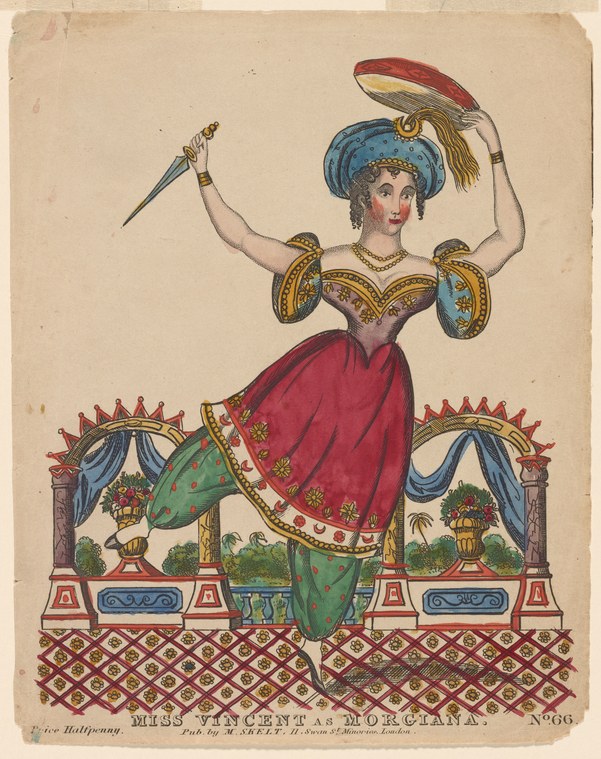
Miss Vincent as Morgiana
Unknown artist
- Collection:
- Prints depicting dance
- Source:
- New York Public Library
- Rights:
- Public domain — free to use, share and adapt.
- Recorded as:
- Public Domain
This work documents the appearance and physical vocabulary of 19th-century theatrical spectacle dance in a non-ballroom context—the domain of pantomime, extravaganza, and dramatic performance that shaped how Victorian audiences understood female movement, power, and exotic fantasy. It shows a female performer in a pose of armed agency and triumph, illustrating how stage conventions allowed women to embody martial and heroic action within the framework of entertainment.
What you are looking at
A woman in theatrical costume stands alone on an ornate stage set, posed in a dramatic moment of exertion or triumph. She wears a jeweled breastplate in gold and blue, a crimson skirt, and emerald-green harem-style trousers. A blue turban with red and gold plumage crowns her head. Her arms are raised high—the right hand holds a curved dagger or scimitar, the left a large round shield or targe. Her body leans forward slightly, weight on one leg, in a pose suggesting either preparation for combat or the conclusion of vigorous action. Behind her stretches a stage set rendered in miniature perspective: pavilions with ornate arches, draped fabrics in blue and red, topiary, and architectural ornament suggesting an exotic Eastern palace or courtyard. The ground is patterned in geometric relief. The entire composition is hand-colored in the style of a theatrical print, with clear outlines and bright, opaque pigments.
The dancing
A single female figure dominates the frame, positioned with high-raised arms in an asymmetrical stance. The right arm is extended upward and forward, gripping a weapon; the left arm is similarly raised, holding a shield. The torso is compressed and angled forward from the hips. The visible leg bears the weight while the other is concealed by the full skirt, making specific footwork assessment impossible, though the forward lean suggests dynamic weight transfer. There is no partner or ensemble; this is a solo moment of individual display and martial action.
The dance depicted
This does not depict social or concert dance in the modern sense, but rather a moment from a theatrical pantomime or dramatic performance—likely from the 19th-century English stage tradition of spectacular musical drama or burlettas. The title identifies the performer as Miss Vincent in the role of Morgiana, a character from *Ali Baba and the Forty Thieves* (most famously the heroine of Romantic-era pantomime). The pose combines elements of feminine theatrical performance with male warrior convention: the raised arms and forward-leaning stance suggest the exertion and victory typical of sword-and-shield action, while the exotic costume and solitary display position evoke the spectacular 'transformation' or 'trick' scenes that were central to 19th-century English pantomime dance spectacle. The gesture is performative rather than balletic—a dramatic attitude held for visual effect rather than part of a flowing sequence.
How it was made
This is a hand-colored engraving or woodcut print, characteristic of mid-to-late 19th-century theatrical portraiture. The technique allowed mass production and rapid distribution of images of celebrated performers to theatregoing audiences and collectors. The bold outlines, flat color application, and small scale indicate a commercial print intended for pocket or album collection rather than fine art exhibition. The text at the bottom—"Miss Vincent as Morgiana"—confirms this is a performer portrait, a standard commodity of the Victorian theater print trade. The hand-coloring suggests a smaller printing house rather than a major publisher, adding to the sense of a specialized theatrical souvenir.
About this work
This is a Victorian theatrical print documenting a moment from a 19th-century stage performance of an *Ali Baba* pantomime variant. It captures a solo pose of dramatic combat or triumph, combining the spectacular costume and exotic staging typical of English pantomime 'transformation' scenes with the physical attitudes of Romantic-era stage combat. The figure of Morgiana—traditionally a slave-girl heroine who saves her master from the Forty Thieves—is shown here in a moment of martial action, armed and dominant, a theatrical convention that allowed female performers to enact strength and agency within an otherwise decorative role.
The print belongs to a large category of 19th-century theater ephemera that documented the appearance and poses of celebrated performers. Such prints were collected by theater enthusiasts and served as both documentation and advertisement, allowing playgoers to relive favorite moments and actors to maintain public visibility between performances. This particular work records a specific interpretation of a fairy-tale character in a performance idiom that has since disappeared from the stage, making it valuable evidence of Victorian theatrical practice and the visual culture of stage dance and spectacle.
How to look at it
Attend to the asymmetry of the pose—how the raised arms create a dynamic diagonal from lower left to upper right, and how the forward lean of the torso creates tension with the stillness of the lower body. This is a 'held' pose, not a captured moment of motion, which is typical of 19th-century theatrical portraiture: the performer has struck an attitude for the artist to record. Notice the contrast between the martial gesture (weapon, shield, forward aggression) and the feminized presentation (jeweled armor, plumage, ornamental stage set). This contrast was the point—it allowed a female performer to enact power and victory within a framework of spectacle and display. The miniature, almost toylike quality of the stage set behind her is also typical of how 19th-century prints rendered theatrical illusion: not as realistic space, but as decorative backdrop that frames the performer.
The artist
The print is attributed to the publisher/printer Sparey (visible in the imprint), a mid-Victorian theatrical print house active in London. No artist is recorded. Such prints were typically executed by a division of labor: a theater artist would sketch the performer, a printmaker would engrave or wood-cut the design, and colorists would hand-apply pigments in assembly-line fashion. Individual artistic identity was rarely recorded in this commercial context.
The period
This print dates to the mid-or-late Victorian era, when pantomime and spectacular musical drama were dominant forms of English popular theater. The 1840s–1880s saw a explosion of elaborate pantomime productions featuring 'transformation scenes'—moments of magical or martial spectacle in which performers displayed themselves in exotic costumes and dramatic poses. These scenes were proto-cinematic in their use of visual surprise and spectacular effect. The role of Morgiana, drawn from the Oriental tale *Ali Baba and the Forty Thieves*, appealed to 19th-century taste for Eastern exoticism and allowed actresses to combine femininity with action-hero physicality. Theatrical prints were the primary way such performances circulated beyond London and reached a mass audience; they were collected like modern fan merchandise.
Where it lives
This print is held in the NYPL's collection of theatrical prints and dance imagery. It is a commercial theatrical print, one of thousands produced in the mid-19th century to document and publicize London stage performances. The survival of such prints in institutional collections like the NYPL reflects their original status as mass-produced souvenirs, which ensured their circulation and preservation.
Dance in this work
Questions about this work
What is Morgiana, and why was she a popular stage role?
Morgiana is a character from the Oriental tale *Ali Baba and the Forty Thieves*, which entered English popular culture through translations and pantomime adaptation. In 19th-century stage versions, she was typically the heroic slave or attendant who discovers the thieves and saves her master, often through clever action or combat. The role appealed to actresses because it combined romantic appeal with opportunities for spectacular action, exotic costume, and moments of physical dominance—allowing performers to display strength and agency in ways that drawing-room drama did not.
What is a 'transformation scene' in Victorian pantomime?
A transformation scene was a moment in a pantomime or extravaganza in which the stage set changed suddenly (through elaborate machinery or sleight of hand) and a performer appeared in a new, often exotic or magical costume to enact a spectacular pose or brief sequence. These scenes were the climax of acts and the main draw for audiences; they functioned much like special effects in modern entertainment, allowing playwrights to surprise and delight viewers with visual wonder.
Why are so few of these prints signed by the artist?
Theatrical prints were produced on a commercial, industrial model in which individual artistic contribution was not credited. A theater sketch artist, a professional engraver, and hired colorists might each have a hand in the final product, but the copyright and commercial identity belonged to the publisher. This was standard practice in mass-market printing; fine-art prints and paintings were signed, but theatrical ephemera typically were not.
How do we know this depicts dance rather than merely dramatic performance?
The boundary between stage dance and stage drama in the 19th century was fluid. This image documents a theatrical pose—a held attitude rather than a captured moment of ongoing motion. It belongs to the visual vocabulary of stage spectacle and display that informed all Victorian theatrical movement, from pantomime to ballet to dramatic drama. Movements that would now be called 'choreography' were the work of performers and stage managers rather than named choreographers, and the audience experience combined all these elements into a unified spectacle.
More dance artwork





