49 works in this view — arrow keys or swipe to move between them.
Dance in Art
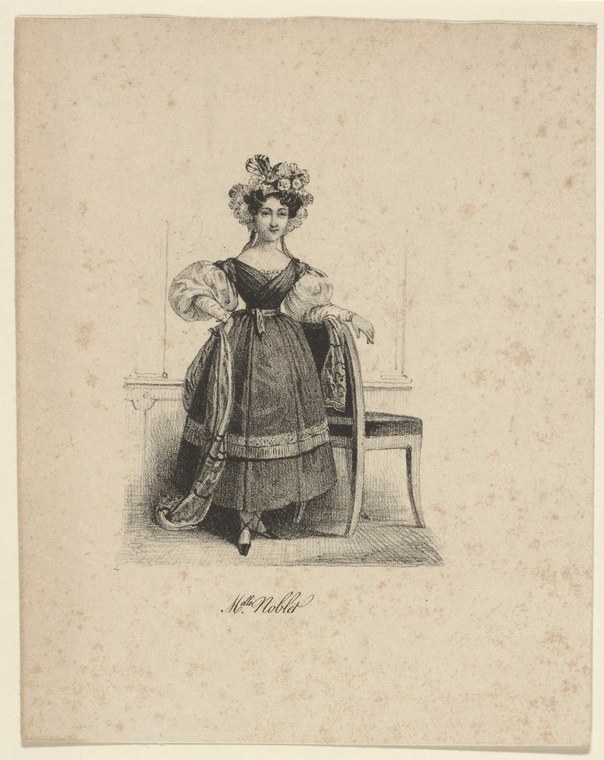
Melle. Noblet
Unknown artist
- Collection:
- Prints depicting dance
- Source:
- New York Public Library
- Rights:
- Public domain — free to use, share and adapt.
- Recorded as:
- Public Domain
The Noblet family were significant figures in Romantic ballet, and named engravings like this one are primary documents of how dancers were celebrated and their images distributed to the public. The formal, portrait-like presentation reveals the cultural status of the ballet dancer as a celebrity whose image—not just her performance—was valuable enough to reproduce and sell. For dance historians, such prints are among the only visual records we have of how dancers of the period dressed, moved, and presented themselves to audiences.
What you are looking at
A single female dancer in Regency-era dress stands in a contemplative pose within a sparse interior. She wears a high-waisted Empire silhouette gown with puffed sleeves and an ornamental headdress, her dark hair swept up in the fashionable style of the 1810s–1820s. A draped shawl or mantle falls from her shoulders to the floor behind her. She stands three-quarter length to the viewer, one arm relaxed at her side, the other resting on or near a simple wooden chair positioned stage-right. The setting is minimal—bare walls with faint architectural details suggested by vertical lines—which concentrates attention entirely on her figure and bearing. The engraving technique creates a silvery, luminous quality against the cream paper, and the careful cross-hatching defines the volume of her costume with precision.
The dancing
The dancer's posture is upright and dignified rather than dynamic. Her weight appears to rest evenly on both feet, with no evidence of active motion or momentum. The relaxed positioning of her arms and shoulders—one hand resting on the chair back—suggests a moment of repose or formal presentation rather than execution of steps. Her gaze is directed outward and slightly upward, meeting the viewer's eye with a composed, serene expression. The stillness of her body and the architectural framing of the chair create a portrait rather than an action image.
The dance depicted
This is almost certainly a theatrical portrait of a named dancer rather than a depiction of a specific dance or performance moment. The style of dress, the early 19th-century engraving technique, and the professional presentation suggest this is a souvenir or promotional print of a performer. The elegant simplicity of the costume and the formal composure indicate a dancer of the Romantic ballet era, when dancers were celebrities whose likenesses were widely distributed as engravings. The absence of active choreography visible in the pose and the emphasis on beauty and bearing over technique suggest this dancer was known as much for her presence and classical elegance as for virtuosity.
How it was made
This is an engraving or fine line engraving on paper, recognizable from the precise parallel lines (hatching and cross-hatching) that model form and shadow, and the crisp, uniform line weight characteristic of hand-engraved plates. The technique allowed for multiple impressions to be pulled from a single plate, making this an affordable and widely distributed image—typical of theatrical souvenir prints of the Romantic era. The fine detail and labor intensity of engraving suited subjects of high cultural status; this format was how theatrical celebrities circulated their images to an eager public before photography became dominant.
About this work
This is a souvenir engraving of a named female dancer of the Romantic ballet era, likely from the 1820s–1840s. The inscription 'Melle. Noblet' identifies her, and the formal portrait composition—with its elegant costume, composed bearing, and minimal setting—is typical of promotional prints distributed to audiences and admirers. The work belongs in a gallery of dance in art because it documents how dancers were visually represented and commodified in the early 19th century, and because it preserves a record of a performer who would otherwise be known only through archival documents. The engraving format also tells us how images of dance circulated in the theatrical marketplace before mass reproduction.
How to look at it
Attend first to the costume: the high waistline, puffed sleeves, and elaborate headdress place this firmly in the 1820s–1840s. Then observe how little the dancer moves or gestures—this is a formal presentation, not a caught moment of performance. The chair functions as a prop of leisure and composure, not an element of choreography. The engraver has emphasized the dancer's face and bearing over her limbs, suggesting that her value as a performer lay as much in her presence, beauty, and social status as in her technical skill. The fine, precise line work demonstrates that this was a labor-intensive and therefore expensive print, implying that the dancer named in the inscription was celebrated enough to justify that cost.
The artist
The artist is not recorded in the catalogue. The engraving style and presentation suggest it was created by a professional theatrical print maker working in Paris or London in the 1820s–1840s, during the height of Romantic ballet's popularity. Such prints were often made by specialists in theatrical portraiture who worked from drawings or paintings supplied by others; the engraver's name frequently appeared on the plate while the original artist remained uncredited. The unsigned or illegibly signed status of this work is typical of commercial theatrical prints of the period.
The period
This engraving dates to the era of Romantic ballet, when works like La Sylphide (1832) and Giselle (1841) established the ballet pantomime as the dominant theatrical form in Europe. Dancers became celebrities comparable to opera singers and dramatic actresses; their likenesses were avidly collected by theater patrons. The Noblets were a performing family of some renown, and their association with major companies would have made their images marketable. The formal, frontal portrait composition of this print reflects the cultural convention of the era: the dancer presented as an idealized figure of beauty and grace rather than as a body in action. At the same time, the subtle asymmetries of pose and the care taken to show the costume and bearing suggest the engraver understood the dancer's professional presentation.
Where it lives
The work is part of the New York Public Library's Prints collection, which documents theatrical subjects and performers from the 19th century onward. It is catalogued as a print depicting dance, reflecting its function as a theatrical souvenir and promotional image.
Dance in this work
Questions about this work
Who was Melle. Noblet?
The Noblet family were prominent dancers in early Romantic ballet, active in Paris and other major European cities during the 1820s–1840s. Without further research this specific engraving, we cannot determine which member of the family is depicted, but the print's quality and distribution suggest she was a celebrated performer of her day. Named prints like this one are among the primary visual documents we have of Romantic-era dancers.
Why is she not dancing?
This is a portrait of a dancer, not a depiction of a specific dance or choreography. The formal, static pose was the convention for theatrical souvenir prints of the era. Such images were meant to preserve the dancer's likeness and costume for collectors and admirers, not to document movement or technique. The portrait format elevated the dancer's cultural status, presenting her as a celebrated public figure rather than simply as a body executing steps.
What does the engraving technique tell us?
Engraving was labor-intensive and relatively expensive, meaning this print was created only because demand existed for this dancer's image. The fine detail and multiple impressions possible from a single plate made engravings the primary medium for distributing theatrical celebrity images before photography. The cost and care of the technique signal that the subject was culturally significant and commercially valuable.
How does this fit into dance history?
Romantic ballet (1830s onward) created the modern cult of the dancer as celebrity. Named engravings like this document how dancers were visually represented, circulated, and commodified in the marketplace. They are also among our best records of how dancers of the period dressed, groomed themselves, and presented their professional identity to the public.
More dance artwork





