49 works in this view — arrow keys or swipe to move between them.
Dance in Art
Marie Adrienne Chameroy: portrait
Unknown artist
- Collection:
- Prints depicting dance
- Source:
- New York Public Library
- Rights:
- Public domain — free to use, share and adapt.
- Recorded as:
- Public Domain
Portraits of named dancers are rare historical documents that anchor the history of dance to specific individuals and reveal how dancers were marketed and remembered. This engraving shows how a Regency-era dancer—neither royalty nor a titled performer—could be commemorated in a form that invited circulation among educated consumers, suggesting her prominence and the growing cultural authority of the dance profession in the early 19th century.
What you are looking at
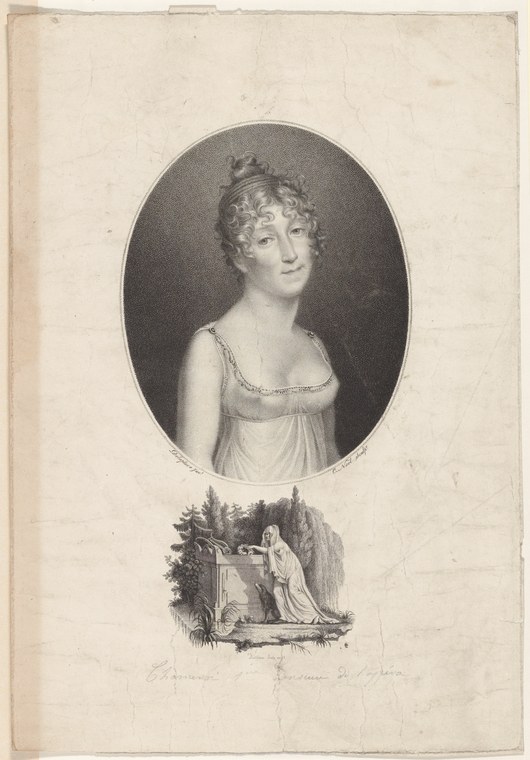
A young woman in classical dress is portrayed in a finely detailed engraving set within an oval frame. She wears a high-waisted white muslin gown with a low, square neckline and thin straps, her curled hair dressed with what appears to be a small ornament or diadem. Her gaze is directed slightly to the left, her expression composed and serene. Below the portrait, a separate engraved vignette shows a woman in similar classical drapery posed in a contemplative attitude beside a classical urn or monument, set within a wooded or garden landscape. The entire composition is rendered in fine stippled engraving, characteristic of late 18th-century portraiture, on a cream-colored paper that shows age-related creasing and foxing.
The dancing
The portrait subject is shown from the shoulders up, with an upright, dignified posture typical of Regency-era portraiture. The supplementary figure below demonstrates a classical contrapposto stance, with weight shifted subtly to one side, one arm raised, and drapery that suggests studied, formal grace rather than spontaneous movement. Neither figure displays the dynamic physicality or specific hold of partnered dance; both embody the refined, statuary quality valued in Regency deportment.
The dance depicted
This is a portrait of a woman known or believed to be a dancer, likely dating to the Regency era (c. 1811–1820). The classical dress, the contemplative pose in the lower vignette, and the overall composition suggest a connection to the Romantic ballet that was emerging at this time, or to the genteel performance dances considered suitable for young women of standing. The lower image may represent an allegorical or thematic allusion to dance rather than a depiction of actual choreography. No specific dance technique or partnered movement is illustrated; the work commemorates a dancer's identity and cultured status rather than capturing a moment of performance.
How it was made
This is a finely executed engraving, likely stipple engraving or a combination of engraving and etching, a technique favored for fashionable portraiture in early 19th-century England. The soft modeling of the face and the delicate rendering of muslin fabric are characteristic of the reproductive engraving tradition. This technique allowed for wide circulation as a print; such works were collected, framed, and distributed among the educated classes, suggesting the subject was a performer of some social prominence. The use of color (in some impressions) and the quality of execution indicate this was a commercial or semi-commercial undertaking.
About this work
This is a Regency-era portrait engraving of Marie Adrienne Chameroy, a dancer whose name appears in the inscription at the lower margin. The work combines a formal bust portrait with a classical allegorical vignette, a convention used to honor performers and public figures in the early 19th century. The sitter's refined dress, dignified bearing, and association with classical imagery reflect the social status and artistic aspirations of dancers in the Romantic era, when ballet was becoming a central art form and female dancers were increasingly celebrated as cultured professionals. The engraving is not a documentation of dance technique but rather a homage to a dancer's elegance, education, and social position. It belongs in a dance collection as evidence of how dancers were represented, honored, and circulated in prints during the period when Romantic ballet was taking root.
How to look at it
Observe the contrast between the formal, still portrait above and the dreamy, narrative vignette below: the engraver has chosen not to capture a moment of dance itself but rather to honor the dancer through classical imagery and refined presentation. Notice the quality of the stipple engraving in the face—the artist lavished care on rendering her features and complexion with soft, naturalistic modeling, the technical standard of high-end portrait work. The lower image invites interpretation: it is not literal documentation of choreography but rather an allegorical or thematic complement, suggesting the world of classical grace and melancholy that Romantic ballet was beginning to evoke. The oval frame, the fine inscription, and the overall finish signal that this was a luxury print intended for a cultivated audience.
The artist
The artist is not recorded in the catalogue. The style and quality of execution suggest a professional reproductive engraver working in London or another major print center during the 1810s–1820s. The use of stipple engraving, the refined handling of fabric and complexion, and the elegant layout are consistent with the work of accomplished portrait engravers of the period, though without a signature or further documentation, the maker cannot be identified.
The period
This engraving was made during the early Romantic era, a pivotal moment in dance history. The 1810s and 1820s saw the rise of Romantic ballet in Paris and London, with Marie Taglioni's debut (1822) and the increased prestige of the female dancer as a central figure in theatrical art. At the same time, women of the middle and upper classes were expected to master dancing as a social accomplishment, and professional female dancers began to move into the cultural mainstream, reflected in their appearance in fashionable prints and lithographs. The classical dress and allegorical framing of this portrait align with Regency aesthetics, which favored Greco-Roman imagery and the idealization of the female form. Portraiture in engraved form was a standard vehicle for promoting stage performers, and the fact that Chameroy's portrait was committed to this medium suggests she had achieved a level of recognition that warranted such treatment.
Where it lives
This engraving is held by the New York Public Library in its collection of prints depicting dance. It is catalogued by name rather than accession number in the entry provided, suggesting it is a known work within the holdings, though its publication details, publisher, and date of issue are not documented in the available record.
Dance in this work
Questions about this work
Was Marie Adrienne Chameroy a famous dancer?
The engraving itself is evidence that she was known well enough to be commemorated in a fashionable print, suggesting some prominence in Regency theatrical circles. However, her biographical details are not well documented in surviving records, a common situation for dancers of the early 19th century, whose careers often left minimal archival trace outside playbills and prints like this one.
Why does the image show a classical figure in the lower section rather than a dance?
This reflects the conventions of Romantic-era dancer portraiture, which often used classical and allegorical imagery to elevate the subject. The lower figure references the ancient world and idealized grace, framing the dancer as a bearer of culture and refinement rather than simply showing her in performance costume or mid-movement.
How was this image made and shared?
It is an engraving, a technique that allowed multiple prints to be produced from a single copper plate and sold individually. Such prints were framed, collected, and exchanged as luxuries among educated households and theatergoers, making them an important vehicle for the circulation of performers' likenesses in the pre-photographic era.
What does her dress tell us?
The high-waisted white muslin gown with a low neckline is characteristic of Regency women's fashionable dress, circa 1810–1820. Its simplicity and elegance, rather than theatrical or elaborate costume, indicate that this is a portrait of the woman as a refined person rather than as a stage character, emphasizing her status as a professional and a lady.
More dance artwork





