49 works in this view — arrow keys or swipe to move between them.
Dance in Art
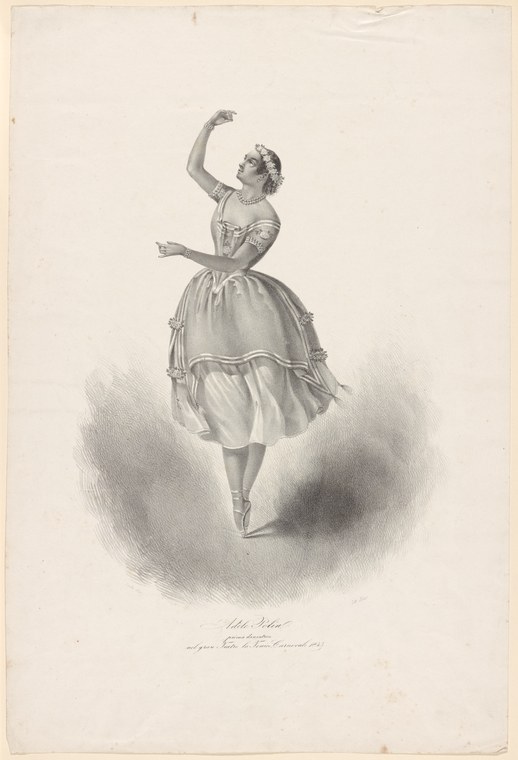
Adele Polin, prima danzatrice, nel gran Teatro d'Apollo in Roma, la primavera del 1840
Unknown artist
- Collection:
- Prints depicting dance
- Source:
- New York Public Library
- Rights:
- Public domain — free to use, share and adapt.
- Recorded as:
- Public Domain
Adele Polin is not as widely remembered as Taglioni or Cerito, but this print preserves her as a real working ballerina of the high romantic period, offering evidence of Italian ballet practice and the commercial celebrity culture around dance in 1840s Rome. It is a rare dated document of a specific dancer in a specific role, bridging the gap between written records and visual evidence of how romantic ballet technique and costume were actually performed.
What you are looking at
A young woman in mid-19th-century dress stands alone against a plain, softly shaded background. She wears a white muslin dress with a fitted bodice and short sleeves, gathered skirts that fall just below the knee, and a pearl necklace. Her hair is styled up with ringlets. She stands en pointe on her right foot, with her left leg raised and slightly bent, her body angled in a graceful contrapposto. Her right arm extends upward in a curved position near her head, while her left arm reaches diagonally across her body. The pose conveys weightlessness and elegance—the characteristic silhouette of a romantic-era ballerina captured at the apex of an arabesque or similar lifted movement. The engraving technique renders the figure in fine grey tones against white paper, with delicate hatching in the background to suggest a subtle shadow beneath her.
The dancing
A single female dancer is shown en pointe, her weight supported entirely on the ball of one foot in a position of perfect balance. Her raised leg is held in an extended attitude or arabesque line, with the body held upright and open. The arm positions follow the balletic conventions of the period: the upper arm curves gracefully, the line flowing from the torso through fingertips. Her weight is perfectly centered, the supporting leg straight and strong. The pose demonstrates the technical foundation of romantic ballet: vertical alignment, elongated line, and an ethereal floating quality.
The dance depicted
This is unmistakably romantic-era ballet, likely a soloistic moment from a mid-19th-century narrative ballet. The inscription identifies the subject as Adele Polin, a prima ballerina who performed at the Teatro d'Apollo in Rome in spring 1840. The print documents her in costume and in a signature arabesque or attitude position—a moment of stillness within an otherwise flowing composition. Polin belonged to the era of Taglioni and Cerito, when Italian ballet was transitioning under Austrian influence while maintaining its own virtuosic tradition. The image captures both her technical achievement and her status as a celebrity performer.
How it was made
This is a steel or copper engraving, a technique that allowed fine detail and wide circulation. The artist used cross-hatching and fine parallel lines to model the figure and suggest atmospheric space around her. The print would have been mass-produced and distributed as a theatrical souvenir or publicity item—standard practice for celebrating celebrated dancers of the 1840s. Engraving was the dominant medium for portraiture and celebrity imagery before photography became widespread, making such prints primary documents of how dancers presented themselves and were publicly understood.
About this work
This engraving documents Adele Polin, an Italian prima ballerina, in a moment of romantic ballet performance at Rome's Teatro d'Apollo in spring 1840. It captures the aesthetic ideal of the era: a solitary, ethereal figure suspended in a pose of technical perfection and apparent effortlessness. The print is both a celebrity portrait and a technical record, showing how romantic ballet looked to an educated viewer of the period—the pointe work, the elongated line, the graceful arm positions, and the gauzy muslin costume that defined the style. As a theatrical souvenir, it represents the machinery by which 19th-century dancers became public figures and their technical innovations were circulated and understood beyond the opera house.
How to look at it
Attend to the precision of the pose: the ankle and foot alignment en pointe, the centered weight despite the extended leg, the curve of the arm that avoids any hardness or angularity. Notice how the engraver has used light and shadow to suggest the muslin skirt's volume without overloading the image—the hatching is minimal, allowing the white of the paper to convey the fabric's lightness. The inscription at the base serves as a label, in the manner of theatrical prints, identifying the subject and her date of appearance. This is not a narrative moment but a posed ideal—the dancer shown at her best, in her costume, in a signature position.
The artist
The artist is not recorded, which is typical for commercial theatrical engravings of the period. The work is a professional print made for mass distribution, likely produced in Rome or a major European printing center. The engraver was skilled in the fine conventions of figure portraiture and understood ballet conventions well enough to render the pose accurately—the kind of specialist work that sat below the level of named fine artists but was essential to the celebrity machinery of 19th-century theater.
The period
This print dates to 1840, the height of the romantic ballet era in Europe. Pointe work had been fully integrated into the female dancer's technique; the Romantic tutu (shorter, airy, white muslin) was the standard costume. The 1830s and 1840s saw intense international competition among prima ballerinas, especially between the Italian school (known for technical virtuosity and mime) and the French school. Rome, under papal rule but culturally active, maintained its own operatic and balletic traditions. Theatrical prints of celebrated dancers were as ubiquitous in 1840 as film stills would become in the 20th century—mass-produced souvenirs that spread knowledge of specific performers across Europe.
Where it lives
This is a theatrical portrait engraving held in the New York Public Library's collection of prints depicting dance. Such prints were commercial products, produced for sale to the public and to dancers themselves as calling cards and publicity. The lack of artist attribution is standard for this category of work.
Dance in this work
Questions about this work
Who was Adele Polin?
Adele Polin was an Italian prima ballerina active in the mid-19th century. This print documents her appearance at Rome's Teatro d'Apollo in spring 1840. Beyond this record, biographical details are sparse—she belongs to the generation of dancers overshadowed by the more famous Taglioni and Cerito, yet was clearly a significant performer in her own context.
What is that pose called?
The pose is likely an arabesque or attitude, the two most recognizable lifted positions in classical ballet. In an arabesque, the supporting leg is straight and the raised leg extends behind, forming a long line. The print captures the ethereal quality that romantic-era dancers sought—a pose that appears to float rather than to strain.
Why is she standing on one toe?
Pointe work—dancing on the tips of the toes in specially reinforced shoes—became central to female ballet technique in the early 19th century. It created an illusion of weightlessness and otherworldliness, exactly the effect sought in romantic ballet. By 1840, pointe work was essential to a ballerina's technical vocabulary and public image.
What is this print made from?
This is an engraving, likely on steel or copper plate. The artist incised the design into the plate, then inked and printed it. Engraving allowed fine detail and could be reprinted many times, making it the ideal medium for producing affordable celebrity portraits and theatrical souvenirs in the 19th century.
More dance artwork





