49 works in this view — arrow keys or swipe to move between them.
Dance in Art
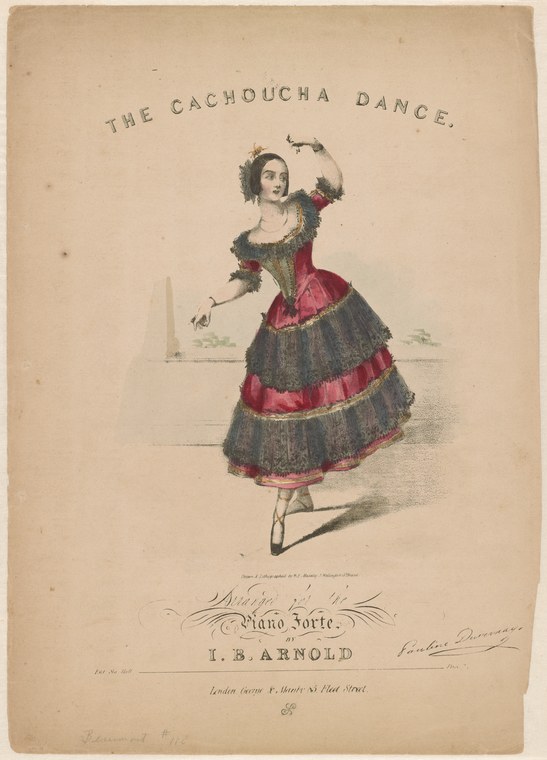
The cachucha dance.: Arranged for the piano forte by I. B. Arnold
Unknown artist
- Collection:
- Prints depicting dance
- Source:
- New York Public Library
- Rights:
- Public domain — free to use, share and adapt.
- Recorded as:
- Public Domain
The Cachucha represents a pivotal moment in dance history: the moment when exotic, earthy Spanish and Latin American dances were imported into the elite world of European ballet and transformed into vehicles for Romantic aesthetics—ethereal, technically refined, and ultimately domesticated. For historians of Orientalism and cultural appropriation in performance, this print is evidence of how 19th-century theatrical culture consumed and repackaged 'foreign' material. For musicians and social historians, it shows how a stage sensation became a commodity for the middle-class parlor, distributed through sheet music and engravings like this one.
What you are looking at
A young woman in mid-19th-century theatrical dress performs a solo dance against a pale background suggesting a stage or studio. She wears a dark corseted bodice with short puffed sleeves trimmed in red, and a full skirt composed of dark fabric gathered into horizontal bands of red silk or satin at the hem—a style characteristic of Romantic-era ballet costume. Her dark hair is styled up with what appears to be a decorative comb or ornament. She stands on the ball of her right foot in a lifted pose, with her left leg extended behind her, her left arm raised overhead with a graceful curve, and her right arm extended to the side. The pose suggests a moment of suspended elegance mid-movement. In the background, barely sketched, are faint architectural forms suggesting a seaside setting or classical balcony. The image is a hand-colored engraving or lithograph, showing the detailed linework typical of early-19th-century theatrical prints.
The dancing
A single female dancer captured in what appears to be an échappé or développé position, with weight on the supporting right foot en demi-pointe (ball of foot) and the left leg extended behind in an arabesque line. Both arms are raised in a soft, open frame—the left arm lifted above the head with a gentle curve typical of Romantic ballet port de bras, the right arm extended to the side at approximately shoulder height. The dancer's torso is upright and elegant, with no visible strain; the overall impression is one of ethereal lightness rather than athletic vigor. The positioning shows understanding of the balletic line and the aesthetic of graceful, elongated movement valued in this period.
The dance depicted
This is The Cachucha, a Spanish character dance that became one of the most famous theatrical dances of the Romantic era after its performance by dancer Fanny Elssler in the late 1830s. The cachucha is a lively, flirtatious solo typically danced to Spanish or Cuban-influenced music, characterized by rapid footwork, hand gestures, and a playful demeanor. However, the pose captured here—a moment of suspended balance and classical line—shows the dance as it was theatricalized and incorporated into the Romantic ballet vocabulary, where Spanish national character dances were exotic spectacles performed in classical technique. The music arrangement by I. B. Arnold for piano forte suggests this was a popular recreational piece for amateur musicians and dancers in the drawing room as well as the concert stage. The frozen moment here emphasizes the aesthetic and refined presentation of the dance rather than its original Spanish vivacity.
How it was made
This is a hand-colored engraving or possibly a lithograph from the early-to-mid 19th century, recognizable by the fine linear detail, the characteristic line quality of mechanical reproduction, and the application of watercolor or tinted pigment by hand to create the costume colors and flesh tones. The printing technique allowed for multiple copies to be produced and colored by hand, making this an affordable item for music shops, theater lobbies, and middle-class homes. The presence of the composer's credit and the indication "London George P. Harris 33 Fleet Street"—a known music publisher address—confirms this as sheet music cover art, designed to promote both the theatrical performance and the domestic musical arrangement. This format was central to disseminating dance imagery and music in the 19th century.
About this work
This is a theatrical advertisement in the form of a hand-colored engraving, promoting both a stage performance and a piano arrangement of The Cachucha, the Spanish character dance that became an international sensation when performed by the celebrated dancer Fanny Elssler. The print captures a moment of classical balance within an exotic national dance, reflecting the Romantic era's fascination with distant cultures and femininity. As a music-cover engraving, it belongs to a vast category of 19th-century popular prints that shaped how theatrical dance reached domestic and concert audiences. It demonstrates how a single dance could be transformed from a folk or popular form into high theatrical art, and then re-exported as a fashionable amateur entertainment.
How to look at it
Notice the precise moment the artist chose: not a moment of dynamic movement or footwork, but of balanced suspension and classical line. This reflects the Romantic ballet aesthetic, which prized stillness and ethereal lightness over the rapid, virtuosic footwork that may have characterized the original Spanish cachucha. Observe how the dancer's arms are posed in the soft, open positions of classical ballet rather than in the more energetic or gestural positions Spanish dance might demand. The hand-coloring distinguishes the red silk at the hem of the skirt—a detail that emphasizes the costume's theatricality and the 'national' character it is meant to signal. Finally, note the faint, barely-realized background: the figure is isolated against abstraction, emphasizing the dancer as an object of aesthetic contemplation rather than as part of a dramatic narrative or social scene.
The artist
The artist of the engraving is not recorded in the catalogue, but the credit line indicates publication by George P. Harris, a London music publisher active in the 1830s–40s, at 33 Fleet Street. Harris was a significant distributor of theatrical music prints and dance illustrations, specializing in hand-colored engravings that advertised both stage performances and domestic piano arrangements. The engraver's name may appear elsewhere on the print or in publisher records. This was a collaborative commercial enterprise: the composer I. B. Arnold arranged the dance music for piano, and a skilled engraver translated the dancer's pose into the fine linear detail required for printing and hand-coloring.
The period
The 1830s–40s were the apex of Romantic ballet and the height of the vogue for Spanish and Latin American character dances in European theaters. Fanny Elssler, the Austrian dancer who popularized The Cachucha in Paris (1836) and London (1837–38), became an international celebrity; the dance itself spawned countless imitations, arrangements, and spin-offs. This same period saw the rise of the theatrical print industry: engravings and lithographs of famous dancers became collectible commodities, sold at theaters, music shops, and through the post. Sheet music arrangement for piano made theatrical dances available to amateur musicians and dancers in drawing rooms across Europe and America. The print sits at the intersection of three 19th-century phenomena: the Romantic cult of the dancer as exotic, ethereal being; the commercial expansion of theatrical entertainment; and the democratization of music through domestic performance and print culture.
Where it lives
This print is held in the New York Public Library's prints collection, part of a broader archival effort to document dance imagery in visual culture. It is a music cover engraving and promotional print, the kind of commercial object that was mass-produced, hand-colored, and distributed through music shops and theatrical venues. Most such prints were ephemeral and discarded; the survival of this example reflects the archival value assigned to theatrical prints and dance documentation.
Dance in this work
Questions about this work
Who was Fanny Elssler and why does the Cachucha matter?
Fanny Elssler (1810–1884) was an Austrian dancer who became one of the most celebrated performers of the Romantic era. She performed The Cachucha in Paris in 1836 and London in 1837–38, where it became a sensation. The dance was exotic (Spanish), flirtatious, and showcased rapid footwork and playfulness—qualities that set Elssler apart from the ethereal, otherworldly aesthetic of her rival, Marie Taglioni. The Cachucha became Elssler's signature role and one of the most famous dances of the 19th century, spawning countless imitations and adaptations like this one.
Is this the actual dance from Spain, or a European version?
This is a thoroughly European, ballet-ized version. The cachucha originated in Spanish and Cuban popular culture as a lively, earthy solo dance with rapid footwork and flirtatious movement. When Elssler and other European dancers performed it, they incorporated classical ballet technique, slowed the tempo, and emphasized ethereal line and refined gesture. This engraving captures that theatricalized, Romanticized version—notice the classical arabesque pose and soft arm positions, which would not be typical of the original folk dance. The process is sometimes called 'balletic appropriation': taking a foreign dance and translating it into the vocabulary and values of European high art.
What is this object exactly?
This is sheet music cover art—specifically, a hand-colored engraving advertising an arrangement of The Cachucha for piano by composer I. B. Arnold. It served a dual purpose: it promoted the theatrical dance as performed on the London stage, and it allowed amateur musicians and dancers to engage with the piece in the home. Such prints were sold at music shops and theaters, and some were collected by enthusiasts. This example is now in the NYPL's collection as a document of 19th-century dance history and popular culture.
How can you tell what period this is from?
Several clues point to the 1830s–40s: the woman's costume (corseted bodice with short puffed sleeves, full gathered skirt, hairstyle) is characteristic of Romantic-era fashion; the hand-coloring technique and line quality of the engraving match early-19th-century printing methods; the publisher's address and credit line are consistent with London music publishing of that era; and the dance itself (The Cachucha in its Romantic vogue) dates to the late 1830s onward. Together, these elements point to a print made within a decade or so of Elssler's famous performances.
More dance artwork





