49 works in this view — arrow keys or swipe to move between them.
Dance in Art
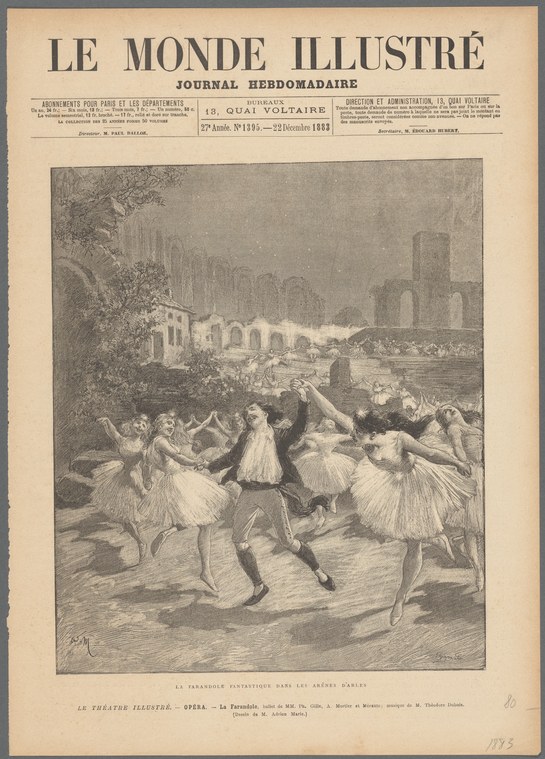
La farandole fantastique dans les arênes d'Arles
Unknown artist
- Collection:
- Prints depicting dance
- Source:
- New York Public Library
- Rights:
- Public domain — free to use, share and adapt.
- Recorded as:
- Public Domain
This image captures a crucial moment in European dance history: the appropriation and theatrical transformation of regional folk traditions into high-art theatrical spectacles. The farandole became a symbol of Provençal identity and national cultural heritage precisely through such theatrical stagings and their circulation in mass media. For historians of dance, theater, and visual culture, the work reveals how 19th-century audiences consumed regional tradition and how live performance was mediated and mythologized through print.
What you are looking at
A fantastical scene set in the Roman amphitheater of Arles, with the ancient arena's distinctive arches visible in the atmospheric background. In the foreground, a group of young female dancers in pale tutus performs an energetic, swirling group dance. The figures are arranged in loose formation across an open ground, their bodies in various attitudes of motion—some with arms raised, others mid-pirouette or in dynamic poses. The setting is rendered with romantic haze and distance; the stonework of the arena recedes into shadow and mist. The composition captures a moment of theatrical fantasy: a supernatural or legendary gathering rather than a documented performance. The dancers' costumes and the delicate rendering suggest this is a theatrical or operatic vision of a folk dance, not a naturalistic scene.
The dancing
The dancers are young women in classical ballet tutus, rendered with ethereal, elongated proportions typical of 19th-century theatrical lithography. Their arms are held high and open, in positions suggesting Romantic-era ballet vocabulary—extended, reaching, weightless. Several figures appear to be turning or in mid-leap; the poses convey lightness and buoyancy rather than grounded, earthy movement. The grouping is loose and circular rather than in formal lines or pairs, suggesting a communal or ensemble quality. The artist has prioritized the visual effect of swirling motion and the ethereal qualities of the dancers over anatomical precision or clear footwork detail.
The dance depicted
The work depicts the farandole, a traditional circle or chain dance from southern France (particularly Provence and the Arles region) that typically involves linked or joined hands and continuous forward movement. The title promises a 'fantastical' farandole, and the theatrical context—Roman ruins, atmospheric stage lighting, ethereal tutus, the publication in an illustrated newspaper—indicates this is a representation of the farandole as performed on the operatic or theatrical stage, not as a folk practice. The farandole was idealized and romanticized by 19th-century French theater and ballet as a picturesque national tradition, often featured as a divertissement or finale. This image captures that theatrical interpretation: the dancers are not in the characteristic linked-hand chain of a folk farandole, but rather in a dreamy, dispersed ensemble arrangement that prioritizes visual spectacle over structural accuracy.
How it was made
This is a wood engraving or wood-cut illustration, printed as part of *Le Monde Illustré*, a major French weekly illustrated newspaper founded in 1857. The technique allows for fine detail and tonal gradation through cross-hatching and line work; the atmospheric quality of the background and the delicate rendering of the dancers' forms show the skill of the engraver. Publication in a mass-circulation periodical meant this image reached a broad urban middle-class audience hungry for theatrical news and cultural imagery. The quality of the engraving—the careful modeling of light and the romantic treatment of the subject—suggests this was a significant theatrical production worthy of prominent illustration.
About this work
This is a wood engraving from a French illustrated newspaper documenting or celebrating a theatrical performance of the farandole—a traditional Provençal chain dance—staged in or referencing the Roman amphitheater at Arles. The work belongs to 19th-century visual culture's fascination with folklore, regionalism, and the staging of 'national' traditions on the operatic and theatrical stage. The image records not the dance as performed by rural communities, but the dance as imagined and theatricalized by the Paris stage: a dreamy, ethereal ensemble piece featuring young women in ballet costume against an evocative historical backdrop. It exemplifies how dance iconography in the period operated on two registers simultaneously—documenting contemporary theater while invoking romantic narratives of place, history, and cultural authenticity.
How to look at it
Attend to the tension between the title's promise of a 'fantastic' or supernatural event and the actual arrangement of the dancers. The figures are not linked hand-to-hand in the continuous chain characteristic of the folk farandole, but rather dispersed and individualized, each in a graceful ballet pose. This choice tells us that the engraver (and the theatrical production it documents) has prioritized pictorial beauty and the visual language of Romantic ballet over structural or ethnographic fidelity. The atmospheric background—the hazy arena receding into shadow—is as important as the dancers themselves; the setting and mood matter more than the precise documentation of steps or formation. This is theater, not reportage.
The period
The 19th century saw a sustained theatrical and artistic fascination with folk dance, regional tradition, and picturesque national character. The Romantic movement elevated folk culture—especially peasant and rural traditions—as expressions of authentic national spirit. In France, the Provençal region held particular appeal as a site of historical depth, classical associations, and cultural specificity. Theatrical producers routinely incorporated folk dances as divertissements or finales in operas and plays; the ballet stage adopted folk themes and figures. *Le Monde Illustré*, founded in 1857, was among the most important media through which such performances reached the urban public. The farandole had appeared in French theater since at least the 18th century but gained particular prominence in the mid-19th century as regional folklorism intensified. The amphitheater of Arles itself was a potent symbol—evoking classical Rome, historical French territory, and southern exoticism simultaneously.
Where it lives
*Le Monde Illustré* was a weekly illustrated newspaper published in Paris from 1857 to 1900, one of the most prestigious and widely circulated publications of its kind. This engraving appeared in the issue of 27 August 1883 (no. 1115, dated 27 Aug.–2 Sept. 1883). It is held by the New York Public Library as part of their collection of prints and dance-related imagery.
Dance in this work
Questions about this work
What is the farandole?
The farandole is a traditional chain or circle dance from Provence and southern France, typically performed with linked hands or arms and continuous forward motion. Participants form a long line or circle, moving together in a unified rhythm. In the folk tradition, it is performed at festivals, celebrations, and communal gatherings and dates back centuries. The dance became a symbol of Provençal identity and was frequently featured in 19th-century theatrical productions, ballet, and opera as a picturesque representation of French regional culture.
Why is this a 'fantastical' farandole?
The engraving shows a theatrical or imagined version of the farandole, not a documentary scene. The dancers are in individual ballet poses rather than the linked-hand formation of the authentic dance, and they float against a romantic, atmospheric backdrop of Roman ruins. The word 'fantastique' in the title signals that this is a stage fantasy—a theatrical interpretation and artistic elevation of folk material—rather than an attempt at ethnographic accuracy or representation of how the dance was actually performed in Provence.
What does it mean that this appeared in a newspaper?
*Le Monde Illustré* was a mass-circulation illustrated weekly that brought images of theater, society, and culture to the urban middle-class public. This engraving likely documented an actual theatrical performance or announced an upcoming production. The quality and prominence of the illustration reflect the cultural prestige of the event. Through such publications, theatrical interpretations of folk dance circulated widely and shaped public understanding of regional traditions—often as romantic fantasy rather than lived practice.
Who are these dancers?
The engraving does not identify specific performers. The dancers are rendered as generic young women in ballet costume, representatives of the farandole tradition rather than named individuals. This was typical of theatrical illustration in the period: the focus was on the dance, the spectacle, and the cultural or historical narrative, not on individual performer identity. The anonymity also allowed viewers to imagine the dancers as embodying the spirit of Provence rather than as specific stage personalities.
More dance artwork





