49 works in this view — arrow keys or swipe to move between them.
Dance in Art
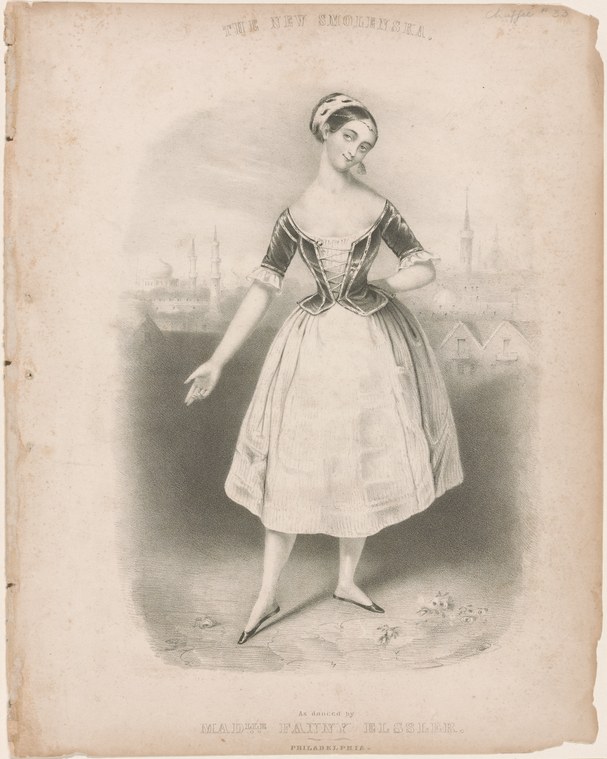
The new smolenska. As danced by Madlle. Fanny Elssler
Unknown artist
- Collection:
- Prints depicting dance
- Source:
- New York Public Library
- Rights:
- Public domain — free to use, share and adapt.
- Recorded as:
- Public Domain
Elssler was arguably the most influential female dancer of her generation, and this print is a direct record of her performance practice in a genre—the character dance—that shaped how European ballet consumed and presented the wider world. The image shows how mid-19th-century theater used dance to stage nationality and exoticism, a practice whose visual conventions are on full display here.
What you are looking at
A single female dancer stands in a three-quarter pose against a hazy urban backdrop. She wears a dark, short-sleeved bodice with a white full skirt that reaches to mid-calf, her posture upright and composed. The setting appears to be a city street or public space, suggested by architectural forms and church spires barely visible in the misty background. The engraving technique gives the scene a soft, atmospheric quality, with the figure rendered in careful gradation of tone. Her gaze is directed downward and to the side, suggesting a moment of introversion or transition within the dance rather than direct performance address.
The dancing
The dancer stands with her weight balanced, one arm extended away from her body with a natural, relaxed hand position, while the other rests at her side. Her posture is upright but not rigid, with a slight tilt to her frame that suggests weight in the supporting leg. The silhouette shows the characteristic stance of early-to-mid 19th-century dance vocabulary: a figure at ease within the movement, neither caught in dramatic extension nor in a formal position. There is a single dancer only, isolated in the composition.
The dance depicted
The title identifies this as "The New Smolenska" as performed by Fanny Elssler, one of the most celebrated European dancers of the 1830s–1840s. The Smolenska (or Smolensk dance) was a character dance with Russian or Eastern European associations, part of the exotic nationalist choreography that gained popularity in the Romantic ballet era. Elssler was known for her virtuosity in character dances as much as in classical roles. The simple, upright posture and modest costume here suggest the dance was presented as a folk or national number rather than a showpiece of technical extremity—consistent with how character dances were framed in the period.
How it was made
This is an engraving, likely a steel or copper-plate engraving given the fine detail and even tonal gradations. The technique allowed for wide circulation as a print, making it accessible to theater audiences and collectors beyond those who saw Elssler perform in person. The soft modeling of flesh and fabric through parallel lines and stippled tones shows skilled hand-engraving work. The print's production and distribution suggest it was a commercial venture tied to Elssler's fame, part of the apparatus that made celebrity dancers into commodities recognizable across Europe.
About this work
This engraving documents a performance by Fanny Elssler, the dominant female dancer of the 1830s–1840s, in a character piece—"The New Smolenska"—that was part of her regular repertory. Character dances occupied an important but sometimes understudied place in Romantic ballet: they were the vehicle for national and exotic color within the classical frame, and they were often where the greatest technical and dramatic demands fell. Elssler's association with character roles (as opposed to purely classical ones) was central to her artistic identity and her popularity with audiences. This print preserves a moment from that repertory and offers a window into how such dances were visually marketed and remembered.
How to look at it
Notice the calm, almost meditative quality of the pose—this is not a moment of climactic display or technical brilliance, but a moment of repose or transition. The downward gaze and the modest, balanced stance suggest the dance was performed with a kind of dignity rather than virtuosic flash. The white skirt, full but not extremely voluminous, and the simple dark bodice mark this as costume for a character piece, not a classical role. The atmospheric background, with its softly rendered cityscape, places the figure in a public space rather than the abstract void of pure classical ballet.
The artist
The artist is not recorded. The engraving was published in Philadelphia, suggesting it was produced for the American market, possibly in response to Elssler's celebrated tours of the United States (1840–1842). American publishers of the period made substantial capital from reproducing images of famous European performers; such prints were affordable and collectible, feeding demand from theater-goers and amateur dancers.
The period
The 1830s–1840s saw the height of Romanticism in ballet and the codification of character dance as a distinct category within the classical vocabulary. While the great Romantic heroines—Taglioni, Cerrito, Grisi—were celebrated primarily for their ethereal classical technique, Elssler built her reputation partly on character roles that showcased different technical and dramatic modes. At the same time, European ballet was hungry for material coded as exotic or national: Russian, Spanish, Hungarian, Polish dances proliferated on stage as part of the Romantic appetite for geographic and cultural variety. The Smolenska fits squarely within this moment.
Where it lives
The print is held in the New York Public Library's collection of prints depicting dance. It was published in Philadelphia, suggesting it was part of the commercial circulation of celebrity dance imagery in 19th-century America.
Dance in this work
Questions about this work
Who was Fanny Elssler?
Elssler (1810–1884) was an Austrian dancer and the leading female performer of the 1830s–1840s, rivaling Marie Taglioni in fame. She was celebrated for her technical brilliance and dramatic range, particularly in character dances and demi-caractère roles. Her tours of Europe and America made her one of the first truly international dance celebrities.
What was a character dance?
Character dances were stylized representations of national or folk dances, performed within the classical ballet context. They used the vocabulary of classical technique but were associated with particular countries or regions—Russian, Spanish, Polish, etc. They were a major part of 19th-century ballet, both as divertissements within larger works and as solo vehicles for great dancers.
Why was this printed and sold?
Celebrity dance imagery was a popular commercial product in the 19th century. Prints like this one were sold to theater audiences and collectors as souvenirs and as records of famous performances. They were affordable ways to own an image of a celebrated performer, and they helped spread that performer's fame beyond those who could attend live performances.
More dance artwork





