49 works in this view — arrow keys or swipe to move between them.
Dance in Art
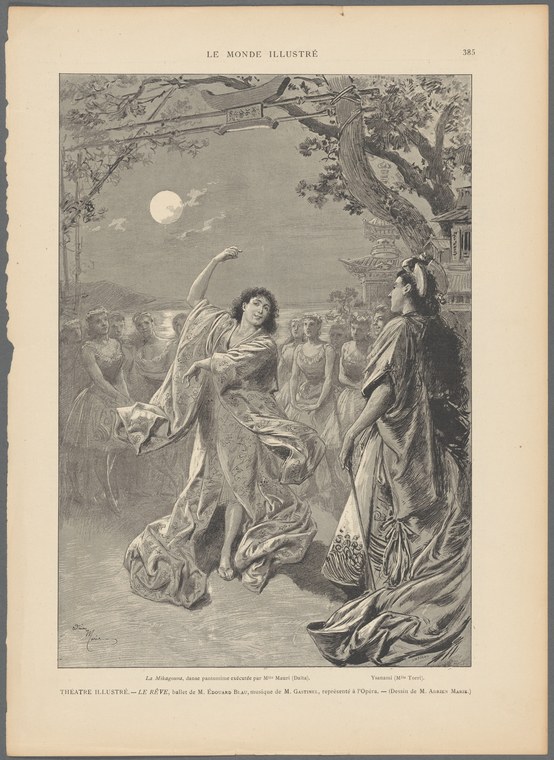
Le rêve, ballet de M. Edouard Blau, musique de M. Gastinel, représenté a l'Opéra
Unknown artist
- Collection:
- Prints depicting dance
- Source:
- New York Public Library
- Rights:
- Public domain — free to use, share and adapt.
- Recorded as:
- Public Domain
This is primary visual documentation of a Paris Opéra ballet performance, capturing not just costume and setting but also the specific movement vocabulary and emotional register of mid-19th-century Romantic dance. The publication in a major illustrated journal reveals how ballet was distributed and consumed beyond the theater itself, making this an artifact of the reception and popularization of dance culture.
What you are looking at
A moonlit garden scene set in classical antiquity, dominated by a central female figure in graceful contrapposto, her body arched backward with one arm raised and the other extended. She wears flowing drapery that swirls around her legs, and her pose suggests abandonment or ecstatic reverie. Around her stand several other figures in classical dress, some observing from the shadows at left, others prominent at right. The setting is framed by architectural elements — a colonnade and trees — and a large full moon illuminates the scene from above. The composition is theatrical and deliberately posed, arranged as a tableau vivant rather than a narrative moment. The engraving technique creates strong contrasts between lit and shadowed areas, emphasizing the central figure's isolation within the gathered crowd.
The dancing
The principal dancer (presumably the dreaming protagonist) stands alone in the center, her body weight shifted onto one leg while the other appears lifted or pointed. Her torso arches backward in a pronounced curve, with her head tilted back and one arm raised high in an open, expressive gesture. The other arm extends at shoulder height. This pose combines elements of classical dance vocabulary — the contrapposto stance, the lifted leg position, the open frame — with theatrical expressionism. The surrounding figures are stationary and arranged in a loose semicircle, functioning as witnesses or participants in whatever dream or vision is being enacted.
The dance depicted
This appears to be a scene from a theatrical ballet or pantomime-ballet from the 19th century, likely depicting a dream or fantastical vision sequence — common genres for the Paris Opéra. The catalogue identifies this as *Le Rêve* (The Dream), choreographed by Édouard Blau with music by Gabriel Gastinel, performed at the Opéra. The central figure's arched back and raised arm are characteristic of Romantic ballet vocabulary, particularly poses of emotional intensity or transcendence. The moonlit setting and the presence of observing figures suggest this moment captures the protagonist's reverie or supernatural encounter. Without access to the ballet's scenario, the exact narrative cannot be confirmed, but the visual language is unmistakably that of mid-to-late 19th-century Romantic ballet, with its emphasis on ethereal grace, classical line, and emotional drama.
How it was made
This is a wood engraving or steel engraving, executed with fine parallel lines and careful cross-hatching to model form and create tonal depth. The technique allowed for mass reproduction and circulation in periodicals, and indeed this image appears in *Le Monde Illustré*, a major Parisian illustrated journal. The engraving captures the full composition — stage, figures, lighting effects — in a way that photography could not yet reliably achieve. The medium's reliance on line rather than tone required the artist to compose the scene with clarity of silhouette and strong value contrasts, which accounts for the dramatic moonlight effect and the crisp definition of the dancers' forms.
About this work
This engraving documents a scene from *Le Rêve*, a theatrical ballet performed at the Paris Opéra in the mid-19th century. The work is a visual record of a specific moment onstage — the central character's ecstatic or transcendent pose during what appears to be a dream vision. The engraving reproduces the full theatrical spectacle, including costume, setting, and supporting cast, and its publication in *Le Monde Illustré* makes it an artifact of how ballet was circulated and consumed by the educated Parisian public. The Romantic ballet vocabulary — the arched back, the lifted leg, the expressive arm gesture — is on clear display, and the moonlit garden setting exemplifies the genre's taste for the ethereal and the supernatural.
For dance historians, the image is valuable as evidence of how a specific Parisian ballet looked in performance and how contemporary illustrators rendered movement and theatrical spectacle. The pose chosen — a moment of apparent emotional or spiritual climax — suggests the artist understood the grammar of Romantic ballet and selected a moment that would read clearly as drama to the journal's readers.
How to look at it
Attend first to the central figure's pose: the arched back and raised arm are not natural resting positions but deliberately theatrical and expressive gestures, signaling emotion or transcendence. The artist has frozen the dancer mid-movement, capturing a moment of apparent climax or revelation. The surrounding figures — some lit, some in shadow — function as framing devices and as witnesses, which was a common compositional strategy in ballet imagery: the soloist's vision or moment is set apart from the chorus or court that surrounds her. The moonlight and garden setting are not incidental but essential to the meaning; this is a scene of magic or dream, not of everyday life.
The artist
The engraving is uncredited in the record, but it was produced for publication in *Le Monde Illustré*, one of the most prestigious illustrated journals of Second Empire France. The journal employed skilled engravers and illustrators to document Parisian cultural events — theater, opera, ballet — for a middle-class readership. The technical sophistication of the line work and composition suggests a practiced hand, likely a staff engraver or illustrator working from a sketch or description made at a performance.
The period
This work dates to the height of the Romantic ballet era, when the Paris Opéra was the center of European dance innovation. Ballets featuring dream sequences, supernatural encounters, and ethereal female protagonists were the dominant aesthetic of the period. The taste for moonlit, atmospheric settings — seen here in the full moon and garden setting — reflects broader Romantic preoccupations with the dream, the night, and the boundary between the real and the otherworldly. The publication in *Le Monde Illustré* is characteristic of the mid-19th century moment when illustrated journalism became a major vehicle for disseminating images of high culture to a broad urban audience.
Where it lives
This engraving is held in the New York Public Library's collection of prints depicting dance. It was published in *Le Monde Illustré*, a Parisian journal of the mid-19th century, as a record of a performance at the Opéra.
Dance in this work
Questions about this work
What is this scene actually showing?
This is a documented scene from the ballet *Le Rêve* (*The Dream*), performed at the Paris Opéra. The central figure is the protagonist in a dream or supernatural encounter. The pose — arched back, raised arm — expresses emotional or spiritual intensity, and the moonlit garden setting reinforces the otherworldly nature of the vision. The surrounding figures are likely other characters or the corps de ballet witnessing this moment.
How do we know this is a real performance and not an imagined scene?
The engraving was published in *Le Monde Illustré*, a major Parisian journal that documented actual performances at the Opéra for its readers. The ballet *Le Rêve* with choreography by Édouard Blau and music by Gabriel Gastinel is documented in Opéra records. The engraving's style and level of detail — accurate costume, identified dancers and choreographer — are consistent with journalistic documentation rather than fantasy illustration.
What period of ballet is this?
This is Romantic ballet, characterized by ethereal female dancers in long skirts, supernatural or dreamlike scenarios, and emphasis on grace and emotional expression. The vocabulary visible in the central figure's pose — the arched back, the pointed leg, the open arm frame — and the nocturnal setting are hallmarks of mid-19th-century Romantic aesthetics.
More dance artwork





