49 works in this view — arrow keys or swipe to move between them.
Dance in Art
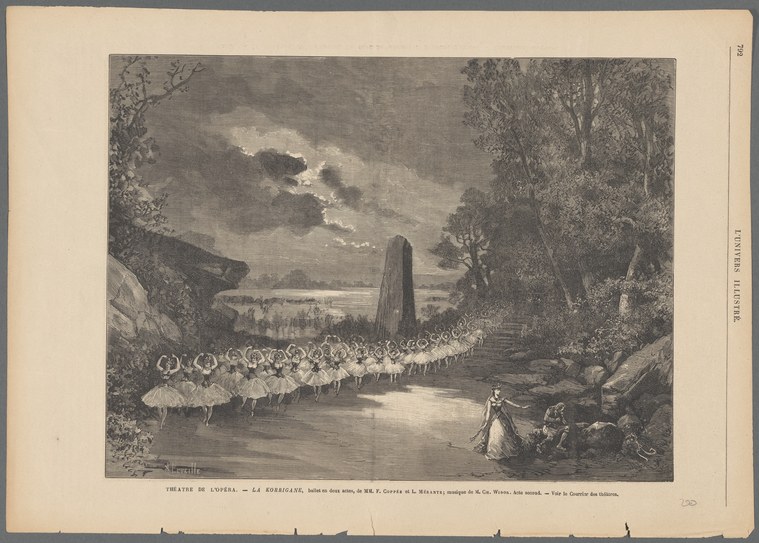
Théâtre de l'Opéra. La korrigane, ballet en deux actes, de MM. F. Coppée et L. Mérante; musique de M. Ch. Widor. Acte second
Unknown artist
- Collection:
- Prints depicting dance
- Source:
- New York Public Library
- Rights:
- Public domain — free to use, share and adapt.
- Recorded as:
- Public Domain
This image is rare evidence of how late Romantic ballet staged the supernatural: not through abstract movement but through the visual impact of a regimented, geometric corps. For dance historians, it shows the persistence of the corps de ballet as a tool for creating spectacle long after the great age of Romantic ballet, and it documents a specific and celebrated work by a major Paris Opéra choreographer. For those interested in nineteenth-century theatrical practice, it is a window into how such productions were documented, publicized, and consumed by a literate urban public.
What you are looking at
A moonlit landscape frames an extraordinary theatrical moment: a corps de ballet of dozens of dancers in pale tutus stands in a tight, orderly formation in and around a shallow stream, their bodies creating a precise geometric pattern. The dancers are arranged in long lines that curve and compress, some wading in the water, others on the banks. The setting is densely wooded with tall trees framing both sides; a tall stone monument or obelisk rises prominently in the middle distance. The sky is dramatic with dark clouds parted to show moonlight. In the foreground right, two figures in darker dress—likely the hero and heroine or a guide figure—stand on a rocky outcrop observing or gesturing toward the supernatural assemblage. The composition captures a moment of revelation or enchantment, with the corps arranged as if in thrall to an otherworldly force.
The dancing
The corps de ballet occupies the entire middle ground, arranged in disciplined linear formations that ripple and compress around the stream. Each dancer appears to be in an upright or slightly tilted position, arms raised or positioned symmetrically—consistent with the formalized port de bras of mid-nineteenth-century ballet. The figures in the foreground assume attitudes of wonder or command: one points toward the assembled dancers with an extended arm while the other bends or genuflects slightly, suggesting narrative engagement rather than participation in the ethereal dance. The dancers' pale costumes and the geometric precision of their arrangement suggest neither naturalistic movement nor character dancing, but rather a spectral or magical corps de ballet.
The dance depicted
This engraving documents the second act of *La Korrigane* (*The Korrigane*), a ballet-pantomime choreographed by Louis Mérante to music by Charles-Marie Widor, with a libretto by François Coppée. The Korrigane is a Breton fairy or magical being, and this scene almost certainly depicts the summoning or appearance of the korrigane's attendant spirits—a supernatural corps de ballet. The precise linear arrangement and the emphasis on geometric spectacle are hallmarks of Romantic ballet staging, where the corps de ballet was often deployed to create visual magic and otherworldly atmosphere rather than to dance a recognizable social or character idiom. The dance appears to be a grand tableau or cortège, designed to astound rather than to move naturally.
How it was made
This is an engraving (not a lithograph or photograph), executed with fine line work and cross-hatching to create tonal gradation and atmosphere. The engraver has used varying line density to model the human figures and to create the effects of moonlight and shadow in the landscape. The technique allows for precise rendering of costume detail and spatial recession, and the resulting image would have been reproducible and distributable as a page in an illustrated theatrical chronicle or souvenir. The tonal subtlety—the silvery quality of the moonlight, the dark woods, the pale tutus—is characteristic of mid-to-late nineteenth-century theatrical engravings, when audiences collected printed records of celebrated stage productions.
About this work
*La Korrigane*, which premiered in 1880, was a signature work of the Romantic ballet tradition at the Opéra in Paris. Mérante, a celebrated dancer and choreographer, created the role of the korrigane for the dancer Léa Fonta, and the ballet became known for its spectacular scenic and choreographic effects, not least this second-act tableau of the fairy corps. This engraving preserves not the literal choreography but the visual impression the scene left: an army of pale, geometrically arranged bodies summoned from the supernatural realm. It is a document of how Romantic ballet used the corps de ballet as a visual metaphor for magic and otherness, and of how that spectacle was circulated and memorialized in prints for a large public.
How to look at it
Look first at the architecture of the corps: the dancers are not scattered or moving fluidly through space, but locked into a rigid geometric shape, almost like a phalanx or procession. This is not realism but designed theatricality. Note the contrast between the precise, upright bodies of the corps and the more naturalistic poses of the two figures in the foreground—the image is telling two kinds of story at once. The moonlight, the woods, and the obelisk frame the dancers as a supernatural phenomenon. The engraver's use of moonlight to whiten the tutus and darken the landscape emphasizes the otherworldly quality the choreography and design were meant to create.
The artist
The engraver is not identified in the catalogue record. The engraving was created as a theatrical souvenir or document and would have been published in an illustrated journal or album dedicated to the Opéra production. Such prints were a standard practice in Paris theatrical culture and were both distributed to subscribers and sold individually to theatre-goers and collectors.
The period
The ballet was created at a moment when Romantic ballet—the aesthetic movement of the 1830s–1850s—had crystallized into a formal tradition. By 1880, the Romantic vocabulary of the supernatural, the sylph, and the fairy was being revived and restaged in ever more elaborate productions. Charles Widor, best known as an organist and symphonist, was a prolific ballet composer, and this work sits at the intersection of high Romantic music (influenced by Wagner) and balletic spectacle. The engraving's technique and style are consistent with late nineteenth-century Parisian theatrical documentation.
Where it lives
This engraving is held in the New York Public Library's collection of prints depicting dance. It is part of a larger archive of theatrical documentation from the Paris Opéra and related French theatrical institutions, and would have been published in the early 1880s as a souvenir or record of the production.
Dance in this work
Questions about this work
What is a korrigane?
A korrigane is a figure from Breton folklore: a small, magical being, often female, associated with the fairy mounds of Brittany. In this ballet, the korrigane is reimagined as a Romantic heroine and supernatural presence. The work draws on the Romantic era's fascination with Celtic mythology and with the magical and the otherworldly.
Who choreographed this ballet?
Louis Mérante (1828–1887) was a celebrated dancer, mime, and choreographer at the Paris Opéra. He was known for his dramatic and narrative ballets and for his ability to integrate pantomime with dance spectacle. *La Korrigane* was one of his most successful works and showcased his gift for creating vivid theatrical scenes.
Why is the corps de ballet arranged in such rigid formations?
This is a deliberately theatrical choice, not a naturalistic one. The geometric precision of the corps creates a visual metaphor for the supernatural: the dancers are not individualized characters but a unified, almost hypnotic force. This was a common strategy in Romantic ballet for staging magic, enchantment, or otherworldly realms.
How do we know this is an engraving and not a lithograph or drawing?
The technique visible in the image—the fine parallel lines (hatching and cross-hatching) used to create tonal gradation, the precision of the line work, and the lack of the softer, more variable mark-making typical of lithography—all point to engraving. The medium allows for the kind of precise, repeatable detail we see here, including the architectural rendering of the tutus and the delicate effects of moonlight.
More dance artwork





