49 works in this view — arrow keys or swipe to move between them.
Dance in Art
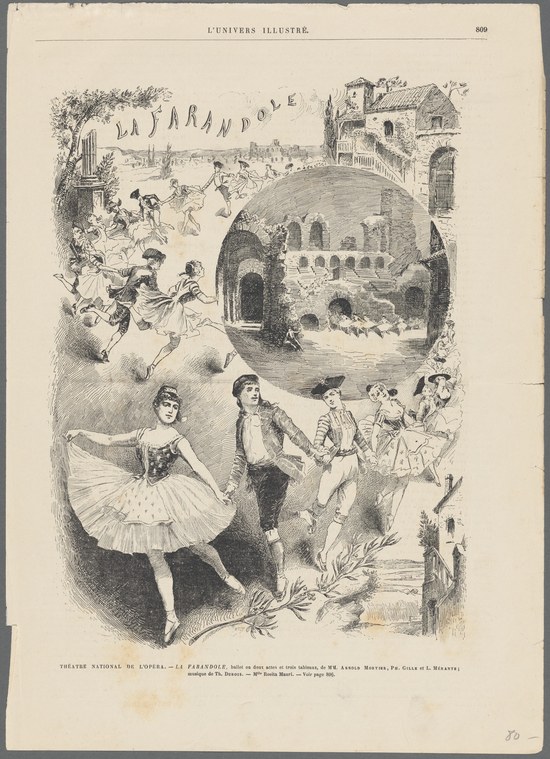
Théâtre National de l'Opéra. La farandole, ballet en deux actes et trois tableaux, de MM. Arnold Mortier, Ph. Gille et L. Mérante; musique de Th. Dubois. Mlle. Rosita Mauri
Unknown artist
- Collection:
- Prints depicting dance
- Source:
- New York Public Library
- Rights:
- Public domain — free to use, share and adapt.
- Recorded as:
- Public Domain
Rosita Mauri was one of the great prima ballerinas of the late 19th century, and this engraving is evidence of her celebrity and the technical demands placed on dancers of her rank. The work also documents the dominance of romantic and neo-romantic ballet in Paris during the 1870s–1880s, a period often overshadowed in ballet history by earlier romanticism and later Russian innovations. For anyone studying how 19th-century theatrical dance was disseminated, designed, and remembered, this image is primary evidence.
What you are looking at
This is an engraving illustrating a scene from a theatrical ballet production, divided into multiple vignettes that together tell the story of *La Farandole*. The composition is crowded and playful, typical of 19th-century theatrical publicity prints. At lower left, a principal female dancer in a white tutu and pointe shoes strikes a dynamic pose, one leg extended, arms raised in arabesque or attitude; her face shows the focused expression of performance. To her right, a male dancer in period costume (tights and jacket) stands with a smaller, more reserved frame. Above them, a architectural setting—an Italian town square or piazza with arches and a bridge—unfolds across the upper portion, populated with multiple figures in folk or period dress, suggesting the ballet's narrative context. The middle register shows what appears to be a grand interior space, possibly the opera house itself or a ballroom scene within the ballet, with numerous costumed figures moving through an arcade. The entire composition frames the narrative action within a decorative border of vine-like flourishes, emphasizing the theatrical and romantic nature of the production.
The dancing
The principal ballerina dominates the lower left in a clear arabesque or attitude derrière, weight on a supporting leg en relevé (on pointe), with the working leg extended behind at hip height or higher, and the upper body inclined forward in the classical épaulement of the era. Her arms are raised and extended, creating an open, expansive frame characteristic of Romantic ballet vocabulary. The male dancer beside her maintains an upright, formal stance with a closed frame—legs turned out, arms held low and composed. The numerous secondary figures scattered through the composition vary in pose and energy: some are seated or standing in social groupings, others appear to be in motion, suggesting the choreographed crowd scenes that were essential to 19th-century ballet spectacle.
The dance depicted
This is *La Farandole*, a three-act ballet choreographed by Louis Mérante with music by Théodore Dubois, performed at the Théâtre National de l'Opéra (the Paris Opera) with the renowned prima ballerina Rosita Mauri in the leading role. The farandole—a traditional French folk line dance from Provence—provides both the ballet's narrative frame and its title character. The engraving documents the spectacle of late 19th-century romantic ballet, which combined classical technique (as seen in the ballerina's pointe-work and arabesque) with elaborate scenic design, corps de ballet formations, and narrative pantomime. The multiple registers of the composition suggest the ballet's structure as a series of set pieces alternating between intimate dramatic moments and grand ensemble scenes set in Italian towns and grand ballrooms.
How it was made
This is a wood engraving or steel engraving, a reproductive print technique that allowed theatrical scenes to be disseminated widely in journals and as standalone sheets. The fine hatching and careful tonal gradation visible in the architectural elements and fabrics show the hand of a skilled engraver working from a drawn design—likely a costume or set sketch provided by the ballet's production team. This technique was the standard for theatrical publicity in the 1870s–1880s, before photographic reproduction became viable. The print would have appeared in journals like *L'Univers Illustré* (as indicated by the page header), reaching a broad educated audience and serving as both promotion for the ballet and a record of the production design and star performers.
About this work
This engraving documents a performance of *La Farandole*, a three-act romantic ballet choreographed by Louis Mérante and first staged at the Paris Opera in the late 19th century. The work represents a crucial moment in ballet history when classical technique, romantic narrative conventions, and contemporary theatrical spectacle merged in the service of an essentially French subject—the provincial folk dance of the farandole. The engraving's composition, with its multiple vignettes framing both the ballerina's technical virtuosity and the elaborate scenic design, shows how ballet was marketed and understood by audiences: as a synthesis of dance, drama, visual design, and music. This print, published in the illustrated journal *L'Univers Illustré*, serves as a visual record of how the ballet was staged, how the star performer was presented, and what audiences came to see.
How to look at it
Notice the contrast between the detailed, precise rendering of the ballerina's body and costume, which shows clear understanding of classical pointe technique and the aesthetic ideals of romantic ballet, and the looser, more cursory treatment of the architectural and crowd scenes. The engraver has prioritized the star performer and her technical accomplishments, which is exactly what the advertisement intended. Look at how the composition uses the decorative vine border and the fragmented vignettes to create a sense of theatrical spectacle while keeping the eye drawn to the principal dancer. The absence of dynamic male partners or prominent male dancers in the foreground reflects the star system of 19th-century ballet, in which prima ballerinas dominated the visual and narrative center.
The artist
The engraver is not identified in the catalogue, but the print's appearance in *L'Univers Illustré* suggests it was commissioned as part of the journal's regular coverage of Parisian theatrical productions. The Paris Opera's publicity machine would have supplied costume sketches, set designs, or even photographs of performances to skilled wood and steel engravers who translated them into the fine, reproducible line work required for periodical publication. Such engravings were typically created quickly to appear in print alongside reviews or advertisements, making them commercial and collaborative products rather than independent artworks.
The period
The ballet dates to the late 1870s or 1880s, a period when the Paris Opera was the center of European ballet despite competition from Russian companies. The romantic ballet tradition that dominated mid-century was giving way to a more eclectic, spectacular style that incorporated folk material (as here with the farandole), historical settings, and increasingly complex scenic machinery. This was also the era when theatrical journals and illustrated newspapers had become the primary means through which theater was documented and circulated to audiences who could not attend performances. Wood engraving was the cutting edge of reproductive technology—photographic printing had not yet become practical for mass circulation.
Where it lives
This engraving is part of the New York Public Library's collection of prints depicting dance, preserved as evidence of how dance performances were visualized and publicized in the 19th century. The page header indicates it appeared in *L'Univers Illustré*, a weekly illustrated journal published in Paris that served as a primary venue for theatrical coverage and artistic reproduction.
Dance in this work
Questions about this work
Who was Rosita Mauri?
Rosita Mauri (1850–1923) was an Italian prima ballerina who had a long career at the Paris Opera and was renowned for her technical virtuosity and dramatic presence. She danced in many of the important ballets of the late 19th century and was a major figure in preserving Italian ballet technique in Paris when the influence of Italian ballet schools was waning.
What is a farandole and why did it matter to ballet?
The farandole is a traditional French line dance from Provence, performed in a snake-like formation with linked hands. Its use as the subject and title of a grand opera-house ballet demonstrates how 19th-century choreographers sought to elevate folk material through classical ballet technique and elaborate theatrical production—a strategy that was both nationalist and romantic in impulse.
How was this image made and distributed?
This is a wood or steel engraving, a technique in which a finely detailed image is incised into a wooden or metal block that is then used as a printing plate. The engraver would work from sketches or designs provided by the opera house. The print appeared in *L'Univers Illustré*, a weekly illustrated journal with a large circulation, making this a form of mass media and theatrical publicity.
Why is the ballerina shown in arabesque?
The arabesque was one of the signature positions of classical and romantic ballet, requiring strength, flexibility, and control. By showing Mauri in this pose, the engraver documents both her technical achievement and the aesthetic ideal of the period. It is the most recognizable and prestigious ballet position, so it was natural to feature it in promotional imagery.
More dance artwork





