49 works in this view — arrow keys or swipe to move between them.
Dance in Art
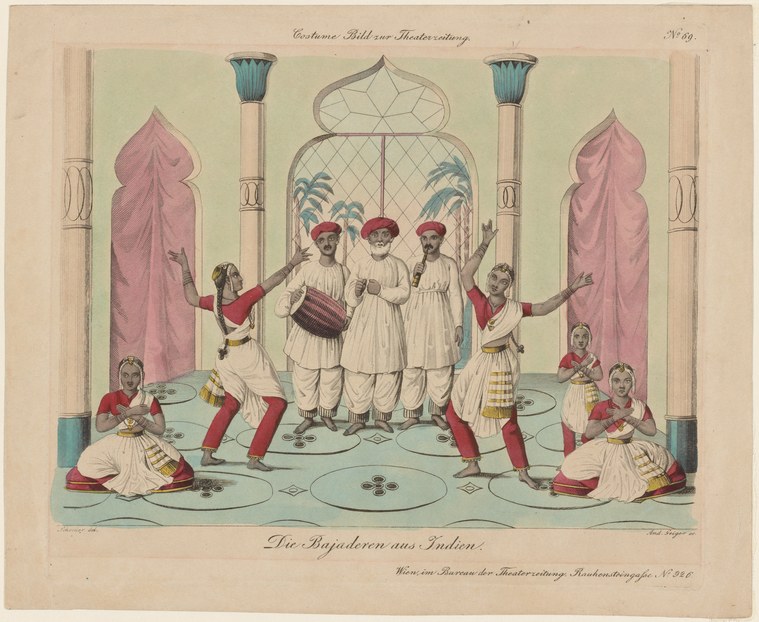
Die Bajaderen aus Indien
Unknown artist
- Collection:
- Prints depicting dance
- Source:
- New York Public Library
- Rights:
- Public domain — free to use, share and adapt.
- Recorded as:
- Public Domain
This image reveals the mechanisms by which European theatre created 'India' as a visual spectacle: through architectural fantasy, costume invention, and geometric staging that prioritised symmetry and spectacle over movement authenticity. For historians of Orientalism in dance, it is a primary document of how Indian dance was refracted through European Romantic aesthetics and theatrical conventions, often without reference to actual Indian practice.
What you are looking at
A hand-coloured engraving depicts a theatrical scene of Indian dancers in an ornate interior. Three central female figures in white muslin dresses stand upright, their arms raised and extended in symmetrical poses, wearing red turbans or caps. They are flanked by four additional dancers in similar dress, positioned lower and to the sides, creating a hierarchical composition. The setting is an elaborate architectural space with tall fluted columns topped with blue-green capitals, pink damask curtains, and a decorative latticed screen or window behind the central figures. Two male musicians or attendants stand to either side, one holding a drum, both gesturing expansively. Two seated female figures occupy the foreground left and right, attending to tasks or in poses of repose. The floor features geometric patterns in green and blue. The entire scene is rendered in muted tones with careful attention to the folds of fabric and the interplay of light across the drapery.
The dancing
The three central dancers adopt an upright, formal posture with arms extended outward at shoulder height, palms open, suggesting controlled, stylised movement rather than rapid action. The supporting dancers maintain similar vertical alignment and arm positions, creating visual symmetry. None of the figures appears to be in rapid motion or off-balance; all weight is grounded and centred. The two male figures with outstretched arms suggest accompaniment or orchestration of the dance. The composition privileges verticality and frontal facing, with dancers arranged in a shallow stage plane rather than receding into depth.
The dance depicted
The title identifies these as dancers from India (Bajaderen aus Indien). The formal posture, white garments, turbaned headdresses, and the architectural setting suggest a stylised European interpretation of Indian court or temple dance, rather than documentation of actual practice. The symmetrical arrangement, upright carriage, and extended arm positions do not clearly correspond to any identifiable South Asian classical dance form (Bharatanatyam, Kathak, Kathakali, Odissi). This appears to be a Romantic-era theatrical fantasy, created for European audiences, that borrows visual motifs associated with the Orient rather than depicting authentic Indian dance. The presence of the drum player and the formal staging suggests this may represent a scene from a European ballet or theatrical production with an Indian theme.
How it was made
This is a hand-coloured engraving, as indicated by the fine linear hatching visible throughout and the application of watercolour or gouache over the printed base. The technique allowed for wide reproduction and circulation among European audiences, making this an image designed for theatrical programme publication or popular print consumption. The hand-colouring adds specificity of costume and setting that line engraving alone could not convey, suggesting either a luxury edition or a later colouring of a commercially successful print. The precision of the architectural rendering and the regularity of the dancers' poses indicate training in classical engraving technique and knowledge of European stage design conventions.
About this work
This is a theatrical costume and scenery design engraving from the Romantic period, depicting a European imagining of Indian dancers. It belongs in a dance collection as evidence of how European ballet and theatre of the late 18th or early 19th century constructed and consumed 'Oriental' spectacle, borrowing visual elements from Indian dress and architecture without engaging with actual Indian dance forms or their aesthetics. The work documents not Indian dance itself but the European fascination with exoticised representations of it—a phenomenon central to the history of how non-European dance entered European theatrical consciousness during this period.
How to look at it
Attend to the absolute stillness and symmetry of the composition: no dancer is captured mid-leap or caught in asymmetrical abandon. Instead, all figures are held in formal, upright poses that resemble tableau vivant more than dance as kinetic practice. Notice the careful rendering of the muslin folds and the precision of the architectural frame—this is a designer's vision of an ideal stage picture, not documentation of movement or technique. The presence of the drum player and the frontal address of the dancers suggest this is a moment of formal presentation or opening, a static inauguration of the spectacle rather than its climax.
The artist
The artist is not recorded. The engraving bears a publication mark suggesting it comes from a theatrical costume or scenery book (Kostüme, Bild zur Theater-Ausstattung), a popular print genre in German-speaking Europe from the 1770s–1830s. Such prints were often produced collaboratively by theatre designers, engravers, and publishers, with individual artists sometimes uncredited. The style and subject matter are consistent with German and Austrian theatrical print production of this period.
The period
This image dates from the height of European Romantic theatre's fascination with the 'Orient'—a period when ballet and theatrical production increasingly incorporated exotic or foreign settings and costumes as markers of spectacle and artistic ambition. The late 18th and early 19th centuries saw the rise of ballets d'action with non-European themes (such as those choreographed by Jean-Georges Noverre and later Romantic choreographers), which relied heavily on costume and scenic invention to signal 'otherness' to European audiences. India, as both colonial possession and imaginative space, was a frequent source of such theatrical exoticism. The architectural vocabulary and the sculptural posturing of these dancers reflect neoclassical influence in European theatrical aesthetics while the 'Indian' dress and setting mark it as part of the Romantic era's appetite for cultural difference.
Where it lives
This engraving comes from the NYPL's collection of prints depicting dance. It is catalogued under the German title Die Bajaderen aus Indien and appears to be part of a suite of theatrical costume and scenery designs. The inscription on the lower edge references a theatrical publication (Wiens im Bureau der Theater-ausstattungs-Handzeichnungen), suggesting it was published as part of a series of designs for theatrical use or consumption.
Dance in this work
Questions about this work
Is this documentation of actual Indian dance?
No. This is a European theatrical fantasy, created for stage spectacle rather than ethnographic accuracy. The postures, symmetrical arrangement, and architectural setting reflect European Romantic theatre conventions, not Indian dance practice. The title 'Bajaderen' (a Dutch and German term for Indian dancing women, derived from Portuguese colonial terminology) already signals this as a European representation rather than an Indian source.
What would 'Bajaderen' have meant to a European audience of this period?
The term referred generically to exotic, often erotically coded female dancers associated with European fantasy of colonised territories. In European theatre, 'Bajaderen' dances were often sensual, spectacular, and positioned as entertainment for European male gaze. They bore little resemblance to actual Indian temple or court dance and served primarily as a vehicle for costume display and scenic novelty.
What is the white dress and red turban meant to evoke?
The white muslin echoes actual Indian garments and the prized Indian textiles that were central to European trade and desire in this period. The red turban or cap may reference Mughal or Indo-Persian court dress, flattened into a generic 'Oriental' visual marker. Together, they create a silhouette readable to Europeans as 'Indian' without claiming documentary accuracy.
Why are there seated and standing dancers in different poses?
This suggests a formal courtly or temple setting with dancers of different ranks or roles—attendants, musicians, and principal performers arranged hierarchically. The composition may represent a scene from a European ballet narrative about India, staging a moment of ceremony or ritual within an imagined Indian court.
More dance artwork





