49 works in this view — arrow keys or swipe to move between them.
Dance in Art
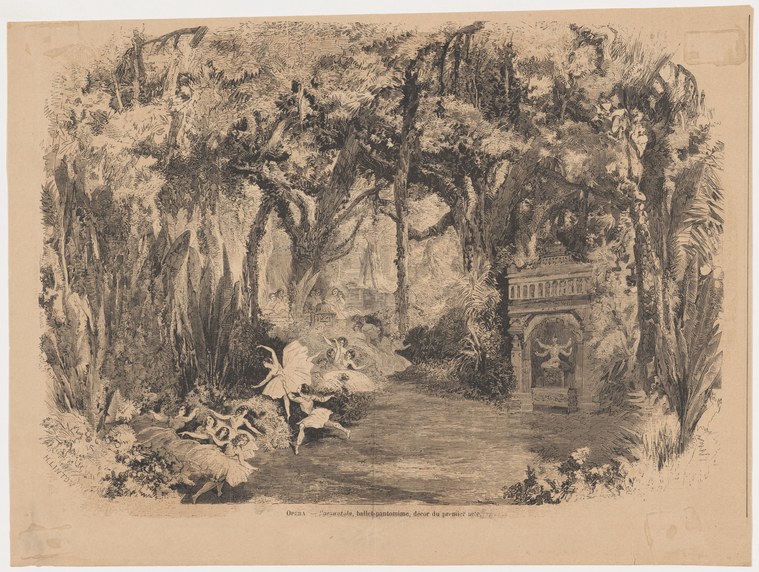
Opéra. Sacountala, ballet-pantomime, décor du premier acte
Unknown artist
- Collection:
- Prints depicting dance
- Source:
- New York Public Library
- Rights:
- Public domain — free to use, share and adapt.
- Recorded as:
- Public Domain
This image captures a crucial shift in how ballet was designed and consumed in the 19th century: the rise of the scenic spectacular and the integration of dance into landscape and atmosphere. For historians of Romantic ballet and the visual culture it generated, this engraving is primary evidence of how productions like *Sacountala* were marketed, remembered, and circulated to audiences who never saw the live performance. For dancers, it illustrates the theatrical context that shaped the Romantic vocabulary of ethereality and supernatural presence.
What you are looking at
This engraving depicts a forest glade in soft focus, with tall trees creating a columned arcade that recedes into atmospheric haze. The foreground is dominated by a pool of water reflecting light, bordered by lush vegetation and flowering plants. At right, a classical pavilion or garden folly with ornamental relief work sits elevated above the water's edge. In the middle distance, two or three figures in flowing drapery appear to move or pose near the water's edge, their forms rendered with delicate hatching that suggests gossamer fabrics and graceful limbs. The entire scene is composed in the Romantic picturesque manner: nature idealized, theatrical depth achieved through overlapping planes of foliage, and human figures integrated as poetic accessories to landscape rather than as protagonists. The light is cool and diffuse, creating a dreamlike, nocturnal or twilit atmosphere.
The dancing
The dancers are small in the composition and rendered somewhat indistinctly, consistent with the engraving's atmospheric style. What is legible suggests figures in classical or pseudo-classical poses: upright carriage, arms extended or held in positions suggesting elevation and grace. Their garments appear to be tunics or empire-waist gowns of the early 19th-century theatrical style, flowing freely and responsive to movement. The poses suggest a stately, ornamental use of the body rather than vigorous footwork; if this depicts dance, it is pantomime or processional rather than rapid or acrobatic action.
The dance depicted
The title identifies this as a scene from *Sacountala, ballet-pantomime*, likely the 1830 Paris production or a later restaging of this popular Romantic-era work. Sacountala was based on Kālidāsa's Sanskrit play and mounted frequently at the Opéra during the Romantic period, often with elaborate scenic investiture. This particular engraving documents a scenic design rather than a moment of virtuoso dancing; the dancers function as part of a landscape tableau. Romantic ballet frequently suspended narrative action in order to create such painted or sculptural moments, and this is almost certainly that kind of image—a *mise-en-scène* revealing the designer's conception of a magical forest or divine realm.
How it was made
This is an engraving, most likely a steel or copper engraving executed in the mid-19th century, identifiable by the fine parallel hatching, the tonal gradations built from line rather than wash, and the overall linear precision. The technique allowed such works to be reproduced in large editions, making them accessible to the theatre-going and art-buying public as records of celebrated productions. The atmospheric effect—the suggestion of mist, soft focus, and romantic dimness—was achieved through careful modulation of line density, a sophisticated use of the medium's constraints. Such engravings were commonly bound into published accounts of notable operatic or ballet productions, or sold as independent prints to collectors interested in theatrical history and design.
About this work
This is a scenic engraving documenting a moment from *Sacountala*, one of the most celebrated Romantic-era ballets. It records not the dancing itself but the design philosophy of the period: the belief that ballet should create enchanted spaces, that dancers should be absorbed into landscape and atmosphere, and that the spectacular and decorative were as much the substance of dance as movement. The work belongs to a genre of theatrical-production engravings that shaped how the 19th-century public understood and remembered ballet—not as choreography, but as total artistic vision. The small, ethereal figures in the forest confirm that this was an era when the Romantic ballet dancer was imagined as a supernatural being, moving through magical environments as much as across the stage.
How to look at it
Look first at what has been removed from the scene: there is no stage frame, no footlights, no sense of a proscenium. The entire image is composed as a landscape that happens to contain dancers, rather than a performance that takes place in front of us. Attend to the scale of the figures: they are tiny, rendered delicately and with less detail than the vegetation. The artist's choice to obscure rather than clarify the dancing suggests that the enchanted *place*—the forest, the pavilion, the supernatural atmosphere—is the protagonist. This is characteristically Romantic: the notion that ballet exists to create beauty and atmosphere, and that dancers embody or ornament those rather than transcend them.
The artist
The artist is not recorded. The engraving is likely French, given the subject (a Paris Opéra production), the style (consistent with mid-19th-century French theatrical engravings), and its inclusion in a collection of theatrical prints. Such scenic engravings were often produced by specialist firms or anonymous engravers working after designs by the original stage designers; attribution to the engraver, when it existed, was often considered less important than fidelity to the scenic design itself.
The period
Romantic ballet emerged in the late 1820s with works like *La Sylphide* (1832) and *Giselle* (1841), which displaced the neoclassical emphasis on technique and narrative clarity with an aesthetic of mystery, landscape, and supernatural beings. *Sacountala* premiered in 1830 and was frequently revived; it exemplified the Romantic appetite for exotic and literary subjects, here drawing from Sanskrit drama. The 1820s–1840s saw the rapid development of sophisticated stage machinery, gas lighting (which allowed for more atmospheric effects than candlelight), and the rise of the *maître décorateur*—the stage designer as a celebrated artist. Engravings like this one were part of a new culture of theatrical publicity and criticism in which the visual splendor of a production became as much a subject of public discourse as the dancers themselves.
Where it lives
This engraving is held in the New York Public Library's collection of theatrical prints and related ephemera. It was likely published separately or as part of a bound account of notable Paris Opéra productions; such collections were common among collectors and in public institutions by the mid-19th century. The notation at the bottom of the image (partially legible) suggests it accompanied a caption or was part of a documented series.
Dance in this work
Questions about this work
Is this image of an actual ballet performance?
No. This is a scenic design engraving—a record of the stage design and atmosphere, not of a particular moment in the choreography. It was likely created after the ballet was mounted, as a way of advertising or documenting the production's visual spectacle. The dancers are incidental to the landscape.
Who were the dancers in Sacountala?
The original 1830 production at the Paris Opéra featured principal dancers of the period, but this engraving is too small and indistinct to identify them. The work was frequently revived with different casts throughout the 19th century. No specific cast is recorded in the catalogue for this print.
What is a ballet-pantomime?
In 19th-century practice, a ballet-pantomime was a theatrical work that combined narrative drama (conveyed through mime and gesture) with spectacular scenic design and dance interludes. It was distinguished from pure ballet by its emphasis on plot and mime, and from spoken drama by its use of music and dance. Romantic works often blurred these categories.
Why are the dancers so small and hard to see?
This reflects the Romantic aesthetic that privileged atmosphere and landscape over human virtuosity. The dancers were meant to appear as delicate, ethereal beings moving through a magical space—almost part of the scenery. This compositional choice was revolutionary compared to earlier neoclassical ballet, which foregrounded the dancer's body and technique.
More dance artwork





