49 works in this view — arrow keys or swipe to move between them.
Dance in Art
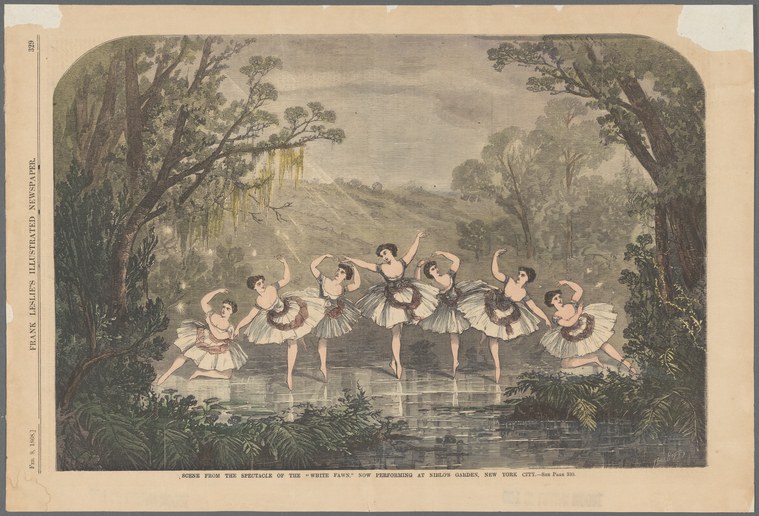
Scene from the spectacle of the White fawn, now performing at Niblo's Garden, New York City
Unknown artist
- Collection:
- Prints depicting dance
- Source:
- New York Public Library
- Rights:
- Public domain — free to use, share and adapt.
- Recorded as:
- Public Domain
This is a rare visual record of an important American theatrical production during the period when Romantic ballet was establishing itself in the United States. It shows exactly how a specific moment of choreography and spectacle was conceived and performed, preserving information about costume, stage technology, and the aesthetics of the corps de ballet that cannot be recovered from written sources alone.
What you are looking at
A troupe of eight female dancers in matching tulle skirts performs on a moonlit stage, positioned on and around a shallow body of water fringed with reeds and overhanging willow trees. The dancers are arranged in a loose line across the water's surface, their bodies caught in synchronized poses suggesting the floating, weightless quality characteristic of Romantic ballet. The composition is framed by dense woodland—dark tree trunks and foliage form a natural proscenium, drawing the eye toward the pale, luminous figures at center. The lighting is theatrical and ethereal, with moonlight or stage lighting illuminating the dancers against a darker sky and landscape, creating strong contrast between the bright costumes and the shadowed surroundings. The setting evokes a magical forest or enchanted glade, a hallmark of mid-nineteenth-century Romantic subject matter.
The dancing
Each dancer wears a fitted bodice and a tulle skirt of knee length, with what appear to be light-colored slippers. Their arms are raised and extended in various graceful positions—some with arms overhead, others to the sides—creating an impression of buoyancy and fluidity. The dancers' bodies are upright and elongated, with legs positioned in turnout typical of ballet. They appear weightless, as if hovering or gliding across the water rather than standing firmly planted, suggesting the use of pointe work or the illusion of it. The group moves as a unified corps, their poses mirroring and complementing one another, indicating disciplined, trained bodies working in concert.
The dance depicted
This is a scene from *The White Fawn* (*La Fawn Blanche* or *Le Faon Blanc*), a spectacular pantomime-ballet that premiered at Niblo's Garden in New York City during the 1860s. The work was part of the wave of Romantic ballets with supernatural and natural themes that dominated mid-nineteenth-century theater, featuring ethereal fairy-tale narratives and corps de ballet sequences designed to showcase ethereal movement and elaborate stagecraft. The water setting and the shimmering, weightless choreography suggest the enchanted-forest or fairy-realm themes typical of Romantic ballet, with the corps de ballet used to create an impression of magical beings moving in an otherworldly landscape. The work exemplifies how Romantic ballet themes and movement vocabulary were adapted for American theatrical audiences of the period.
How it was made
This is a hand-colored engraving or lithograph, as evidenced by the fine linear detailing in the foliage and figures and the soft tonal gradations characteristic of lithographic stone or engraved copper printed with color separations. The technique allowed for precise rendering of the dancers' poses and the elaborate architectural detail of the scenery—the trees, water, and distant landscape—while the hand coloring adds depth and atmosphere, particularly in the darker woodland tones and the pale flesh and fabric of the figures. This method of reproduction made the image affordable and accessible as a souvenir or advertisement for the theatrical production, circulating among the New York theater-going public and potentially among those who had not attended the performance. The theatrical subject and high production quality suggest this was a significant production image intended for wide distribution.
About this work
This engraving documents a moment from *The White Fawn*, a mid-nineteenth-century spectacular theatrical production performed at Niblo's Garden in New York. The scene captures the hallmark visual strategy of Romantic ballet: a corps de ballet of identically costumed, gracefully posed female dancers arranged in a sylvan setting designed to suggest magic, otherworldliness, and the triumph of the ethereal over the material. The work is a key artifact of how European Romantic ballet conventions were staged and promoted in America, and how theatrical prints functioned as souvenirs and advertisements that extended the reach of live performance into the homes and galleries of the theater-going public.
The image is significant not only as a record of a specific production but as evidence of the visual language that defined mid-nineteenth-century ballet spectacle: the emphasis on ensemble movement, the idealization of the female body in motion, the use of landscape and lighting to create mood and meaning, and the deliberate cultivation of an ethereal, supernatural aesthetic. For dancers and historians, it documents how Romantic ideals were realized in practical theatrical terms—costuming, staging, body positions, and the composition of group movement.
How to look at it
Attend to the suspended quality of the dancers' poses: the artist has frozen them in moment of apparent weightlessness, with many supported on the tips of their toes (the illusion of pointe work, though not all feet are clearly visible), and with their limbs extended in harmonious, elongated lines. Notice how the uniform costumes and synchronized positioning create a visual rhythm that echoes the symmetries of the landscape—the dancers are arranged almost as natural elements themselves, part of the enchanted forest rather than visitors to it. The theatrical lighting, which isolates the dancers from their surroundings, is crucial: this was not naturalistic illumination but the calculated artifice of stage lighting, designed to make the bodies appear to float and to emphasize the demarcation between the magical world of the stage and the ordinary world of the audience. The artist has chosen to depict not a moment of virtuosic technical display but one of poetic unity and ethereal calm—the quintessential Romantic ballet ideal.
The period
The 1860s were a transitional moment in American theater. Romantic ballet, which had flourished in Europe through the work of choreographers like Jean Coralli, Jules Perrot, and Arthur Saint-Léon, was being adapted and elaborated for American audiences with increasingly ambitious scenic investments and large corps de ballet. *The White Fawn* exemplifies this trend: it was a long-running spectacular at Niblo's Garden, one of New York's premier theaters, and it combined imported European ballet technique with American theatrical resources and audience expectations. The work coincided with the height of the Romantic era in European ballet (though that era was already giving way to more technical virtuosity), but in America, Romantic spectacle remained a dominant form of theatrical dance through the 1870s and beyond.
Theater prints like this one served a specific cultural function: they advertised forthcoming performances, commemorated successful runs, and allowed those who could not attend—or wished to relive the experience—to own an image of the spectacle. The quality of this print and its careful composition suggest it was an official or authorized image, likely distributed by the theater itself or by the production's managers. Such prints are now invaluable documents of performance history, as the choreography, costumes, and staging of nineteenth-century ballet survive almost entirely through images and written description.
Where it lives
The image is held in the New York Public Library's collection of prints depicting dance, a resource of theatrical and performance documentation assembled from playbills, theater archives, and prints distributed as souvenirs and advertisements. It is a theater souvenir and advertisement from the 1860s, likely produced in the hundreds or thousands for distribution to patrons and the broader New York public.
Dance in this work
Questions about this work
What is The White Fawn and why was it important?
*The White Fawn* was a long-running spectacle at Niblo's Garden in New York, starring the French dancer Giuseppina Morlacchi. It combined pantomime, ballet, and elaborate scenery in the tradition of European Romantic ballet, adapted for American audiences. The production was one of the most commercially successful theatrical works of its era and demonstrated the popularity and profitability of ballet spectacle in America during the Civil War and Reconstruction periods.
Why are the dancers posed on water?
The setting reflects the Romantic ballet tradition of supernatural and nature-themed narratives, often set in enchanted forests, lakesides, or magical realms. The water amplifies the ethereal effect: it suggests weightlessness and otherworldliness, as if the dancers are spirits or magical creatures rather than human performers. The water also provided a technical challenge and visual spectacle that would have impressed audiences of the 1860s.
How does this image differ from actual choreography?
This is a single frozen moment, posed for the engraver or photographer. The actual choreography would have involved movement, transitions, and sequences not visible here. Theater prints of this period often stylized and idealized the poses, emphasizing grace and beauty over technical precision. The print documents the visual aesthetic and costume of the production rather than the kinetic reality of the performance.
What does this tell us about 19th-century ballet technique?
The upright posture, extended arms, turned-out legs, and apparent use of pointe work all reflect the training and aesthetic ideals of classical ballet as taught and practiced in the 1860s. The corps de ballet is arranged to create unified, flowing visual compositions rather than individual display—a hallmark of Romantic ballet choreography that prioritized ensemble harmony over solo virtuosity.
More dance artwork





