49 works in this view — arrow keys or swipe to move between them.
Dance in Art
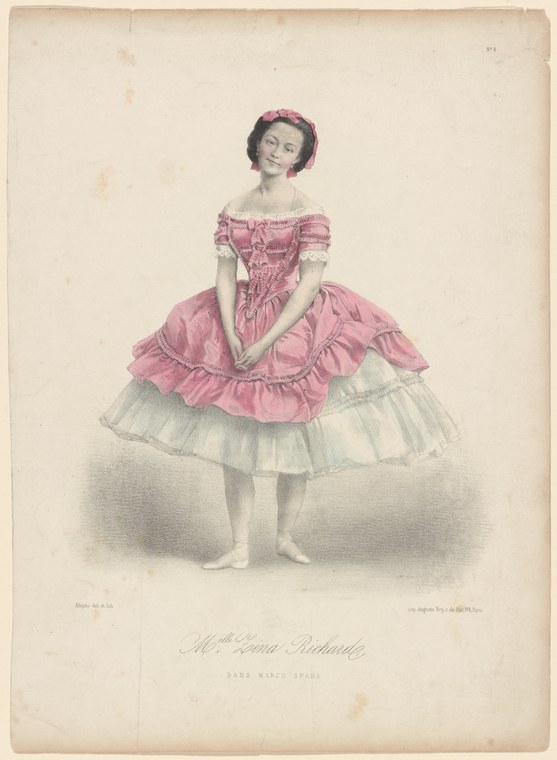
Melle. Zina Richard dans Marco Spada
Unknown artist
- Collection:
- Prints depicting dance
- Source:
- New York Public Library
- Rights:
- Public domain — free to use, share and adapt.
- Recorded as:
- Public Domain
This print is primary evidence of how nineteenth-century Romantic ballet dancers were marketed, consumed, and remembered by the public. It shows what audiences valued: the exotic costume, the youthful body, the named star—and how the theatrical image circulated far beyond the theater itself, shaping public taste and desire.
What you are looking at
A young female dancer stands alone against a plain background, posed in a moment of stillness rather than active movement. She wears a rose-pink off-shoulder dress with pronounced horizontal ruching and ruffles across the bodice and skirt, which extends to just below the knee and reveals her legs and bare feet. The skirt is voluminous and structured, with a stiffened petticoat visible underneath creating a bell-like silhouette. Her dark hair is styled close to her head with what appears to be a ribbon or headdress. She stands with her weight centered, one arm hanging naturally and the other positioned across her body in a pose of repose. The image is a color-tinted lithograph or engraving, with subtle shading creating dimension around the figure against the neutral ground.
The dancing
The dancer is depicted in a standing position with relaxed posture, her frame open and frontal. There is no active partnering, and her arms are positioned naturally rather than in any formal ballet frame. Her feet appear to be in a neutral stance rather than in any turned-out position characteristic of classical ballet technique. The overall bearing is that of a performer pausing between actions rather than executing a specific step or movement phrase.
The dance depicted
This print documents a performer in the Romantic ballet era, likely from a well-known work of the 1840s–1850s. The inscription identifies this as Melle. Zina Richard in the role of Marco Spada, an opera-ballet that was popular in Paris during this period. Marco Spada (or Marco Spada, il bravo) was a comic ballet pantomime premiered in Paris; the pink tutu and off-shoulder bodice are typical of mid-nineteenth-century theatrical costume. The image shows the dancer in performance dress but captured in a portrait-like moment of stillness, emphasizing the exotic appeal of the star rather than the execution of a specific choreographic phrase.
How it was made
This is a hand-colored lithograph or tinted engraving, a reproductive print technique that was the primary vehicle for circulating images of theatrical stars in the nineteenth century. The color hand-tinting and the delicate hatching visible in the background and shading suggest work by a commercial Parisian print house, likely from the 1840s–1850s when such souvenirs of celebrated dancers were mass-produced and sold to theater audiences and collectors. The technique allowed for rapid, affordable distribution of theatrical imagery and made the dancer's likeness—her face, costume, and public persona—portable and collectible.
About this work
This is a theatrical portrait print documenting a named performer in a named work from the Romantic ballet era. Zina Richard was a dancer of the Paris Opéra, and this print captures her in the costume of Marco Spada, a comic ballet that drew crowds in the mid-nineteenth century. The image belongs to a vast body of ephemeral theatrical merchandise that was as much a part of ballet's cultural presence as the performances themselves. The print shows not a moment of virtuosity but a moment of display—the dancer posed to showcase her costume, her face, and her stage persona to an audience that valued her as a celebrity and a subject for collection.
How to look at it
The print presents the dancer at rest rather than in motion, which is typical of Romantic-era portraiture. The artist has chosen to emphasize the costume and the dancer's face and bearing rather than to depict a virtuosic moment of technique. Notice the care taken to render the texture and volume of the skirt—the horizontal ruffles and the stiffened petticoat are the visual signature of the Romantic ballet aesthetic. The bare feet and the neutral stance suggest a performer ready to move rather than caught mid-leap, allowing the viewer to contemplate the body and costume as a whole.
The period
This print dates to the height of the Romantic ballet era in Paris (circa 1840–1860), when the Paris Opéra was the center of European dance culture and when ballerinas were among the most celebrated and commodified public figures. The Romantic tutu—shorter, fuller, and more voluminous than earlier costume—had become the iconic uniform of the art form. Lithographic and color-tinted prints of individual dancers were standard merchandise sold in theater lobbies, print shops, and by subscription; collectors assembled them in albums and portfolios. The inscribed name and the specific ballet title indicate this was part of a commercial series documenting the major roles and personalities of the Paris Opéra's current season.
Where it lives
This print is held in the New York Public Library's Prints collection, part of a broader archive of theatrical imagery from the nineteenth century. It is one of thousands of such prints produced and distributed by Parisian commercial publishers to document and promote the stars and works of the Paris Opéra.
Dance in this work
Questions about this work
Who was Zina Richard?
Zina Richard was a dancer at the Paris Opéra in the mid-nineteenth century, active during the height of the Romantic ballet era. She was known enough to be documented in prints circulating to the public, indicating she held a significant role in the company, though fuller biographical records do not survive in accessible form. This print is primary documentation of her public presence and one of her celebrated roles.
What is Marco Spada?
Marco Spada is a comic ballet with music by Auber, premiered at the Paris Opéra in 1857. It was a popular work in the Romantic repertory, known for its lighter tone and spectacular production values. The title role (or a role within the ballet) was performed by Zina Richard, as this print documents.
Why are so many 19th-century dancers documented in prints like this?
Lithographic and engraved portraits of celebrated dancers were a major commercial enterprise in Paris and London during the nineteenth century. They functioned as theatrical merchandise, fan items, and collectibles—similar to how we use photographs of performers today. For theaters and performers, these prints were essential publicity; for audiences, they were souvenirs of beloved stars and a way to participate in the glamour of theatrical culture even outside the theater.
What does the costume tell us about Romantic ballet?
The off-shoulder bodice, the short full skirt with pronounced ruffles, and the bare feet are all hallmarks of Romantic ballet costume from the 1840s–1860s. This silhouette—lighter, more voluminous, and more ethereal than earlier dance dress—became the visual symbol of the Romantic movement in ballet. The pink color was conventional for female dancers and signified both the theatrical beauty of the role and the delicate, otherworldly aesthetic that Romantic choreography prized.
More dance artwork





