49 works in this view — arrow keys or swipe to move between them.
Dance in Art
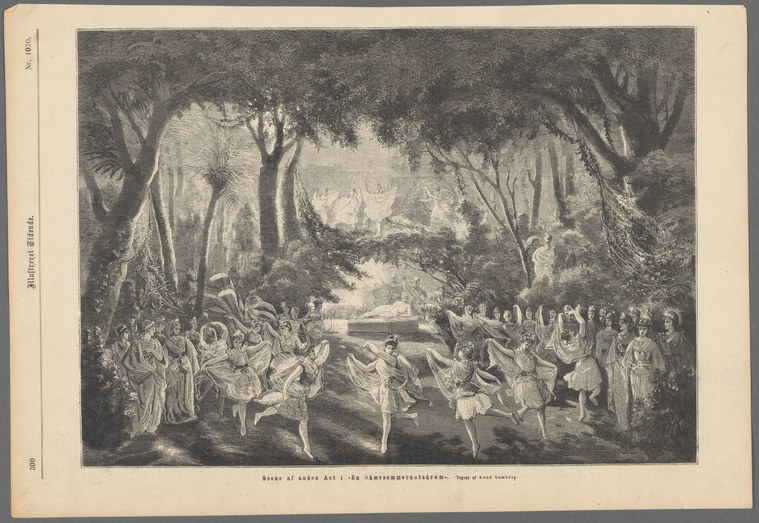
Scene af anden Act i, En Skærsommernatsdrom
Unknown artist
- Collection:
- Prints depicting dance
- Source:
- New York Public Library
- Rights:
- Public domain — free to use, share and adapt.
- Recorded as:
- Public Domain
This is primary-source evidence for how Romantic theatrical dance was staged, costumed, and composed in the 19th century. It shows not the disciplined uniformity of ballet technique but the expressive, individualized movement that characterized fairy and supernatural scenes, where classical training was deployed in service of narrative and atmosphere. For historians of theater, dance, and visual culture, this image documents both what audiences saw and how these moments were preserved and circulated to a wider public through the print medium.
What you are looking at
A woodland glade opens before us, the trees forming a natural architectural frame that recedes toward brilliant light in the background. Dozens of figures populate this space, moving in a celebratory gathering. They wear flowing, classical drapery in pale tones—predominantly white and cream—which catches light and creates a luminous effect against the shadowed forest. The composition divides into a foreground of active dancers and musicians, a middle ground of standing figures, and a receding background where the assembly dissolves into atmosphere. The mood is festive and mythological: this is a fairy or sylvan celebration, with nymphs and attendant figures arranged both in movement and in elegant repose. The technique is intaglio engraving, which gives precise control over the tonal gradations and the definition of the human form. Light emanates from within the composition—from the clearing and from the figures themselves—creating an almost supernatural atmosphere.
The dancing
The dancers move in loose, asymmetrical groups rather than in the rigid formations of classical ballet. Some figures are en pointe or moving with raised bodies, while others curve, reach, and bend with abandon. Arms are raised, extended, or draped; some dancers appear to be turning or leaping, while others stand in attitudes of rapture or observation. The poses suggest classical training—the elongation of the body, the lightness of weight—but deployed in a romantic, individualized way rather than in unison. Multiple dancers interact in pairs and small groups; the overall arrangement is rhythmic but not regimented.
The dance depicted
This depicts a scene from *A Midsummer Night's Dream*—specifically, the fairy revels in the enchanted wood. The title confirms this is "Scene af anden Act i, En Skærsommernatsdrom" (Scene from Act II of A Midsummer Night's Dream). This is not ballet proper but romantic theatrical dance as it would have been staged in the 19th century, when Shakespeare's fairy world was a showcase for ethereal, flowing movement and the newly fashionable pointe work. The figures wear the gossamer drapery and pale tights typical of the sylph aesthetic. The setting and the mythological subject matter anchor this securely in Romantic theatrical practice, where classical training met imaginative abandon.
How it was made
This is an engraving, executed in the intaglio technique, which allowed for fine hatching and tonal control to render the atmospheric woodland and the luminosity of the pale-draped figures. Engraving was the principal reproductive medium for theater imagery in the 19th century, allowing popular theatrical scenes to circulate to a broad audience who had not seen the production. The precision and detail of the medium—evident in the careful delineation of individual dancers and the architectural framework of trees—suggests this was a valuable record, made to preserve and distribute an important production.
About this work
This is a 19th-century engraving documenting a stage performance of Shakespeare's *A Midsummer Night's Dream*, specifically the fairy scenes of Act II. The work belongs to the tradition of theatrical portraiture and scene documentation that flourished before photography; it captures both the romantic aesthetic of the era—the sylph-like figures, the woodland setting, the ethereal mood—and the actual staging practices of classical romantic ballet and pantomime. The image preserves not a single moment but an entire tableau, a visual record of how this beloved play was brought to life on stage, and specifically how dance and spectacle were integral to its production.
How to look at it
The artist has chosen to freeze a moment of collective celebration rather than a single dramatic peak. Attend to the variety of poses: some dancers are clearly in motion (turning, leaping, reaching), while others are static, creating a rhythm across the composition. Notice how the frame of trees directs attention inward and upward, drawing the eye toward the light and the most elevated figures. The medium—engraving—allows you to see the individual definition of bodies, the precision of the choreography, and the subtle gradations of light that create atmosphere. This is not a snapshot but a composed and layered document.
The period
This engraving dates to the 19th century, when Shakespeare's *Midsummer Night's Dream* became a central vehicle for spectacle and dance on the Romantic stage. The fairy scenes in particular were opportunities for choreographers and designers to create ethereal, supernatural worlds using the newly available vocabulary of Romantic ballet—pointe work, gauzy costumes, atmospheric lighting, and individualized expressiveness. The play was adapted and staged repeatedly throughout the century, with major productions in London, Paris, and across Europe. This image likely documents one significant production, and its circulation as an engraving made the theatrical spectacle available to readers and theater-goers who could not attend.
Where it lives
The work is held in the Prints collection at the New York Public Library, catalogued as dance-related imagery. It is part of a broader collection of theatrical prints and engravings that documented 19th-century stage productions.
Dance in this work
Questions about this work
Is this actually from a performance of Midsummer Night's Dream?
Yes. The title states it is Act II of *En Skærsommernatsdrom* (the Danish title for the play). The fairy scenes, woodland setting, and ethereal costuming confirm this. The image documents how this scene was staged, though we cannot identify the specific production or year from the image alone.
What dance styles are shown?
This is Romantic theatrical dance—a blend of classical ballet technique (visible in the raised bodies, use of pointe, and precise arm positions) with the freer, more emotionally expressive movement associated with fairy and supernatural scenes. It is not a single codified style but rather classical training deployed for narrative and spectacle.
Why is this an engraving and not a photograph?
This predates or was made concurrent with early photography. Engraving was the standard method for circulating images of theatrical performances, because it allowed artists to compose the scene, clarify detail, and control the tonal range in ways that photography, in its early stages, could not. The engraving was a more reliable and beautiful record.
How many dancers are there?
The composition includes roughly 40–50 figures, ranging from active dancers in the foreground to attendant figures and observers throughout the scene. Not all are in vigorous motion; the tableau includes both movement and stillness, creating visual rhythm.
More dance artwork





