49 works in this view — arrow keys or swipe to move between them.
Dance in Art
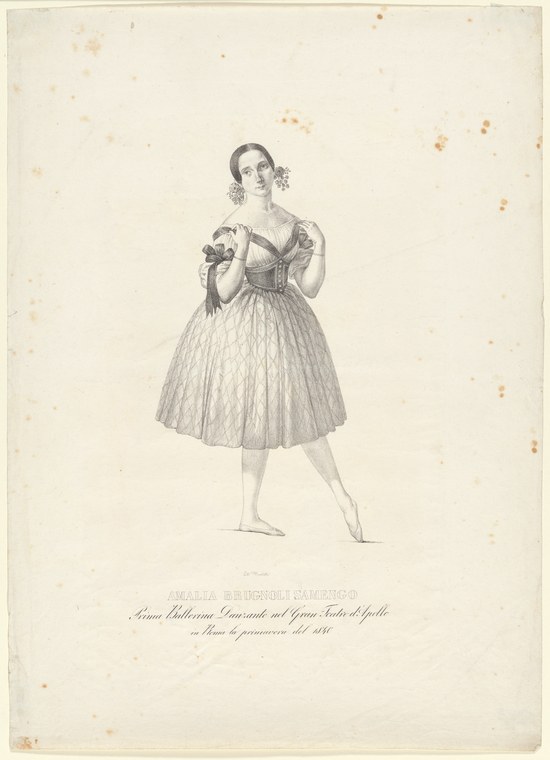
Amalia Brugnoli Samengo, prima ballerina danzante nel gran Teatro d'Apollo in Roma, la primavera del 1840
Unknown artist
- Collection:
- Prints depicting dance
- Source:
- New York Public Library
- Rights:
- Public domain — free to use, share and adapt.
- Recorded as:
- Public Domain
This image is one of thousands of theatrical portrait prints made in the 19th century, yet each one is a direct visual record of how a real dancer moved and presented herself in a specific time and place. For a historian or dancer studying Romantic ballet, the costume details, the precise arm positions, the facial expression, and the overall composition all convey information about training, aesthetic values, and theatrical convention that written texts cannot fully capture. The print is also evidence of the celebrity culture surrounding ballet dancers in the 1840s—that professional ballerinas were known by name across Europe, were promoted through images, and were subjects of popular fascination.
What you are looking at
A young woman stands alone against a plain cream background, positioned in a classical ballet pose that suggests the moment of preparation or arrest in movement. She wears a white Romantic-era ballet costume: a fitted corseted bodice with short puffed sleeves and a bell-shaped skirt that falls to mid-calf, drawn with fine parallel lines to suggest the gathered muslin or silk typical of 1840s theatrical dress. Her dark hair is parted and pulled back, adorned with what appears to be flowers or feathers. Her arms are held in a gentle, expressive frame—the left arm raised to chest height with hand delicately positioned, the right lower and slightly extended—conveying the épaulement (articulation of the torso) that characterized Romantic ballet. Her weight appears centered over one leg, with the other leg extended but not fully pointed, suggesting either a preparatory stance or a sustained arabesque-like position. The pose is intimate rather than grand: she faces slightly toward the viewer with a calm, almost inward expression, and there is no indication of movement through space, but rather a moment of stillness or quiet readiness.
The dancing
A single figure, a young woman, dominates the composition in a classical ballet stance. Her arms show the soft, rounded port de bras characteristic of Romantic ballet—neither sharply extended nor held close to the body, but rather floating in an expressive intermediate position. Her torso is engaged and elongated, with visible épaulement. One leg appears to bear the weight while the other is extended or lifted, though not dramatically high; the extension is moderate and controlled. Her feet are pointed or nearly pointed, consistent with ballet training of the period. The overall frame conveys refinement and control rather than athleticism or virtuosic display—what a trained observer of 1840s ballet would recognize as the comportment of a prima ballerina in a moment of sustained, lyrical movement.
The dance depicted
This is almost certainly a portrait of a Romantic ballet dancer, rendered as a theatrical print documenting a specific performer in her professional role. The inscription identifies her as Amalia Brugnoli Samengo, a prima ballerina, dancing in Rome's Teatro d'Apollo in spring 1840. The costume, pose, and setting all confirm that this represents ballet as it was danced in the early Romantic period—the era of La Sylphide and Giselle—though the image itself does not depict a narrative scene from a specific ballet. Instead, it presents the dancer as a type: the idealized Romantic ballerina in her characteristic dress and carriage. The pose suggests the vocabulary of Romantic ballet—sustained extensions, expressivity of the upper body, and an emphasis on ethereal lightness and grace—without attempting to capture a moment of narrative drama. This is a document of how ballet dancers presented themselves to the public at mid-century.
How it was made
This is a lithograph or engraving on paper, rendered in black ink with fine linear detail; the catalogue does not record the medium, but the technique is clearly a print process suited to mass reproduction and theatrical promotion. The delicate cross-hatching used to model the dancer's form, the fine lines defining the folds and texture of the costume, and the even tonal ground are all consistent with a professional lithographic or engraved portrait. The page bears visible foxing and age-staining, suggesting it has survived as a ephemeral theater print—the kind of souvenir or promotional image distributed to audiences or sold at the opera house. The preservation of such prints was often accidental; they were not created as high art but as documents of performance and celebrity, circulated widely enough that we encounter them today in archives and collections, yet fragile enough that each surviving example is evidence of chance survival rather than institutional care.
About this work
This is a theatrical portrait print documenting Amalia Brugnoli Samengo, a professional ballet dancer, as she appeared in Rome in 1840. It is neither a narrative scene nor an action shot, but rather a formal presentation of the dancer in her professional identity and costume—a type of image that was mass-produced and distributed as a record of theatrical celebrity and as a souvenir for audiences. The print captures the aesthetic and physical vocabulary of Romantic ballet at its height: the costumes, the body carriage, the expressive arm work, and the ideal of the ethereal, controlled, and graceful female dancer that dominated European theatrical culture in the 1840s. As a historical document, it is invaluable evidence of how ballet dancers dressed, moved, and were publicly presented in the decades after the establishment of the Romantic ballet as the dominant theatrical form.
How to look at it
Look first at the pose: the dancer is not moving dramatically through space, but is held in a moment of quiet readiness or sustenance. Notice how her arms are shaped—soft, not stiff, with the hands delicately articulated. Observe the engagement of her torso and the tilt of her head, which suggest awareness and expression even in stillness. The costume is the key to understanding the date and style: the short, full skirt, the fitted bodice, and the simple slipper are the markers of Romantic ballet. Finally, note the inscription at the bottom, which grounds this image in a specific person, place, and moment—this is not an idealized type, but a record of a real dancer's appearance and role.
The period
This print was made in 1840, at the height of the Romantic ballet movement in Europe. La Sylphide had premiered in Paris in 1832, establishing the aesthetic and vocabulary that dominated the following decades: the pointe shoe (though not yet worn throughout an entire performance), the ethereal female dancer as the central figure, the supernatural or dreamlike narrative, and the idealization of feminine grace and lightness. By 1840, this style had been exported throughout Europe, and dancers trained in the Romantic idiom were performing in theaters from London to Rome. Rome's Teatro d'Apollo was a major operatic and ballet house, and the fact that Amalia Brugnoli Samengo was dancing there as a 'prima ballerina danzante' (principal dancing ballerina) indicates that the city had a thriving ballet culture. The print's technique—lithography—had itself become widespread in the 1830s as a means of reproducing theatrical images rapidly and affordably, making it an ideal medium for circulating images of famous dancers and keeping audiences engaged between performances.
Where it lives
The print is held in the New York Public Library's collection of prints depicting dance. It survives as an example of 19th-century theatrical ephemera—the kind of image created for immediate consumption and circulation, with no expectation of permanence.
Dance in this work
Questions about this work
Was Amalia Brugnoli Samengo a famous dancer?
She was prominent enough to be documented in theatrical prints circulated in Rome in 1840, which indicates she held a significant position in the ballet world of her time. The title 'prima ballerina danzante' (principal dancing ballerina) was a formal rank in Italian opera houses, distinguishing her from other female dancers. However, historical records about individual dancers from the 1840s are often sparse, and fame was also geographically specific—a dancer celebrated in Rome might be unknown in Paris or London.
What does the pose tell us about how she danced?
The pose reveals training in the Romantic ballet vocabulary: controlled extensions, expressive arms, and an emphasis on the upper body and line rather than jumps or turns. The moderate height of the extension and the soft articulation of the arms suggest a dancer trained in grace and lyricism rather than technical virtuosity. The overall composure and the gentle expression indicate that the aesthetic valued in female dancers was one of ethereal delicacy.
Why is this image valuable for dance history?
It is one of relatively few surviving visual records of how professional ballet dancers actually looked, moved, and dressed in the 1840s. Paintings and sculptures of dancers are rare; prints like this one were made in quantity and are therefore more likely to survive, giving us evidence of costume details, body positions, and the presentation of the dancer to the public that we would otherwise lack.
More dance artwork





