49 works in this view — arrow keys or swipe to move between them.
Dance in Art
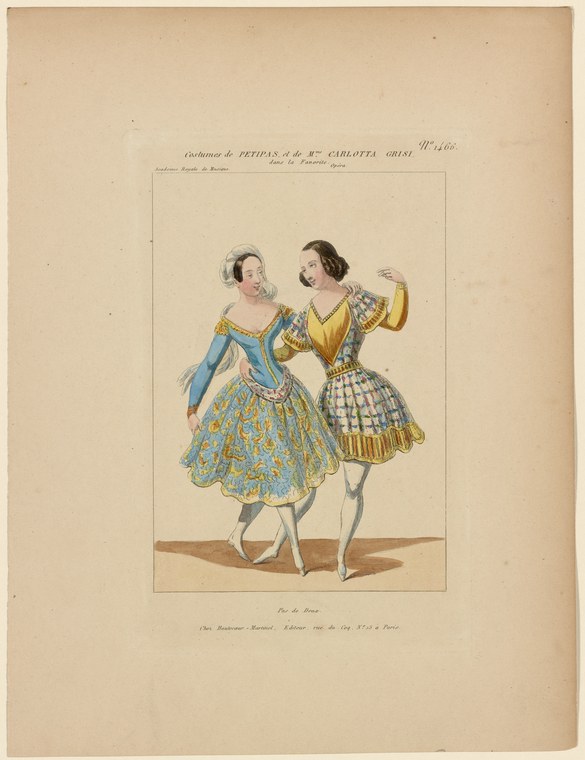
Costumes de Petipas et de Mme Carlotta Grisi dans La favorite, opéra, Académie Royale de Musique
Unknown artist
- Collection:
- Prints depicting dance
- Source:
- New York Public Library
- Rights:
- Public domain — free to use, share and adapt.
- Recorded as:
- Public Domain
Carlotta Grisi was a defining figure of Romantic ballet, and images that document her actual stage presence are rare and valuable. This print preserves not a painting or memory of her performance but a commercial record made for circulation among the Paris theater public—it tells us what audiences saw, how the roles were visually presented, and what standards of elegance and refinement governed theatrical dress at the height of the Romantic period.
What you are looking at
Two dancers in elaborate stage costume stand against a plain background, posed in a moment of theatrical interaction. The figure on the left wears a voluminous blue silk dress embroidered with gold floral motifs, with a white lace cap or headdress and pale stockings. The figure on the right, dressed in a gold and white plaid or checkered tunic-style skirt with gold trim, reaches toward the left figure with one arm raised in a gesture of appeal or greeting. Both dancers stand in refined, upright postures with legs clearly visible beneath their skirts. The composition is a costume study—a formal record of two performers' dress and bearing rather than an action moment, though the raised arm of the right figure suggests choreographic interaction. The coloring is hand-applied to what appears to be a printed base, giving the costumes jewel-like saturation against the cream paper.
The dancing
Both dancers stand in an upright, turned-out stance characteristic of early 19th-century theatrical dance. The figure on the right extends one arm diagonally upward toward the other dancer, creating a line of connection or address; the left figure remains more static, receiving this gesture. Their legs are extended and visible, showing the high-heeled slippers of the period. The poses suggest a moment of narrative encounter—perhaps a greeting, supplication, or dramatic exchange—rather than active choreography in motion. Both dancers maintain the refined epaulement and elongated line of the Romantic ballet vocabulary.
The dance depicted
This is a costume study for *La Favorite*, an opera that received many productions and ballet interpolations in the 1840s. The inscription identifies these as the costumes of Petipas and Mme Carlotta Grisi for the opera at the Académie Royale de Musique (the Paris Opera). Carlotta Grisi was one of the greatest Romantic ballerinas, and such costume studies served to document the visual spectacle of celebrated productions. The elegant, elaborate dress and refined posture confirm this as theatrical dance of the Romantic period, though the specific choreography cannot be recovered from the image. The casual, conversational pose suggests this may represent a scene outside the main action—possibly a solo or ensemble moment rather than a technically demanding passage.
How it was made
This is a hand-colored engraving or possibly lithograph, printed and then tinted with watercolor or gouache. The technique allowed for wide distribution of costume designs and performance records to the theater-going public, who could own these as souvenirs or references. The care taken in rendering the embroidery and surface texture of the fabrics—the gold brocade of the left costume, the plaid geometry of the right—suggests this was issued as a document of spectacle and elegance, not merely as a technical drawing. Such prints typically sold in Paris theaters or through music publishers, making them valuable records of how celebrated performances actually appeared.
About this work
This is a hand-colored theatrical costume print documenting the dress and bearing of two dancers in a celebrated production of *La Favorite* at the Paris Opera, likely from the 1840s. Carlotta Grisi, one of the Romantic era's greatest ballerinas, is identified in the title, and the elegant figure and refined proportions of both dancers reflect the aesthetic standards of the era—elongated, graceful, and ornately dressed. The work sits at the intersection of dance documentation, fashion history, and theater history, recording not choreography but the visual spectacle that audiences traveled to see.
How to look at it
Attend to the precision of the costume rendering, especially the embroidered and patterned textiles—the artist has lavished detail on the fabrics to convey the luxury and visual spectacle of the stage. The gesture of the right figure, with arm raised in a gentle arc, is the only movement suggested in an otherwise static study; this economy of pose was conventional for costume prints, which prioritized visual clarity over choreographic narrative. Notice the refinement of the dancers' posture and the pale, elongated limbs—these reflect Romantic ballet's aesthetic ideals. The inscription at the top is functional and formal, indicating this was a commercial print made for distribution rather than a fine art print or museum piece.
The period
This print dates to the height of the Romantic ballet era, when elaborate costumes, exotic narratives, and the cult of the ballerina dominated European stages. *La Favorite*, an opera by Gaetano Donizetti with choreography by Jean-Auguste Petipa, premiered in 1840 and remained popular through the 1840s. Such costume prints were standard merchandise of the period—audiences collected them as theater souvenirs, fashion references, and records of celebrated performances. The hand-coloring process was labor-intensive but economical enough to produce these in numbers for the public market, making them among the most widely circulated images of dance from the era.
Where it lives
This work belongs to the New York Public Library's collection of prints depicting dance. It is a hand-colored theatrical costume print, a commercial product of the Paris theater world and music publishing industry, intended for sale to theater-goers and collectors.
Dance in this work
Questions about this work
Was this drawn from life?
Almost certainly not directly—these are costume and pose studies made for publication. They were likely created from performance sketches or dancers' descriptions, then engraved and hand-colored for sale. The refined, idealized quality of the figures and the precision of the costume details suggest studio work rather than theater-box sketching.
Who was Carlotta Grisi?
Carlotta Grisi (1819–1899) was an Italian-born ballerina and one of the greatest dancers of the Romantic era. She created roles in many celebrated works, danced across Europe, and was known for the technical brilliance and dramatic intensity of her performances. She appeared frequently at the Paris Opera and was a major star of the 1840s.
What was La Favorite?
*La Favorite* is an opera by Gaetano Donizetti, with choreography by Jean-Auguste Petipa. It premiered in 1840 in Paris and became a popular work across European opera houses. Like many operas of the era, it included ballet interludes and scenes—this print documents costumes from that production.
How common were these costume prints?
Very common. Theater-goers regularly purchased hand-colored prints of celebrated performances, dancers, and costumes as souvenirs and fashion references. They were sold at theaters, by music publishers, and in print shops, making them among the most widely circulated dance images of the 19th century.
More dance artwork





