49 works in this view — arrow keys or swipe to move between them.
Dance in Art
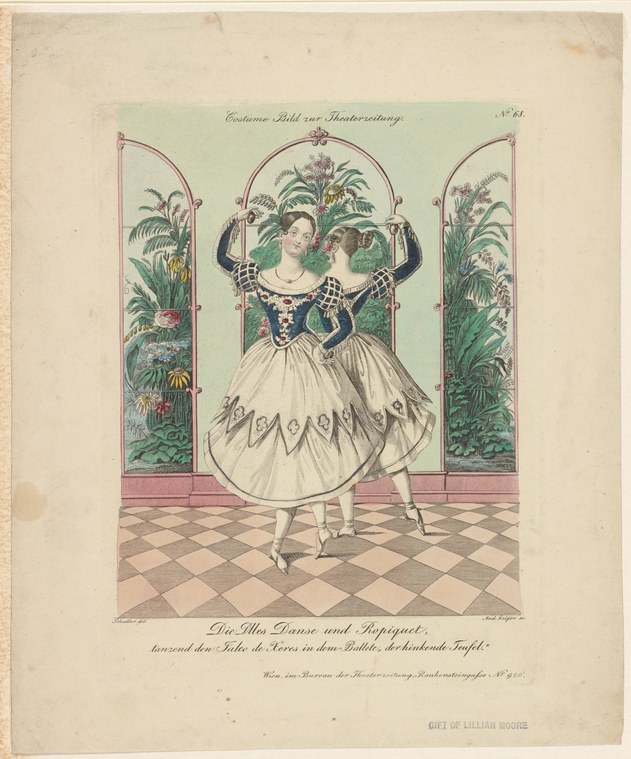
Die Dlles Danse und Ropiquet, tanzend den Jaleo de Xeres in dem Ballete 'Der hinkende Teufel'
Unknown artist
- Collection:
- Prints depicting dance
- Source:
- New York Public Library
- Rights:
- Public domain — free to use, share and adapt.
- Recorded as:
- Public Domain
This image is direct evidence of how Romantic ballet consumed and transformed non-European dance forms. It shows us not just what was performed, but how it was sold: as an image of an individual female body elevated and refined through the apparatus of European theatrical technique. For historians of dance, colonialism, and visual culture, it is a crucial artifact.
What you are looking at
A young female dancer in a white tulle skirt stands center stage within an ornate interior framed by botanical garden panels. The setting is classical—a checkered floor in pink and cream, tall arched niches on either side planted with lush flowering shrubs and trailing vines, and architectural elements suggesting a palace or theater interior. The dancer wears a dark bodice with puffed sleeves and a choker necklace; her skirt is voluminous and gathered, caught mid-motion to show the silhouette of the body beneath. She faces toward the viewer in a frontal pose, one leg slightly extended, in the attitude of a pirouette or traveling step. The composition is perfectly balanced: the dancer occupies the central arc, while the symmetrical garden panels frame her like wings. The hand-coloring in soft greens, pinks, and golds creates an atmosphere of theatrical elegance—this is not a naturalistic moment but a composed and flattering portrait of a performer.
The dancing
The dancer is a single figure shown in profile-frontal attitude, weight shifted onto her supporting leg with the working leg extended or lifted in a light, lifted position characteristic of Romantic-era ballet technique. Her arms are raised to shoulder height in a graceful frame; her posture is upright and elongated. The silhouette of her body shows the balletic line of the period—no visible tension, an sense of effortless suspension. Her head is held high and tilted slightly. The pose suggests a moment of traveling across the stage rather than a stationary position.
The dance depicted
The title names this as the 'Jaleo de Xeres' (a Spanish folk dance associated with Andalusia) performed within a ballet called *Der hinkende Teufel* (The Limping Devil). This was likely a divertissement or ethnic interpolation—a common feature of Romantic ballet in which performers danced "national" dances within a larger theatrical frame. The Spanish jaleo is a rhythmic, percussive dance, but this image shows it translated into the balletic idiom of the 1830s–1850s: the tulle skirt, the turned-out legs, the lifted port de bras, and the frontal presentation are all conventions of Romantic ballet, not Spanish folk practice. The tension between titled source and actual execution tells us about how the Romantic stage consumed and transformed non-European dance.
How it was made
This is a hand-colored engraving or lithograph, likely from the 1830s–1850s, printed from a stone or plate and then tinted by hand in soft pastels. The technique allowed for wide circulation—this image was a commodity, sold to audiences as a memento of a seen performance or as a dream of seeing one. The fine line work defines the architecture and the dancer's anatomy with precision; the hand-coloring adds warmth and glamour. The quality of the tinting—even, not overwrought—suggests a professional theater print shop rather than folk production. Such prints were the primary way dance imagery reached the public in the pre-photographic era.
About this work
This is a Romantic-era theatrical print documenting a moment from a ballet performance, likely European (German or Austrian, given the German title and publishing context). It commemorates a specific dancer—identified in the German inscription—performing a Spanish folk dance (jaleo) as a set piece within a larger theatrical production. The image is a primary document of how Romantic ballet absorbed, reframed, and displayed 'exotic' dance forms for European audiences. It belongs in a dance-in-art collection because it reveals the mechanics of cultural translation in nineteenth-century theater: how a rhythmic Andalusian folk practice was remade as a lifted, ethereal, individuated ballet performance. The print also preserves the physical vocabulary of Romantic technique—the tulle, the turnout, the delicate port de bras—in a way that illuminates how that vocabulary was understood and marketed.
How to look at it
Look at the pose: the lifted leg and raised arms show us a body in suspension, not weight-bearing. This is balletic uplift—the opposite of the grounded, rhythmic quality that authentic Spanish jaleo possesses. The artist has caught a moment of ascent or travel, not percussion or earthiness. Note also the perfect symmetry of the composition: the dancer is centered, the gardens mirror each other, the floor pattern is mathematical. This is not a candid moment but a flattering, composed image—the equivalent of a lithographed souvenir postcard. The hand-coloring adds to the glamour and distance from reality.
The period
The Romantic era in ballet (c. 1830–1870) was marked by the emergence of the ballerina as a solo star, the rise of the tulle skirt and pointe work, and a fascination with 'otherness'—with national, exotic, and supernatural bodies rendered legible through the vocabulary of European ballet. Interpolated national dances (pas espagnol, pas indien, pas chinois) were routine in ballets of this period. The printmaking industry was booming: lithography and hand-colored engraving were the primary media through which dance images circulated to a paying public. This print sits squarely within that economy.
Where it lives
The work is held in the New York Public Library's prints collection documenting dance. It is part of a larger body of nineteenth-century theatrical prints, a commercial genre that serves as a primary historical source for performance history.
Dance in this work
Questions about this work
Was this a real Spanish dance?
The jaleo de Xeres is a real Andalusian folk form, rhythmic and percussive, danced close to the ground with hand-clapping and hip movement. This image shows it translated into Romantic ballet vocabulary—lifted, turned-out, ethereal. The title is a signal of exoticism; the execution is entirely European.
What was 'Der hinkende Teufel'?
We do not have detailed information about this ballet in the record. It was likely a European production of the mid-nineteenth century featuring supernatural or comic themes (a 'limping devil' suggests comedy or pantomime). Interpolated dances like the jaleo would have been set pieces designed to display both the ballet and the dancer.
How do we know this was a real performance and not invented?
The German inscription names the dancer and the ballet; the print was produced and distributed commercially. This is documentary evidence, even if romanticized. Theater prints of this era are generally reliable in crediting performers and titles, though the image itself is a highly composed and flattering representation.
More dance artwork





