49 works in this view — arrow keys or swipe to move between them.
Dance in Art
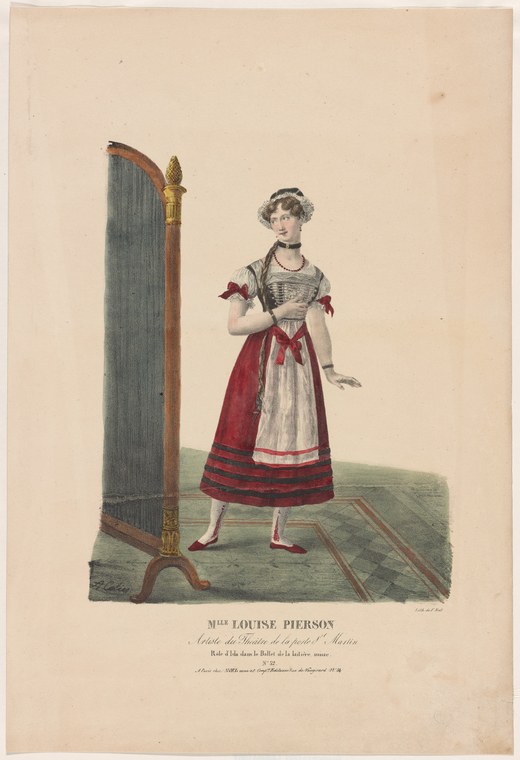
Mlle Louise Pierson, artiste du théâtre de la porte St. Martin, rôle d'Ida dans le ballet de La laitière suisse
Unknown artist
- Collection:
- Prints depicting dance
- Source:
- New York Public Library
- Rights:
- Public domain — free to use, share and adapt.
- Recorded as:
- Public Domain
This print is documentary evidence of a named performer in a specific role at a specific theatre, making it valuable for reconstructing the visual and gestural languages of early-19th-century popular theatre and Romantic ballet. The costume detail and pose reveal how contemporary audiences understood and represented 'Swiss' or pastoral character dancing—a genre that blended fashionable elegance with folkloric reference. Such theatrical portraits are among the few surviving records of how performers actually looked and carried themselves on stage before the invention of photography.
What you are looking at
A young woman in early 19th-century dress stands in a studio or theatrical space, posed in a moment of gestural dance or pantomime. She wears a white muslin chemise or underdress with short puffed sleeves, a black or dark-colored corset bodice, and a striking two-tiered skirt: white linen in the upper portion and deep crimson red with horizontal black stripes in the lower. The skirt has been lifted slightly at one side, revealing the red fabric beneath. Her hair is styled in fashionable ringlets. Behind her stands a tall, narrow rectangular object—a tall mirror or framed panel with a gold finial at the top and decorative foot—which anchors the composition and suggests an interior setting, perhaps a dressing room or stage prop. The background is plain and neutral, rendered in soft greens and creams. The style is hand-colored engraving or lithograph, with careful attention to the texture of fabrics and the subtle modeling of flesh tones.
The dancing
The dancer is shown in a three-quarter view, with her weight shifted and her body angled slightly away from the viewer. Her arms are extended in a gesture of expression or narrative—the left arm rises and curves gently, while the right hand is lowered, both in the delicate, controlled manner of early-19th-century theatrical movement. Her posture is upright and composed, her frame open, with no closed holds or technical footwork visible. The impression is one of grace and propriety rather than technical virtuosity; the body demonstrates the refined, balletic carriage expected of a performer of her social standing.
The dance depicted
This work documents Mlle Louise Pierson in the role of Ida from *La laitière suisse* (*The Swiss Milkmaid*), a ballet or theatrical narrative that was performed at the Théâtre de la Porte Saint-Martin in Paris in the early 19th century. The costume—a fashionable version of Swiss peasant dress—confirms the pastoral, folkloric subject. Pierson's pose suggests a moment of emotional expression or pantomimed narrative rather than classical ballet technique; this is consistent with the mixed form of early Romantic theatre, where dancing, mime, and dramatic gesture were interwoven. The raised skirt reveals the fashionable red underdress, a costume detail that would have signaled both youth and dramatic spectacle to contemporary audiences.
How it was made
This is a hand-colored engraving or possibly lithograph, a reproductive print intended for circulation among theatre-goers, collectors, and the fashionable public. The technique allowed for mass production and wide distribution of images of celebrated performers, making them accessible to those who could not attend performances in person. The fine linear work and careful hand-coloring—visible in the subtle gradations of the fabrics and the precise rendering of detail—suggest skilled execution by a professional printmaker. The image was likely produced and sold as a souvenir of a notable performance, a common practice in early-19th-century Paris.
About this work
This is a theatrical portrait print documenting a specific role created for a named performer, Mlle Louise Pierson, in a Parisian popular theatre of the early Romantic era. It captures not a moment of virtuosic dance but a stylized, gestural theatrical pose—the kind of pantomimed expression that was central to early-19th-century narrative ballet and melodrama. The work belongs in a gallery of dance art because it documents a performer in a recognizable theatrical costume, frozen in an attitude of expressive performance, and because such prints are primary historical evidence of how dance and dramatic gesture were understood, marketed, and consumed in the period. Dance historians rely on images like this to understand the aesthetic values, costume conventions, and mixed theatrical forms of the early Romantic stage.
How to look at it
Notice the pose: Pierson is not captured mid-movement or at a moment of technical difficulty, but in a balanced, sustainable attitude. This reflects an aesthetic that prized control, grace, and the ability to hold an expressive form. The lifted skirt is a deliberate compositional choice, not an accident of movement—it showcases the fine red fabric beneath and suggests a moment of theatrical self-presentation rather than naturalistic action. The tall mirror behind her is a studio convention of the period, establishing that this is a professional portrait of a performer in her stage dress, posed for the print-maker. The frontality and stillness are typical of theatrical portraiture; the viewer is invited to admire the figure, the costume, and the pose as a unified aesthetic object.
The period
This print dates to the early 19th century, the era of Romantic ballet and French popular theatre at its height. The Théâtre de la Porte Saint-Martin was a venue for melodrama, vaudeville, and mixed theatrical forms that sat between the official Opéra and street entertainment. The Swiss setting of *La laitière suisse* reflects the broader Romantic fascination with rural, exotic, or 'authentic' cultures, often represented through pastiche costumes and stylized folk gestures rather than ethnographic accuracy. For dance, this was the period when the pointe shoe was becoming standard in ballet, though Pierson's pose here is more gestural than technical. The hand-colored print itself was a dominant medium for circulating images of performers and fashionable dress in this period, before lithography made colored reproduction faster and cheaper.
Where it lives
The work is held in the Prints collection of the New York Public Library, where it forms part of a wider archive of dance-related prints and theatrical imagery. It is catalogued as a theatrical portraiture print, a common category of souvenir and publicity material from the early-19th-century Parisian stage.
Dance in this work
Questions about this work
Was Mlle Louise Pierson a famous dancer?
She is named in the print as performing at the Théâtre de la Porte Saint-Martin, a popular Parisian theatre, but little else is known about her career or prominence. The print itself is the primary record of her performance in this role. Like many theatrical performers of the period, she may have been celebrated in her time but left little documented legacy.
What is 'La laitière suisse' and why was it popular?
The title translates as 'The Swiss Milkmaid.' It was part of a wave of Romantic-era interest in rural, Alpine, and 'authentic' European cultures. Such ballets and theatrical pieces mixed dance, mime, and dramatic narrative, and were often scored with folk-flavored music and set in picturesque landscapes. They allowed performers to display both refined training and an illusion of rustic simplicity.
Why does this look so still and posed rather than like an action shot?
This is a theatrical portrait, not a documentary photograph. The pose is a carefully composed attitude—a moment the performer could hold and that the artist could translate into a print. It demonstrates the performer's grace and the elegance of the costume, which were the primary selling points of early-19th-century theatrical portraiture.
How do we know this is a Swiss peasant costume?
The title of the print explicitly names the role as Ida from 'La laitière suisse.' The costume—with its fashionable high waist, puffed sleeves, and the striking red underskirt—was understood by contemporary audiences as a stylized version of Alpine dress. Accuracy to actual Swiss clothing was not the goal; the effect was a theatrical pastiche that suggested rurality and exoticism to Parisian sophistication.
More dance artwork





