49 works in this view — arrow keys or swipe to move between them.
Dance in Art
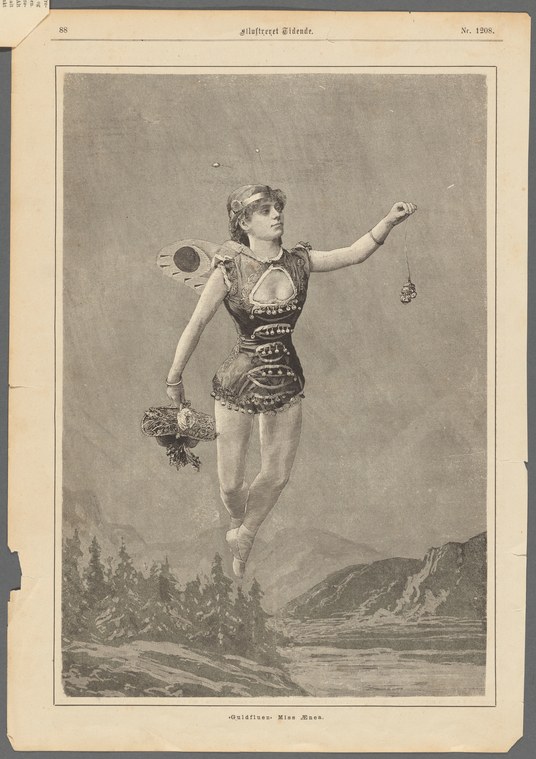
Guldfluen. Miss Ænea
Unknown artist
- Collection:
- Prints depicting dance
- Source:
- New York Public Library
- Rights:
- Public domain — free to use, share and adapt.
- Recorded as:
- Public Domain
This print is evidence of how ballet was understood and valued in the 19th century: as spectacle, as a vehicle for female dancers to embody otherworldly fantasy, and as a subject worthy of skilled reproductive engraving. The identification of the dancer by stage name and the care taken in rendering her pose and costume show that individual performers had recognizable fame and that their roles could be marketed as distinct properties.
What you are looking at
A female dancer in classical theatrical dress floats above a mountainous landscape in this engraved or etched work. She wears a decorative short tunic or bodice with ornamental beading or trim, paired with tights and what appear to be soft ballet shoes. Her pose is weightless and ethereal: her right arm extends upward and outward in an open gesture, while her left arm hangs at her side holding what looks like a flower crown or wreath of vegetation. Her body is tilted slightly backward, legs extended in a balletic line, creating the impression of flight or suspension above the ground. The landscape below—rendered in soft tones with coniferous trees and a distant body of water—recedes far beneath her, emphasizing the supernatural quality of the moment. The composition places the dancer centrally against a neutral sky, isolating her figure and the dramatic contrast between her living form and the scenic wilderness below.
The dancing
A single female dancer, her body arranged in a configuration suggesting classical ballet vocabulary: extended limbs, an open port de bras, and an uplifted carriage. Her right arm traces an arc upward from shoulder height; her left hand holds floral material at approximately hip level. Her legs are fully extended, with the supporting leg straight and the free leg in what may be an arabesque or attitude position. The overall frame is open and expansive rather than closed or grounded, emphasizing verticality and weightlessness. Her head is tilted back, her gaze directed upward, reinforcing the sense of aspiration or transcendence.
The dance depicted
The image depicts theatrical ballet, most likely from the Romantic era (mid-19th century) based on the costume, the ethereal pose, and the supernatural subject matter. The dancer appears to be performing a character or fantasy role—the floral wreath and weightless suspension above a natural landscape are hallmarks of Romantic ballet's engagement with sylphs, spirits, and otherworldly beings. The title *Guldfluen* (The Golden Fly in Danish, or possibly a mistranslation/variant) and the attribution to "Miss Ænea" (a dancer's stage name) suggest this documents a specific performer in a known role, though the work remains otherwise unidentified. The pose itself is recognizably balletic—the extension, the open arm position, the lifted quality—but the artist has chosen a moment of apparent flight rather than a grounded step sequence.
How it was made
This is an engraving or possibly a fine etching, identifiable from the uniform hatching, the use of line to model form and shadow, and the monochromatic palette. The technique allows for fine detail in the figure's anatomy and costume while creating atmospheric effects in the landscape through graduated tonal work. The print medium indicates this was a reproducible image, likely circulated among theater audiences or in illustrated periodicals of the 19th century. The careful rendering of both the dancer's body and the scenic background suggests the work was made from a drawn or painted original, possibly a theatrical scene design or a commemorative portrait of a celebrated performance.
About this work
This engraved or etched print documents a moment from 19th-century theatrical ballet, capturing a female dancer—identified only as Miss Ænea—in a weightless, supernatural pose above a landscape. The work is a record of Romantic-era dance spectacle: the ethereal costume, the open balletic frame, the floating quality, and the fantastical setting all align with the ballet d'action conventions of the period, when dancers regularly portrayed sylphs, spirits, and magical beings. The print belongs to a tradition of circulating theatrical portraits and scene documentation that allowed audiences to remember and share iconic performances before photography. For dance historians, it is an artifact of how a celebrated dancer and her most famous role were visualized and marketed to the public.
How to look at it
Note the moment the artist has chosen: not a leap in mid-air or a turn, but a sustained floating pose—a moment that seems to suspend time and defy gravity. This reflects the Romantic ballet's investment in the otherworldly and the transcendent, achieved through technique but meant to look effortless and magical. Observe the tension between the precision of the balletic line (the extended legs, the controlled arm position) and the impression of weightlessness and flight—the dancer's technique is meant to be invisible, replaced by an illusion of supernatural being. The landscape below anchors the work as a theatrical scene, not a portrait studio setting, reminding us that this is a moment from a narrative performance.
The artist
The artist is not recorded. The quality of the engraving and the professional finish suggest a skilled print-maker working within the commercial theater illustration industry of the 19th century, likely Scandinavian (given the Danish title) or working for a Scandinavian theatrical publication.
The period
This work dates to the height of Romantic ballet (approximately 1830–1870), when the genre was dominated by ethereal, supernatural subject matter and by the cult of the prima ballerina. Works like *La Sylphide* (1832) and *Giselle* (1841) established the template: a mortal male character encounters a magical female being in a moonlit or pastoral setting, leading to tragedy. The print medium was crucial to the dissemination of these works; engravings and lithographs of celebrated dancers and scenes were widely sold and collected, creating a visual archive of performance long before photography became common in theater. The Romantic ballet was also the first dance form to develop an international celebrity culture, with dancers like Marie Taglioni and Fanny Elssler becoming famous across Europe, and their images appearing in widely distributed prints.
Where it lives
The work is held in the New York Public Library's collection of prints depicting dance. It is catalogued by title and dancer's name but lacks attribution to a named artist or a confirmed date; the medium and style suggest 19th-century origin, most likely mid-century based on the costume and printing technique.
Dance in this work
Questions about this work
Who was Miss Ænea?
The catalogue record does not identify her beyond her stage name. She was likely a professional dancer of the 19th century active in Scandinavian theaters, known for this particular role in *Guldfluen*. The print was created to commemorate her performance in this part, though more biographical information would require further archival research.
Is this a real performance or a fantasy?
It documents a real performance—a specific dancer playing a specific role—but the role itself is a fantasy: a supernatural being. The image is a theatrical scene, not a portrait of the dancer in everyday life. The weightlessness and the landscape are part of the drama, not impossible feats.
How did dancers achieve this floating effect on stage?
Through a combination of technique, theatrical machinery, and the viewer's willing suspension of disbelief. Dancers used jumps and balances to create moments of apparent weightlessness; stages also employed wires or other invisible supports for truly weightless scenes. The print captures a moment of technical achievement made to look effortless.
Why is she holding a flower wreath?
The wreath is a prop that identifies her as a nature spirit or sylph—a being from the magical realm. In Romantic ballet, such costumes and properties quickly communicated the character's supernatural status to the audience.
More dance artwork





