49 works in this view — arrow keys or swipe to move between them.
Dance in Art
Dance on music covers
Unknown artist
- Collection:
- Prints depicting dance
- Source:
- New York Public Library
- Rights:
- Public domain — free to use, share and adapt.
- Recorded as:
- Public Domain
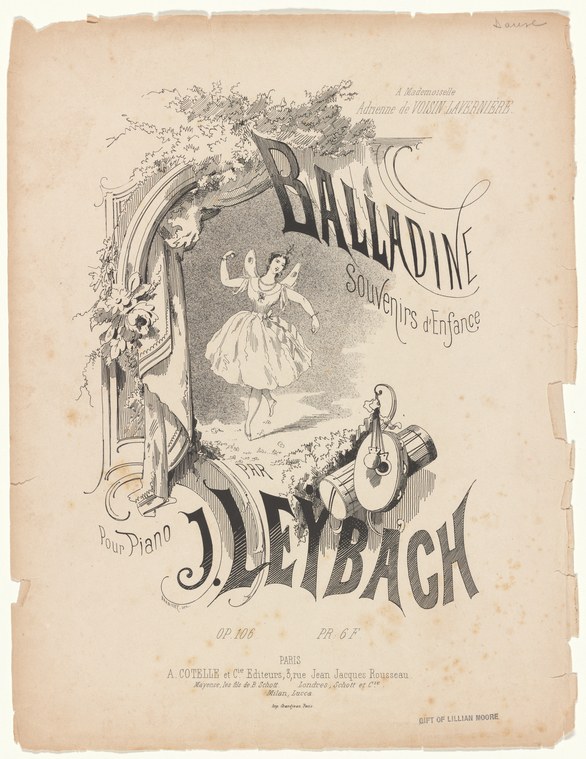
This cover exemplifies how ballet was disseminated and experienced by the European middle class outside the theatre—as printed image, as music to be played at home, as cultural memory. The aesthetic choices (the nostalgic title, the ornamentation, the prominent musician) reveal what audiences valued in ballet imagery: elegance, childhood innocence, and the integration of dance with refined domestic music-making.
What you are looking at
This is a printed music cover for a piano piece titled *Ballerine: Souvenirs d'Enfance* (Ballerina: Childhood Memories), published in Paris by A. Cosselier & Co. The composition is framed by an ornate decorative border of flowering vines that curves gracefully around the central image. At the heart of the design stands a young female dancer in a white tutu, captured mid-movement with arms raised expressively. She occupies the upper portion of the composition. Below her, in the lower section, a musician plays a stringed instrument (likely a mandolin or similar) rendered in darker tones. The overall aesthetic is characteristic of late nineteenth-century commercial printing: the delicate line work, the contrast between the detailed botanical ornamentation and the figural subjects, and the use of typography integrated into the design itself. The word *Ballerine* appears in large decorative script across the upper right, while *Demibach* (likely the composer's name) is positioned lower on the left. The cover projects a sentimental, nostalgic quality befitting its subtitle.
The dancing
The dancer is depicted in a pose of raised arms and lifted torso, her weight appearing to be supported on one leg with the other raised—a position suggesting vertical lift and elevation. Her tutu is rendered with anatomical attention, showing the characteristic bell shape of mid-nineteenth-century ballet costume. The musician below, shown in profile, is seated and bending slightly forward over his instrument in an attitude of concentration. Both figures are relatively small against the decorative border, making them part of a unified aesthetic composition rather than the sole focus.
The dance depicted
The figure is clearly a ballet dancer in the Romantic era tradition, identifiable by the white tutu, pointe shoes (implied by the elongated foot position), and the raised-arm port de bras typical of classical ballet vocabulary. The title *Souvenirs d'Enfance* (Childhood Memories) and the pairing with a musician suggest this is sentimental parlour music depicting or commemorating ballet, a genre that consumed the European middle class through prints, photographs, and sheet music throughout the 1870s–1890s. The work appears to be French, reflecting the dominance of Paris in both ballet practice and commercial music publishing during this period.
How it was made
This is a lithographic print, identifiable by the characteristic tonal qualities, the integration of text and image, and the overall aesthetic of mass-produced commercial lithography. Lithography allowed for the combination of delicate line work (the border), tonal shading (the musician's figure and background), and typography on a single stone, making it ideal for music covers and theatrical promotional material. The technique was economical enough to make these objects widely available to amateur musicians and ballet enthusiasts.
About this work
This is a commercial music cover from the Paris publishing industry, likely dating to the 1870s–1890s, that documents both the technical and sentimental valences of ballet in the period. It belongs to a vast corpus of lithographed sheet music covers that brought ballet imagery into middle-class homes and music rooms. The work is neither fine art nor documentation of an actual performance, but rather a commercial object that shaped how non-dancing audiences encountered and imagined ballet. Its interest lies in what it reveals about the commodification of the ballet dancer as a figure of nostalgic childhood memory, femininity, and artistic refinement. The pairing of visual image and musical composition typical of such covers tells us how ballet was consumed: not as a form to be studied in motion but as a source of sentiment, reverie, and decorative pleasure.
How to look at it
Attend first to the ornamental border and its relationship to the figures it frames: the way the delicate botanical design dominates the composition suggests that the decorative appeal of the object itself—its status as a beautiful thing to own and display—was as important as the ballet image it contains. The moment of the dance is not captured with documentary realism; instead, the dancer is posed in a conventional attitude of classical grace, her raised arms and lifted body designed to convey ethereal elevation. The positioning of the musician below the dancer suggests the conceptual hierarchy of the period: the dance was the primary subject, music its accompaniment, yet both were deemed essential to a middle-class fantasy of refined taste. The use of tone and line in the lithographic process allowed the artist to render the dancer's tutu with surprising delicacy while keeping the musician's figure more shadowed and subordinate.
The artist
The artist is not recorded in the catalogue. The work bears the publisher's mark of A. Cosselier & Co., a Paris-based music publisher active in the mid-to-late nineteenth century. The style and composition suggest the hand of a skilled commercial lithographer working within a well-established tradition of music cover design. Many such covers were produced by anonymous artists or studio teams and bear only the publisher's name.
The period
The 1870s–1890s saw an explosion of commercial lithography in music publishing, particularly in Paris, which remained the capital of European ballet and music. Romantic ballet—emphasizing pointe work, white tutus, ethereal femininity, and melancholic or nostalgic narratives—had been the dominant aesthetic since the 1840s, and by mid-century it had become thoroughly domesticated into middle-class visual and musical culture. Parlour music based on or inspired by ballet became a staple of amateur music-making. At the same time, the rise of photography began to compete with drawn or lithographed imagery, yet printed music covers continued to rely on illustration and lithography because they allowed for decorative integration of text and image that photography could not easily achieve. This cover sits at the intersection of two declining traditions: the Romantic ballet aesthetic and the lithographed music cover, both of which would give way to newer forms of cultural production by the early twentieth century.
Where it lives
This object is held in the New York Public Library's Prints collection, part of a broader archive of printed dance imagery, sheet music covers, and nineteenth-century commercial lithography. It is catalogued generically as 'Dance on music covers,' reflecting the collection's thematic rather than artist-based organization. The holding library's broader collection context is described as documenting popular visual culture, theatrical imagery, and the commercialization of the arts.
Dance in this work
Questions about this work
Is this a real ballerina, or a generic figure?
This is a generalized figure created for commercial purposes, not a portrait of a specific dancer. However, her pose and costume are entirely consistent with the Romantic ballet aesthetic of the 1870s–1890s, and she may have been based on photographs or prints of actual dancers circulating at the time. The title *Souvenirs d'Enfance* suggests the cover evokes a remembered or imagined experience of ballet rather than documenting a particular performance.
Who would have owned and used this object?
This music cover was purchased by amateur pianists and music students, primarily from educated middle-class households. The cover would have been part of a bound or loose collection of sheet music, displayed on a piano or stored in a music cabinet. The image would have been seen repeatedly during practice and performance, making the cover a significant part of how people encountered ballet imagery in their daily lives.
What does the pairing of dancer and musician tell us?
The composition reflects the period's understanding of dance as inherently musical and inseparable from it. The musician is not a conductor or orchestral player but an intimate companion—perhaps a mandolin player in a salon setting—suggesting that domestic music-making and dance were imagined as linked pleasures. This was the fantasy sold by sheet music: that you could own and recreate a moment of artistic refinement in your own parlour.
Why is this a lithograph rather than a photograph or engraving?
Lithography was economical for mass-market music covers and allowed the artist to integrate decorative typography with images in a way that looked elegant and unified. By the 1880s, photography was advancing, but lithography remained the dominant medium for music covers because it privileged beauty and design over documentary accuracy. The ornamental border and carefully controlled tones are results of what lithography made possible and profitable.
More dance artwork





