49 works in this view — arrow keys or swipe to move between them.
Dance in Art
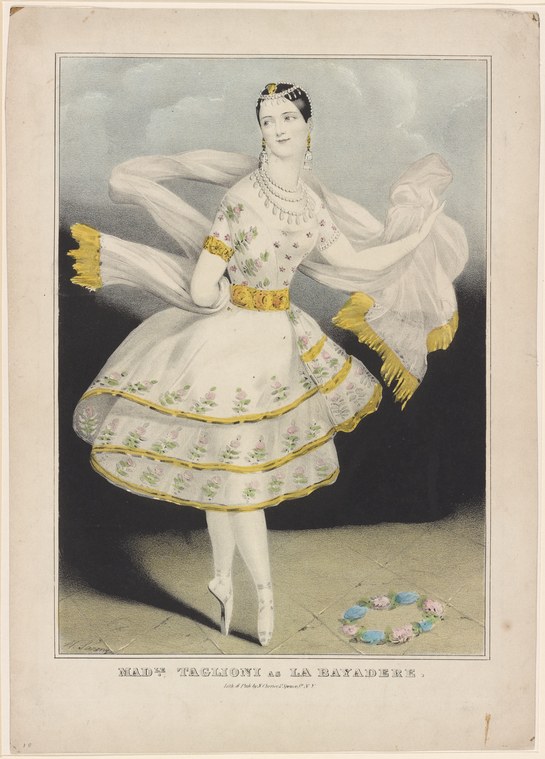
Mad'le Taglioni as La bayadere
Unknown artist
- Collection:
- Prints depicting dance
- Source:
- New York Public Library
- Rights:
- Public domain — free to use, share and adapt.
- Recorded as:
- Public Domain
This work documents the performance practice and celebrity culture of Romantic ballet at its height, showing how Taglioni's innovations—her use of pointe work, her creation of the ethereal body line, her dominance of the international stage—were captured and sold to audiences. The print is visual proof that *La Bayadère* and similar ballets used non-European themes as a framework for Romantic fantasy, a practice with lasting consequences for how ballet has represented other cultures.
What you are looking at
A young ballerina in Romantic-era dress stands en attitude derrière against a dark background, her body turned three-quarter to the viewer. She wears a white muslin tunic with a tiered skirt ornamented with small floral sprigs and edged in gold trim; gold bands circle her upper arms and waist. A gossamer scarf or veil streams from her shoulders and across her body, catching light as it floats. She gazes upward and to the side in an attitude of reverie. Her dark hair is dressed with a jeweled ornament. At her feet lies a small scatter of bright flowers—pinks, blues, and yellows—against the pale foreground, a still-life element that interrupts the stage space and suggests devotion or offering. The figure is isolated, spotlit by convention against the surrounding darkness, presenting the poetic solitude central to Romantic ballet.
The dancing
The dancer stands in a clear attitude position: her working leg extended behind her at hip height, the supporting leg straight beneath her, her torso upright but tilted slightly backward in the characteristic épaulement of the period. Her arms are held softly, one raised, the other lower, framing her body without rigidity. Her weight appears fully on the supporting leg, with the working foot pointed. The pose emphasizes verticality and ethereal weightlessness rather than the muscularity of later technique; the body reads as elongated and delicate.
The dance depicted
This is a Romantic ballet portrait, almost certainly depicting a moment from *La Bayadère* (The Temple Dancer), one of the signature roles of the 19th-century repertoire. The title identifies the figure as Mademoiselle Taglioni, the legendary Swedish ballerina Marie Taglioni, who dominated the Romantic stage in the 1830s and 1840s. The costume—the draped muslin skirt, the gold ornaments, the floral scatter—references Indian temple imagery while remaining wholly European in its execution and silhouette. The flowers at her feet are characteristic of the visual language of Romantic devotion, often appearing in engravings of this ballet to signal the bayadère's spiritual or erotic offering. The upward gaze and floating drapery are conventional poses for capturing the otherworldly, bodiless quality Taglioni was famous for achieving.
How it was made
This is a hand-colored engraving or lithograph, likely a commercial print from the 1830s–1840s. The fine line work, the careful tonal modeling of the figure against the dark background, and the delicate hand-coloring of the costume details are consistent with theatrical portraiture of the era. The printing technique allowed for rapid reproduction and wide circulation; such prints were sold to audiences as souvenirs and publicity, making them primary documents of how performances were marketed and remembered. The colored areas—gold, pale blue, pink, and flesh tones—are carefully bounded by the printed line, suggesting either hand-coloring of an engraving or lithographic printing with selective color application.
About this work
This is a theatrical souvenir print documenting the Romantic ballet *La Bayadère* and one of its most celebrated interpreters, Marie Taglioni. The work belongs to the vast archive of 19th-century dance imagery produced to publicize performers and preserve the memory of performances. It captures the visual and kinetic ideal of Romantic ballet: the emphasis on weightlessness, the incorporation of non-European costume imagery, the pose of spiritualized reverie, and the reduction of the dancer to a solitary, luminous figure set apart from the world. Such prints circulated widely among theatergoing public and remain important evidence of how dance was seen, marketed, and understood in the Romantic period.
How to look at it
Attend to the stillness of the pose—this is not a moment of action or transition, but a held position designed to be contemplated. The artist has chosen the attitude, one of the foundational positions of ballet, and presented it frontally enough to be recognized while angling the body to suggest depth and the possibility of movement. Note the relationship between the solid geometric form of the body and the floating, almost dematerialized drapery; this contrast between structure and weightlessness is the central visual preoccupation of Romantic ballet portraiture. The flowers at the feet anchor the figure to a stage space while remaining strangely still—they are not scattered in chaos but arranged as if sacred.
The artist
The artist is not recorded in the catalogue. The style and execution are consistent with commercial theatrical print production of the 1830s–1840s, when Paris was the center of both ballet innovation and of the print industry that served it. Such prints were produced by lithographers and engravers working from theater sketches or from live performance, often under the direction of the ballet company or the theater management itself.
The period
This print dates to the height of the Romantic ballet era (roughly 1830–1850), when choreographers and audiences embraced non-European, exotic, and supernatural themes as vehicles for exploring emotion, desire, and the ideal of feminine beauty. Marie Taglioni became the defining dancer of this period after her triumph in *La Sylphide* (1832); *La Bayadère*, or versions of it, was part of the broader exoticist fantasy that characterized Romantic stage practice. The commercial print industry, newly mechanized and capable of color production, thrived on images of celebrated dancers; collecting such prints was a standard practice for ballet enthusiasts.
Where it lives
This print is held in the New York Public Library's collection of prints depicting dance. It is a commercial theatrical souvenir or publicity print, likely published in the 1830s–1840s and distributed to audiences and collectors of theatrical imagery.
Dance in this work
Questions about this work
Who was Marie Taglioni?
Taglioni was a Swedish-born ballerina (1804–1884) who revolutionized ballet in the 1830s by developing a technique and aesthetic centered on the appearance of weightlessness and ethereality. She was the first ballerina to dance *en pointe* as standard practice, not just as a special effect, and her performances in *La Sylphide* and other Romantic ballets became the template for how ballet was understood and executed for generations. She was the most celebrated and highest-paid dancer of her era.
What is *La Bayadère* and why does it matter?
*La Bayadère* (The Temple Dancer), first choreographed by Marius Petipa in 1877, is a ballet that uses an Indian setting and the figure of a temple dancer to explore themes of love, sacrifice, and the supernatural. The title refers to a bayadère, a term used in European Orientalist fantasy to mean a sacred or erotic temple dancer. The ballet is significant both as a masterpiece of classical choreography and as an example of how 19th-century ballet used non-European cultures as backdrops for European fantasies—a practice worth examining critically today.
Why are there flowers at her feet?
The flowers are a convention of Romantic ballet imagery, used to signal devotion, offering, and the sacred or ritualized nature of the moment. In the context of a bayadère, they reference both the temple setting and the dancer's spiritual or erotic power. They also ground the ethereal figure in a specific stage space and moment of performance.
How do I know this is a print and not a painting?
The fine, regular line work, the controlled tonal gradations, the evidence of hand-coloring over a printed base, and the repeatable precision of the image all point to an engraving or lithograph. Paintings are unique objects and show the evidence of brushwork; prints like this one were made to be reproduced and sold in quantities, a different kind of object made for a different audience and purpose.
More dance artwork





