49 works in this view — arrow keys or swipe to move between them.
Dance in Art
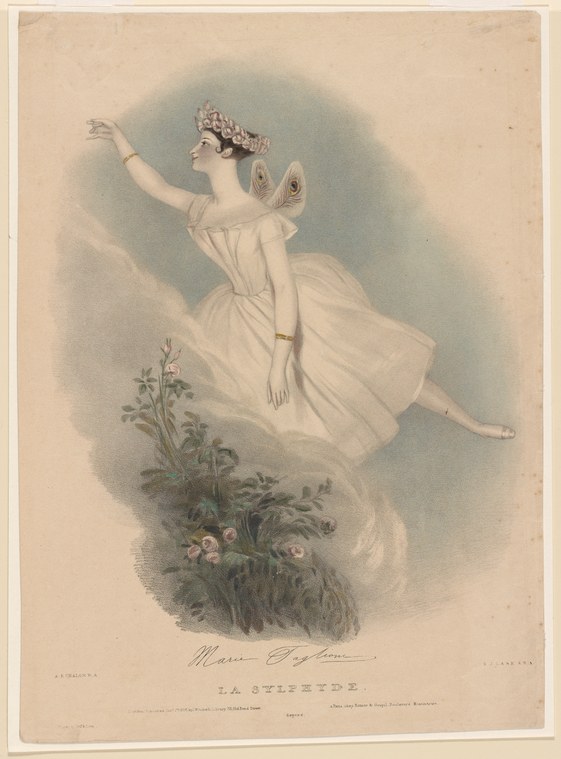
Marie Taglioni (fac. sig.) La sylphide
Unknown artist
- Collection:
- Prints depicting dance
- Source:
- New York Public Library
- Rights:
- Public domain — free to use, share and adapt.
- Recorded as:
- Public Domain
Taglioni's *Sylphide* was the artistic and technical foundation for an entire era of ballet; this print is one of the primary visual documents of that moment and of how romantic ballet's ethereal aesthetic was understood and marketed. For dancers and historians, it is an invaluable record of the actual costuming, the body line, and the physical ideals of the 1830s, before photography could capture movement. The print also demonstrates the critical role of theatrical imagery in making dance legible and memorable across time and distance.
What you are looking at
A sylph in a diaphanous white tunic floats weightlessly above a bed of flowering plants, her body suspended in a pose of ethereal grace. Her left arm extends upward in a gesture of longing or benediction, while her right leg trails behind in a perfect line of extension. The composition is vertically oriented, with the dancer occupying the upper two-thirds of the frame against a soft blue-grey atmospheric haze that suggests clouds or an enchanted realm. Below her feet clusters a naturalistic rendering of flowering vegetation—roses and other blossoms rendered in colour against the otherwise muted palette. The entire figure is suffused with a silvery light that emphasizes the translucence of her costume and the dematerialized quality of her presence. The inscription at the base reads "Marie Taglioni" followed by "LA SYLPHIDE," identifying both the famous dancer and the role.
The dancing
The dancer is captured in a pose of suspended elevation, with her body held in a vertical line from her extended left arm through her torso, the supporting right leg bent and turned outward, and her left leg extended behind in an arabesque or attitude position. Her head is tilted upward, gaze directed toward the raised arm, creating a sense of spiritual yearning. The posture suggests the balletic turned-out positions and the ethereal weightlessness of romantic-era technique. Her frame is delicate and elongated, with the costume—a short tunic of gossamer fabric—allowing full visibility of the extended leg line and the articulation of the supporting foot.
The dance depicted
This is Marie Taglioni in the role of the Sylph from *La Sylphide*, the foundational work of Romantic ballet, first performed in 1832. The pose captures the defining visual language of romantic ballet: the illusion of weightlessness achieved through hyperextension and turnout, the spiritual or otherworldly quality conveyed through upward gaze and ethereal costume, and the elevation and extension that became the technical and aesthetic ideal of the period. Taglioni's legendary technique and her embodiment of this role established the prototype for the romantic heroine that dominated ballet for decades. The pose itself—suspended above earthly ground with one leg extended—references the transcendent moments that define the romantic narrative, where human feeling encounters the supernatural.
How it was made
This is a hand-coloured engraving or lithograph, printed in multiple passes to build up the composition from a delicate linear base. The artist has used soft tonal shading—particularly the blue-grey wash in the background and the green and pink pigmentation in the floral section—to create depth and atmosphere while maintaining the crisp legibility of the figure itself. The technique of hand-colouring allowed for precise control of the dancer's form while creating the luminous, floating quality essential to romantic aesthetics. The work appears to be a theatrical print, a commercial product made for the mass market, designed to circulate the image of the celebrated Taglioni and preserve a record of a famous performance.
About this work
This hand-coloured print documents one of the most iconic roles in ballet history: Marie Taglioni as the Sylph in *La Sylphide* (1832). The image crystallizes the visual language of Romantic ballet—the weightless, turned-out extension, the upward spiritual gaze, the gossamer costume that conceals and reveals the body's geometry—in a single, perfectly composed moment. Taglioni's performance of this role in the original Paris production became the defining statement of romantic ballet's aesthetic and technical aspirations, and this print enshrines that visual ideal for a broad public audience. The work belongs in a dance archive both as a record of a historical performance and as a crystalline example of how engraving served to codify and circulate the feminine ideal of an era.
How to look at it
Observe the precise moment the artist chose to freeze: not an explosive jump or a complex turning sequence, but a moment of suspension and longing—the raised arm, the extended leg, the upward gaze—that conveys emotion and otherworldliness rather than virtuosity alone. Note how the artist has used the contrast between the delicate, sharply rendered figure and the soft atmospheric background to suggest the boundary between the earthly (the flowers below) and the celestial or supernatural. The tunic is rendered with careful attention to how the fabric would actually fall and move, giving specificity to what might otherwise be merely a symbol.
The artist
Unknown. The inscription identifies only the dancer (Marie Taglioni) and the role (La Sylphide). The technical execution suggests a skilled printmaker working in the commercial theatrical print industry of mid-19th-century Paris, where coloured engravings and lithographs of celebrated performers were produced for sale to the theatre-going public and collectors of dance imagery.
The period
This print dates to the height of the Romantic era in ballet (c. 1832–1860). *La Sylphide*, choreographed by Filippo Taglioni for his daughter Marie in 1832, inaugurated the romantic ballet as we know it: the supernatural heroine, the pointe shoe, the tulle skirt, the illusion of weightlessness and otherworldliness. Taglioni's performances became legendary—she was the first great ballerina of the pointe-shoe era and set the standard for technical virtuosity and ethereal presence that defined the ideal dancer for generations. The explosion of theatrical prints in this period reflects both the fame of individual performers and the broader industrialization of culture: dance imagery became a commodity, circulating through print shops and private collections, making famous dancers visible to audiences who would never see them perform live.
Where it lives
This print is part of the Library of Congress's collection of prints depicting dance, held in the Prints and Photographs Online Catalog. It represents the kind of theatrical merchandise that was produced commercially in Paris and London during the 19th century and distributed widely to middle-class collectors and theatre enthusiasts.
Dance in this work
Questions about this work
Who was Marie Taglioni?
Marie Taglioni (1804–1884) was a Swedish-Italian ballerina who became the first great star of Romantic ballet. Her father, Filippo Taglioni, choreographed *La Sylphide* for her in 1832, and the role made her famous across Europe. She was renowned for her ethereal technique, her ability to dance en pointe with ease and grace, and her interpretation of the suffering, yearning heroine that became the romantic ideal.
What is *La Sylphide*?
*La Sylphide* (1832, choreography by Filippo Taglioni, music by Jean-Madeleine Schneitzhoeffer) tells the story of James, a Scottish farmer, who is visited by a sylph—a supernatural air spirit—and falls in love with her. The ballet established the template for Romantic ballet: a mortal man enchanted by an ethereal woman, who ultimately eludes him. Taglioni's performance of the title role became legendary and the ballet remains in the repertory today.
What is being shown in the pose?
The pose shows the dancer in a moment of elevation and extension, floating above the ground with one leg extended in arabesque or attitude. The upturned face and raised arm suggest a moment of spiritual yearning or transcendence—the Sylph's otherworldly nature. This pose became iconic of romantic ballet and was endlessly reproduced in prints, paintings, and sculptures throughout the 19th century.
What is the tulle skirt?
The costume shown here—a short white tunic—is a precursor to the tulle skirt that would become the standard costume for romantic heroines. The short length allowed the audience to see the dancer's legs and footwork, essential to appreciating the technical virtuosity of pointe work. The gossamer, translucent quality of the fabric contributes to the sense of otherworldliness and weightlessness.
More dance artwork





