49 works in this view — arrow keys or swipe to move between them.
Dance in Art
The pet of the ballet
Unknown artist
- Collection:
- Prints depicting dance
- Source:
- New York Public Library
- Rights:
- Public domain — free to use, share and adapt.
- Recorded as:
- Public Domain
This print preserves the visual identity of a celebrated 19th-century ballet performer and the signature silhouette of Romantic-era tutus, which are central to the visual history of ballet. For historians, it offers evidence of how ballet was marketed and consumed as entertainment and celebrity culture, not merely as an art form. The work shows how dance imagery functioned in 19th-century print culture to create and sustain the public persona of performers.
What you are looking at
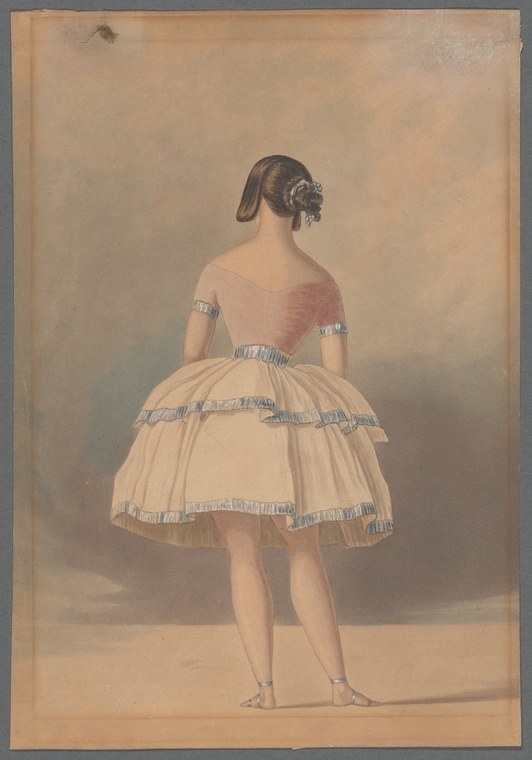
A young female dancer stands alone in three-quarter rear view against a warm, neutral background. She wears a pale pink or salmon-colored corseted bodice with short off-shoulder sleeves trimmed in white, and an expansive skirt of pale cream or ivory tulle gathered at the waist with a blue ribbon or cord. The skirt is voluminous and structured, with two or three horizontal bands or flounces of blue-trimmed ruching creating distinct tiers that project outward. Her dark hair is arranged in an elaborate upswept style typical of mid-to-late 19th-century fashion. She stands in a relaxed pose with weight on both feet, her body angled to display the fullness of the skirt. The composition is a formal portrait—a fashion and costume study rather than an action scene—rendered in what appears to be hand-colored lithography or similar print technique. The soft, diffused lighting and muted earth-toned background emphasize the dancer herself as the sole subject.
The dancing
The dancer's posture is upright but natural, without the turned-out alignment or pointed feet characteristic of classical ballet technique. Her arms hang at her sides in a neutral position. The stance suggests she is standing still for the purposes of costume display rather than captured mid-movement. There is only one figure, isolated in the frame. Her body alignment and foot position do not suggest active balletic deportment, and the overall effect is that of a costumed figure posed for a portrait rather than a dancer frozen in an expressive moment.
The dance depicted
The title 'The pet of the ballet' suggests this is a theatrical ballet figure, likely a principal or featured dancer of the mid-19th century, but the image is a costume portrait rather than a documentation of choreography or movement. The tiered tulle skirt, pale coloring, and off-shoulder bodice are consistent with the Romantic ballet aesthetic of the 1830s–1850s, but the pose and context do not reveal the dancer's technical vocabulary or the style of movement she performed. The work is better understood as a fashion and celebrity portrait than as evidence of how ballet was danced.
How it was made
This is a hand-colored lithograph or similar print process, evident from the soft gradations of color, the careful rendering of fabric texture, and the characteristic palette of muted pinks, creams, and blues. The technique allowed for multiple impressions to circulate as affordable commodities, and the presence of hand-coloring indicates a mid-market product—neither the cheapest mass print nor an expensive oil painting. This was the dominant medium for theatrical celebrity portraiture in the 19th century, aimed at the theater-going public who wanted to own images of their favorite performers.
About this work
This is a mid-19th-century theatrical portrait of a ballet dancer, rendered as a hand-colored print. It documents the costume and silhouette of Romantic ballet rather than the dancer's technique or choreographic practice. The work belongs in a gallery of dance imagery because it preserves a historically significant costume and celebrates the celebrity of the ballet dancer as a theatrical figure, even as it offers limited insight into the actual dance being performed. It is a document of how ballet dancers were presented to the public and how their costumes were understood as objects of beauty and fashion.
How to look at it
Attend to the construction of the skirt: its structure and volume are engineered to display a particular silhouette, and the horizontal ruching is not decorative excess but a technical feature of Romantic tutus. Notice the dancer's relaxed posture and the absence of turned-out feet—this is a costume portrait, not a record of active dance. The work shows how theatrical identity was built through the marriage of costume, body, and public image; the 'pet' of the theater was famous partly for how she looked in this dress.
The period
This work dates to the era of Romantic ballet (1830s–1850s), when the tulle skirt, the gas-lit theater, and the female dancer as a glamorous public figure coalesced into a new form of theatrical entertainment. The Romantic ballet aesthetic privileged ethereal, weightless movement and costumes designed to enhance that illusion—the tiered tulle skirt, pale coloring, and pointe work became visual signatures of the form. In the same period, lithography became the primary medium for celebrity theater portraiture, allowing dancers and actors to be mass-produced as images for fans and collectors. This print is part of that consumer culture of theatrical celebrity.
Where it lives
This print is held in the New York Public Library's collection of prints depicting dance, part of a much larger archive of 19th-century theatrical imagery. As a popular print medium, it would have been sold to theater patrons and collectors and is now part of a historical collection focused on visual documentation of performance.
Dance in this work
Questions about this work
How do I know this is Romantic ballet and not another style of dance?
The tiered tulle skirt, pale coloring, off-shoulder bodice, and the overall silhouette are the visual signatures of Romantic ballet as it developed in the 1830s–1850s. The skirt design and the dancer's presentation are consistent with ballets like Giselle and La Sylphide. However, without a signature or inscription on the print, we cannot identify which specific dancer or performance this depicts.
Why is the dancer just standing still? Shouldn't there be movement?
This is a fashion and costume portrait, not an action scene. The purpose was to display the dancer's celebrity identity and the beauty of the costume to the public—to create a collectible image of a famous performer. Theatrical portraiture of this period often prioritized glamour and stillness over the depiction of actual movement.
What does 'the pet of the ballet' mean?
The title is a colloquial term of affection for a celebrated or favored dancer, likely indicating that this was a principal performer or a favorite of audiences and management. It reflects the celebrity culture of 19th-century theater.
More dance artwork





