49 works in this view — arrow keys or swipe to move between them.
Dance in Art
Le leçon de danse
Unknown artist
- Collection:
- Prints depicting dance
- Source:
- New York Public Library
- Rights:
- Public domain — free to use, share and adapt.
- Recorded as:
- Public Domain
The image is a rare documentary record of dance pedagogy in action during the period when European court dancing was being formalized into a teachable system of steps and positions. For historians of dance, it captures the relationship between instructor and learner, the role of outdoor space in genteel education, and the gendered nature of dance instruction (a male master, female chaperone, mixed-gender pupils). For art historians, it exemplifies the instructional print tradition and the use of genre scenes to communicate social practice.
What you are looking at
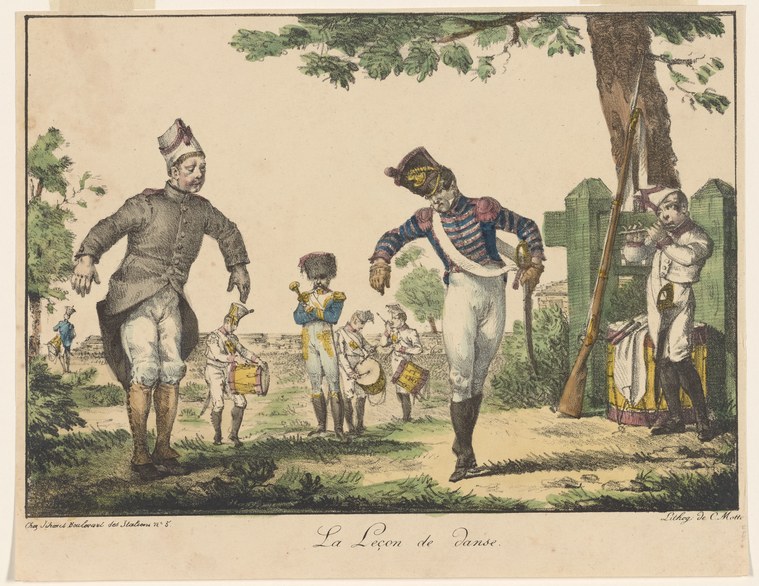
A dance lesson unfolds in a park or garden setting, framed by mature trees. An adult instructor in military dress—tall coat, decorative sash, and a distinctive tall hat—stands at center-right, bending forward slightly to demonstrate or correct the posture of a young student. The child wears a blue jacket and stands in profile. Around them, four additional young pupils of varying ages observe or await their turn; two stand to the left, one sits on the ground with a small drum or similar object, and another stands to the right near a gate or fence. A woman in white dress and bonnet, likely a governess or chaperone, stands supervising at the far right. The composition is lit from above, with deep shadows under the trees creating contrast. The scene captures a moment of formal instruction in a genteel outdoor setting, suggesting a private lesson for children of means.
The dancing
The instructor's forward bend and open hand gesture suggest active demonstration of posture or arm position. The primary student stands upright, receptive, in a formal stance. The observing children display varied attention—some standing at ease, one seated—indicating a teaching sequence rather than a coordinated group dance. The instructor's body angle and the children's stillness emphasize pedagogical hierarchy: this is correction and instruction, not performance or social dancing.
The dance depicted
This is most likely a lesson in court dancing or refined ballroom form, common to elite European pedagogy in the 18th or early 19th century. The outdoor setting, the formal military dress of the instructor, and the careful individual instruction of children suggest a private dancing master training young aristocrats or gentry children in formal deportment and basic dance steps. The emphasis appears to be on posture, frame, and the foundational techniques that would precede any choreographed figure.
How it was made
This is a hand-colored engraving or etching—the inscription at the base reads 'La Leçon de Danse'—indicating it was a published print, likely available to a broad educated audience in the 18th century. The precise line work and formal composition are characteristic of didactic or instructional prints of the period. The hand-coloring creates distinction between the figures' dress and the landscape, enhancing legibility. The technique allowed for multiple impressions to circulate, making the image an accessible record of contemporary dance pedagogy.
About this work
This engraved print documents a formalized dance lesson in the late 18th or early 19th century, showing an instructor in military dress teaching young children in an elegant outdoor setting. The composition emphasizes the professional and hierarchical nature of dance instruction among the European elite, where a single master of ceremonies or dancing master would oversee the deportment and basic technique of multiple pupils. The print preserves evidence of how refined social dancing was transmitted to the next generation of the aristocracy and gentry—as a matter of posture, formality, and individual correction rather than collective performance.
How to look at it
Notice the instructor's demonstration posture: his forward lean and hand position show active teaching, not passive observation. The children's varied states of attention and readiness—some standing, one seated—suggest this is not a finished performance but a work-in-progress lesson. The woman supervising at right anchors the propriety of the scene; without her presence, such mixed-gender outdoor instruction would have been inappropriate. The garden setting, with its mature trees and formal fence, places this among the leisured classes for whom dance was a mark of gentility.
The artist
The artist is not recorded. The style and technique suggest a professional engraver working in the German or French tradition of the late 18th century, producing didactic or satirical scenes of contemporary manners and education. The formal composition and careful attention to dress and setting indicate training in narrative engraving. Without signature or attribution data, attribution remains open.
The period
This print belongs to the era when European dance was undergoing codification—the late 18th century saw increasing systematization of ballroom and court forms, with dancing masters publishing treatises and instructional materials for the rising middle class. Outdoor teaching, as shown here, was fashionable among the elite, combining instruction with the aesthetic pleasure of garden or park settings. The print's genre—the instructional or satirical scene of daily life—was enormously popular in prints and caricature of the period, especially in German and French production.
Where it lives
This engraving is held in the New York Public Library's collection of prints depicting dance. It is a published, hand-colored print, likely one of many impressions, and would have circulated among educated European audiences as an accessible record of contemporary manners.
Dance in this work
Questions about this work
Why is the lesson outdoors?
Open-air instruction in parks and gardens was fashionable among the European elite in the late 18th century, combining practical pedagogical needs (space for movement) with aesthetic and social display. The garden setting signals the wealth and leisure of the family commissioning the lesson.
What is the instructor teaching?
Most likely the foundational posture, arm carriage, and basic steps of ballroom or court dancing—the refined movement vocabulary required of the aristocracy and gentry. The individual correction of posture visible in the image was central to this training.
Why does the woman on the right not participate?
She is almost certainly a governess or chaperone ensuring propriety during the lesson. Her role was supervisory and protective; mixed-gender instruction required an adult female witness, especially for children of respectable families.
More dance artwork





